Pomeranian Breed Guide: Seven Pounds of Personality and Zero Self-Awareness (2026)
The Pomeranian is a tiny dog with the confidence of a German Shepherd and the bark of a smoke alarm. Here's what it's really like to own one.
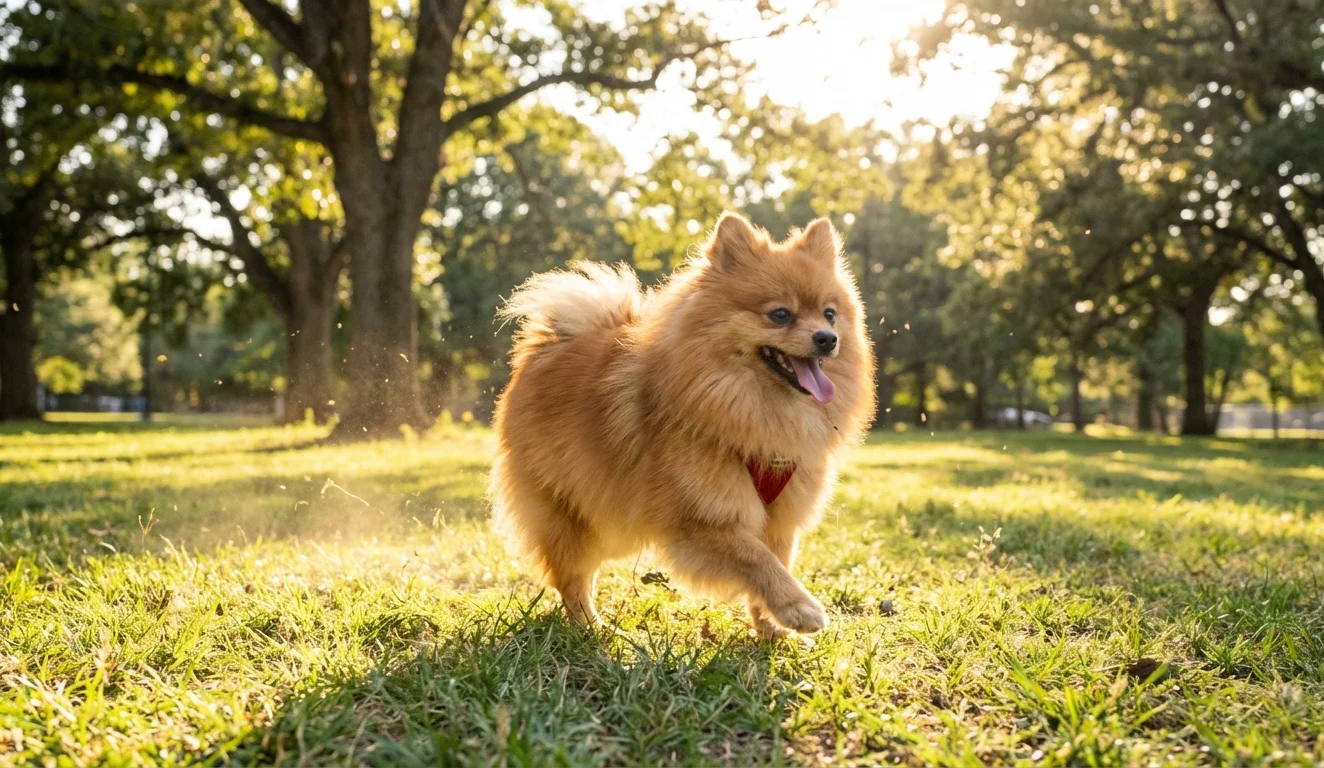
The Pomeranian weighs 3-7 pounds, stands 6-7 inches tall, and lives 12-16 years. Read those numbers again. Six to seven inches tall. That’s barely taller than a coffee mug. And yet the Pomeranian carries itself with the confidence of a dog ten times its size, strutting around the house, barking at the mailman through the window like it could actually do something about him, and demanding attention with the authority of a creature that once weighed 30 pounds and pulled sleds in the Arctic.
In Short: 3–7 lbs, 12–16 years. Moderate-to-high energy. Heavy shedder. Watch for Patellar Luxation. Good for first-time owners, apartment-friendly.
That’s not a joke, by the way. Pomeranians are descended from large sled dogs. The spitz-type ancestors of the modern Pom were working dogs in Iceland and Lapland. Somewhere along the way, breeders miniaturized them into a toy breed, but nobody told the Pomeranian. They still think they’re big. We think that disconnect between their actual size and their perceived size is half the fun of owning one. The other half is watching people who’ve never been around a Pom realize just how much noise a 5-pound dog can produce.
Pomeranian at a Glance
| Trait | Details |
|---|---|
| Breed Group | Toy (AKC) |
| Height | 6-7 in (both sexes) |
| Weight | 3-7 lbs (both sexes) |
| Life Expectancy | 12-16 years |
| Coat | Long, fluffy double coat with dense undercoat |
| Colors | Orange, Black, White, Cream, Sable, Blue, Chocolate, Red, Merle (and more) |
| Temperament | Lively, Bold, Inquisitive |
| Shedding | High |
| Energy Level | Moderate-High |
| Good With Kids | No (best with older children) |
| First-Time Owner Friendly | Yes |
History
Pomeranians get their name from Pomerania, a historical region that spans parts of modern-day Germany and Poland along the Baltic Sea coast. But the breed’s roots go much further back, to the large spitz-type sled dogs of the Arctic regions. Genetic analysis confirms that Pomeranians are part of the spitz family, closely related to the Samoyed, Norwegian Elkhound, and Alaskan Malamute. Yes, the Pomeranian is basically a very small cousin of your neighbor’s Husky.
The early Pomeranians in Europe were considerably larger than today’s version, 20-30 pounds, used as working dogs and farm companions. The miniaturization happened gradually over centuries, but it accelerated dramatically under Queen Victoria of England. Victoria fell in love with a small (12-pound) Pomeranian named Marco during a trip to Italy in 1888 and began breeding smaller and smaller Poms. Her influence was so significant that the breed’s size decreased by roughly 50% during her lifetime. She exhibited Poms at the Crufts dog show, and suddenly everyone in England wanted a small Pomeranian.
The AKC recognized the breed in 1888, the same year Victoria discovered her passion for them. The American Pomeranian Club was founded in 1900. Since then, the breed has been a consistent favorite among toy breeds, currently ranking in the AKC’s top 25 most popular breeds in America.
Size and Appearance
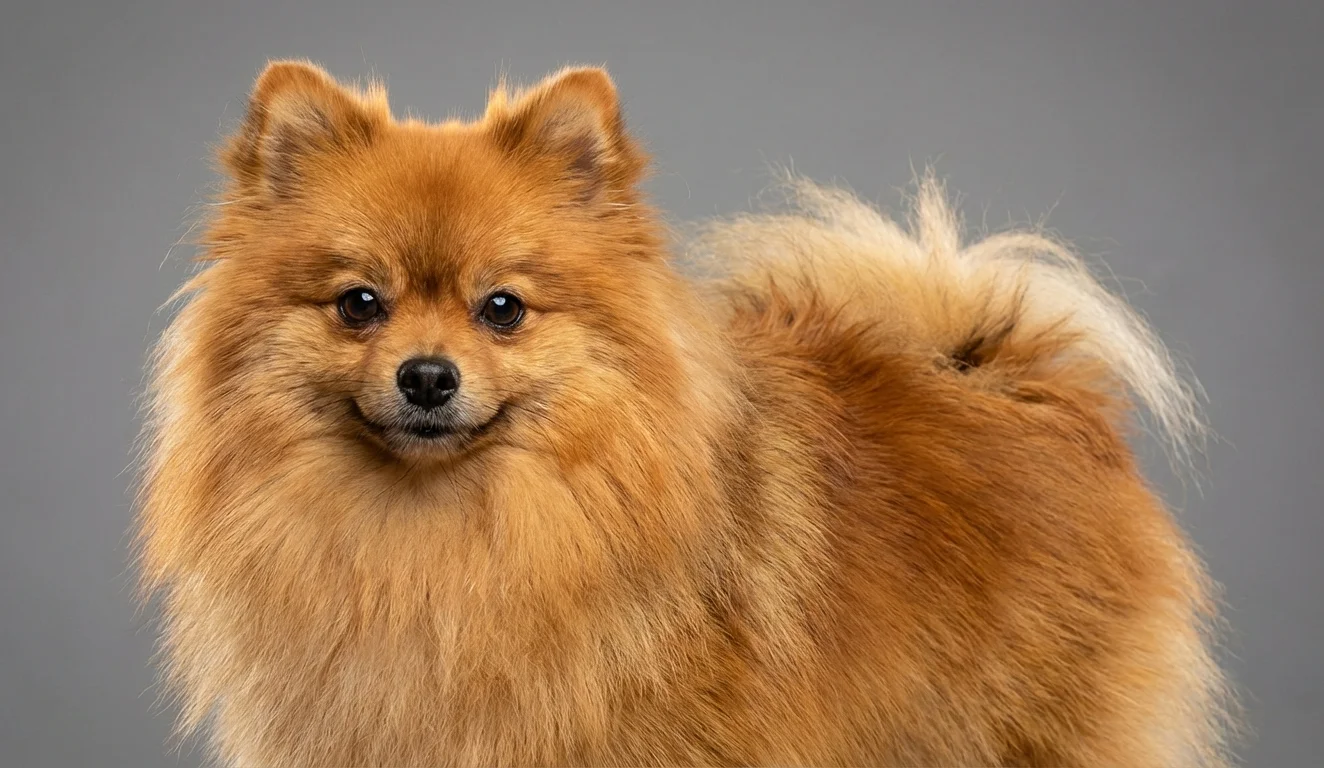
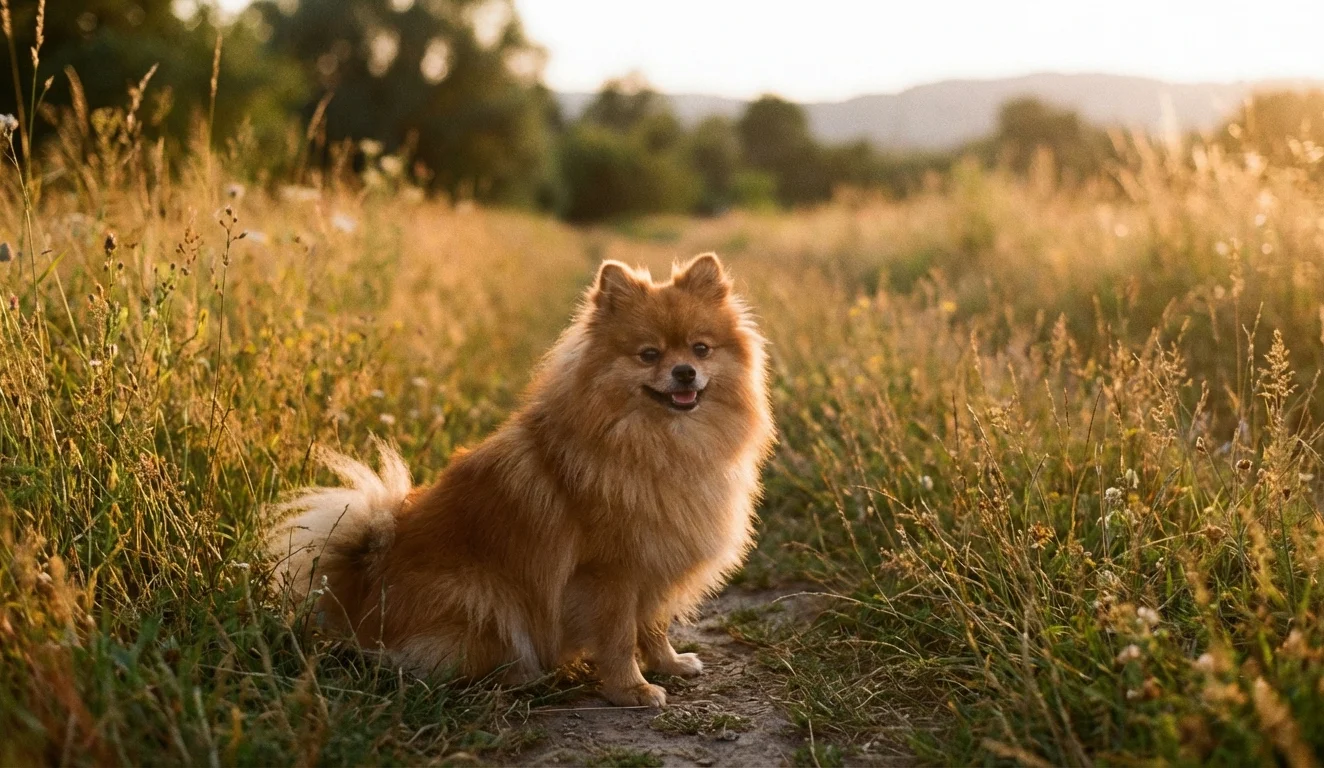
Pomeranians are tiny. The breed standard calls for 3-7 pounds, with the ideal show weight being 4-6 pounds. They stand 6-7 inches at the shoulder. Despite their small size, Poms are compact and sturdy for a toy breed, they have a well-proportioned body, a level topline, and a distinct “foxy” face with alert, dark eyes and small, erect ears.
The overall silhouette is round and fluffy. A well-groomed Pomeranian looks like a puffball with legs and a face. The plumed tail curls over the back and fans out over the body, adding to the round appearance.
Coat and Color
The Pomeranian coat is one of the breed’s defining features. It’s a long, fluffy double coat with a harsh-textured outer coat and a thick, soft undercoat that stands the outer coat away from the body. This is what gives the Pom its characteristic puffy look.
Pomeranians come in more color varieties than almost any other breed. The AKC recognizes orange, black, white, cream, sable, blue, chocolate, red, beaver, merle, parti-color (white with patches), and several other patterns. Orange and red are the most common and most associated with the breed in popular culture. Black Poms are striking but less common. White Poms are beautiful but difficult to keep clean.
The coat requires regular maintenance (more on that in the grooming section), and Poms go through an awkward “puppy uglies” phase between 4-8 months where they shed their puppy coat and temporarily look patchy and scraggly. It grows back. Don’t panic.
Pomeranian Temperament
The Pomeranian temperament is enormous for such a small package. These are bold, curious, opinionated dogs that have no concept of their own size.
What Pomeranians are actually like to live with:
- They have big personalities. A Pom will walk into a room and act like it owns the place. They’re confident, sometimes bordering on cocky, and they’re not intimidated by larger dogs, loud noises, or new situations. This boldness is entertaining but can also get them into trouble, a Pom that challenges a dog 20 times its size at the park doesn’t understand the risk calculation.
- They bark. A lot. We need to be very upfront about this: Pomeranians are barkers. They bark at the doorbell, at people walking by, at dogs across the street, at sounds you can’t even hear, and sometimes at nothing identifiable at all. The bark is sharp and high-pitched, it cuts through walls and closed doors. If you live in an apartment with thin walls and noise-sensitive neighbors, this is a real consideration.
- They’re smart. Poms learn quickly and enjoy mental stimulation. They can learn tricks, follow commands, and figure out patterns (like what time you usually get up, and they’ll make sure you stick to that schedule).
- They bond deeply to one person. While Poms are generally friendly, most develop a clear favorite human and become intensely attached to that person. They’ll follow their person everywhere and can become jealous of attention given to other people or pets.
- They’re not great with young children. This isn’t a temperament issue, it’s a safety issue. A 5-pound dog can be seriously injured by a toddler who falls on it, squeezes it too hard, or drops it. Most Pomeranian breeders won’t sell to families with children under age 6-7. Older children who understand how to handle a tiny dog can do fine with Poms.
Our honest observation: the Pomeranian’s biggest personality flaw is also its most charming trait. They genuinely believe they’re the most important creature in any room. Sometimes this manifests as demanding, yappy behavior that needs management. Other times, it manifests as a tiny fluffy dog strutting through a crowd of Labradors without a care in the world, and you can’t help but respect the audacity.
Exercise Needs
Pomeranians need about 30 minutes of exercise per day. That’s not a lot, which makes them excellent dogs for people who can’t or don’t want to commit to hour-long daily workouts with their dog.
Good exercise options:
- Short walks. Two 10-15 minute walks per day are perfect. Poms have short legs, so what feels like a leisurely pace to you is a decent clip for them.
- Indoor play. Fetch down a hallway, tug-of-war with a small rope toy, or a game of chase around the living room. Poms don’t need a backyard to get enough physical activity.
- Puzzle toys and interactive feeders. Mental exercise is important for smart breeds. A snuffle mat or a treat-dispensing puzzle can tire a Pom out as effectively as a walk.
Watch for overexertion. Pomeranians are small enough that they can overdo it without you realizing. Panting heavily, lagging behind on walks, or refusing to keep going are signs they’ve had enough. In hot weather, keep walks short and stick to cool times of day, tiny dogs overheat faster than large ones because their bodies have a higher surface-area-to-mass ratio.
Also, be careful about where your Pom exercises outdoors. Birds of prey (hawks, owls) have been known to target very small dogs. This isn’t fear-mongering, it’s something Pom owners in rural and suburban areas should be aware of. Supervised outdoor time is always the safest approach for a dog this small.
Grooming
The Pomeranian’s fluffy coat requires consistent upkeep. It’s not the most demanding coat in the toy group (that award goes to the Maltese or Yorkshire Terrier), but it’s not low-maintenance either.
Grooming routine:
- Brush 2-3 times per week with a slicker brush and a metal comb. Focus on areas prone to matting: behind the ears, under the front legs, and around the hindquarters. The outer coat can tangle if brushing is skipped for more than a few days.
- Professional grooming every 4-6 weeks. A groomer can keep the coat trimmed and shaped, clean the ears, trim nails, and handle the sanitary trim that most Pom owners don’t want to do themselves. Budget $40-$60 per session.
- Bath every 3-4 weeks. Poms are fairly clean dogs, but regular bathing keeps the coat healthy and manageable. Use a quality dog shampoo and conditioner, their coat dries out easily with harsh products.
- Dental care is critical. Pomeranians are extremely prone to dental disease. Brush their teeth at least 3 times per week (daily is better), and expect to need professional dental cleanings more frequently than larger breeds. A dental cleaning under anesthesia runs $300-$700 for a small dog.
- Nail trims every 2-3 weeks.
Never shave a Pomeranian. Like all double-coated breeds, shaving removes the insulating undercoat and can cause permanent coat damage. The coat may not grow back properly, resulting in a condition called “post-clipping alopecia.” If you want a shorter coat, ask your groomer for a trim or a “teddy bear cut” that shortens the coat without shaving down to the skin.
Grooming costs typically run $500-$800 per year for professional grooming alone, plus another $100-$200 for dental care products and home grooming supplies.
Pomeranian Health Issues
Pomeranians are generally healthy dogs with a good lifespan of 12-16 years. Their small size and long lifespan work in their favor. But toy breeds have their own set of health vulnerabilities.
Patellar Luxation
This is the most common health issue in Pomeranians. The kneecap (patella) slips out of its groove, causing a skipping or hopping gait. The OFA reports that toy breeds have among the highest rates of patellar luxation, and Poms are one of the most affected. Grades 1-2 can often be managed with weight control and joint support. Grades 3-4 typically need surgery at $1,500-$3,000 per knee. Ask your breeder about patellar luxation history in their lines.
Tracheal Collapse
The trachea (windpipe) weakens and flattens, causing a distinctive honking cough, especially when excited, pulling on a leash, or during exercise. It’s moderately common in small breeds, including Pomeranians. Mild cases are managed with weight control, using a harness instead of a collar (this is non-negotiable for Poms, never use a collar for leash walks), and sometimes medication. Severe cases may need surgery ($1,000-$5,000). This is one reason we always recommend a harness over a collar for any Pomeranian.
Alopecia X (Black Skin Disease)
This condition is particularly associated with Pomeranians and other Nordic breeds. The coat gradually thins and falls out, and the underlying skin may darken. It’s not painful or itchy, but it’s cosmetically significant and the cause isn’t fully understood, it may be related to adrenal hormones. Treatment options are limited and sometimes ineffective ($200-$1,000). Some Poms experience spontaneous regrowth. Others don’t.
Hypothyroidism
Insufficient thyroid hormone production, causing weight gain, lethargy, coat thinning, and skin issues. It’s manageable with daily medication and regular blood work. Ongoing costs are $200-$600 per year.
Legg-Calve-Perthes Disease
The head of the femur (thigh bone) deteriorates due to insufficient blood supply, causing pain and lameness in one or both hind legs. It typically appears in young dogs (5-8 months) and requires surgery ($1,000-$3,000). Small breeds are most commonly affected.
Training
Pomeranians are smart and learn quickly, but they can be stubborn about applying what they’ve learned. The breed has a moderate trainability rating, they’re not as biddable as a Golden Retriever, but they’re more trainable than many toy breeds.
Training priorities for Pomeranian owners:
- Bark management starts early. You’ll never fully stop a Pom from barking, it’s bred into them. But you can teach a “quiet” command and reduce unnecessary barking with consistent training. Acknowledge the bark (so the dog knows you’ve heard the alert), give the quiet command, and reward silence. This takes patience and repetition over weeks, not days.
- Socialization prevents “small dog syndrome.” The term gets thrown around loosely, but the core issue is real: small dogs that aren’t properly socialized and trained can become fearful, snappy, and reactive. This isn’t an inherent Pom trait, it’s a management failure. Expose your Pom to different people, dogs, and situations from a young age, and treat them like a dog, not a fragile ornament.
- Housetraining takes patience. Like most toy breeds, Poms can be slow to housetrain. Their tiny bladders need frequent trips outside, and accidents can go unnoticed in a large house. Indoor potty pads, a consistent schedule, and crate training are your best tools. Most Poms are reliably housetrained by 6-12 months.
- Positive reinforcement works best. Poms respond well to treats and praise. They shut down with harsh correction. Keep training sessions short (5-10 minutes) and upbeat.
- Teach them it’s okay to be handled. Because Poms need regular grooming, dental care, and vet handling, getting them comfortable with being touched, brushed, and having their mouth opened as puppies saves enormous stress later.
Cost
Purchase Price
A Pomeranian puppy from a reputable breeder costs $1,000-$3,000. Show-quality Poms or those with rare colors (blue merle, lavender, true white) can cost $3,000-$5,000+. The breed is popular enough that rescue organizations exist, adoption fees are typically $200-$500.
Be cautious of “teacup Pomeranians” advertised online. There is no separate teacup breed. These are just undersized Poms, often bred specifically for extremely small size at the expense of health. Dogs under 3 pounds are significantly more fragile and prone to health problems.
Monthly Costs
| Expense | Monthly Estimate |
|---|---|
| Food (toy breed formula) | $15-$30 |
| Professional grooming (averaged) | $30-$50 |
| Preventive vet care (averaged) | $15-$25 |
| Pet insurance | $20-$40 |
| Dental care products | $5-$10 |
| Treats and chews | $5-$10 |
| Miscellaneous (toys, supplies) | $5-$15 |
| Total | $60-$150 |
The lower food costs are one of the perks of a tiny breed, a 5-pound dog eats dramatically less than a 70-pound dog. Grooming is the biggest recurring expense. First-year costs beyond purchase price run $1,500-$3,000, including vaccinations, spay/neuter, a small crate, grooming equipment, and initial supplies.
Is a Pomeranian Right for You?
A Pomeranian could be a great fit if you:
- Live in an apartment or small home, Poms are ideal apartment dogs
- Want a dog with a big personality in a small package
- Can handle (and even enjoy) a vocal dog
- Are home frequently and want a close companion who follows you room to room
- Want a long-lived breed (12-16 years is a serious commitment in the best way)
- Can commit to regular grooming and dental care
- Have older children (7+) or no children
- Are a first-time owner who’s done the research on toy breed needs
A Pomeranian is probably not right if you:
- Have toddlers or very young children
- Need a quiet dog (noise-sensitive neighbors will become a problem)
- Want a dog for running, hiking, or extended outdoor activities
- Don’t want to deal with regular grooming appointments and dental care
- Are frequently away from home for long hours, Poms get attached and can develop separation anxiety
- Want a dog that’s friendly with every stranger (Poms can be reserved or barky with new people if not well socialized)
- Are looking for an off-leash dog (their small size makes them vulnerable to predators, traffic, and larger dogs)
Pomeranian owners figure out pretty quickly that the size is the least interesting thing about them. The personality is everything. A Pom will make you laugh daily with their antics, their opinions, and their unwavering belief that they are, in fact, a very large and important dog. They’ll sleep on your pillow, bark at your guests, demand to be included in every activity, and stare at you with those dark little eyes until you pick them up. For the right person, all of that is exactly the point.
Related Breeds
If you’re considering this breed, you might also want to look at:
Frequently Asked Questions
Do Pomeranians shed a lot?
Yes, more than you’d expect from such a small dog. Pomeranians have a thick double coat that sheds year-round, with heavier shedding during seasonal coat blows in spring and fall. The fur is light and fluffy, so it gets everywhere, on clothes, furniture, and in the air. Regular brushing (2-3 times weekly) helps control it, but you’ll never eliminate shedding entirely. The “puppy uglies” phase at 4-8 months involves especially dramatic shedding as the puppy coat is replaced by the adult coat.
Are Pomeranians good with other dogs?
Generally yes, but with an important caveat: Pomeranians often don’t realize how small they are and may challenge much larger dogs. Most Poms do well with other small to medium dogs, especially if socialized early. The risk isn’t that your Pom will be aggressive, it’s that they’ll provoke a larger dog that could injure them. Dog park visits should be in the small dog area, and playdates should be supervised. Many Pom owners find that having two Poms works beautifully, they play together, keep each other company, and match each other’s energy level.
How long do Pomeranians live?
Pomeranians are one of the longest-lived breeds, with a typical lifespan of 12-16 years. Some reach 18-20 years with excellent care. The keys to Pomeranian longevity are maintaining a healthy weight (even one extra pound on a 5-pound dog is a 20% weight increase), consistent dental care (dental disease can affect heart and kidney health), regular vet checkups, and keeping them safe from physical trauma (falls, being stepped on, attacks from larger animals).
Can Pomeranians be left alone?
Adult Pomeranians (over 1 year) can handle 4-6 hours alone, but they’re not a breed that does well with all-day isolation. Poms bond closely with their owners and can develop separation anxiety if left alone for extended periods regularly. Signs include excessive barking, destructive behavior, and house-soiling. If you work full-time, consider a dog walker, doggy daycare, or a second dog for company. Puppies under 6 months shouldn’t be alone for more than 2-3 hours. Crate training helps many Poms feel secure when alone.
What’s the difference between a Pomeranian and a “teacup Pomeranian”?
There is no recognized “teacup” breed or variety. The term is a marketing gimmick used by breeders to charge premium prices for undersized Pomeranians, typically dogs that will weigh under 3 pounds as adults. These extremely small dogs are more prone to health problems including hypoglycemia, fragile bones, dental crowding, and organ issues. Reputable breeders don’t breed specifically for “teacup” size. The AKC breed standard calls for 3-7 pounds, and dogs in the 4-6 pound range are generally the healthiest. If a breeder advertises “teacup Pomeranians,” consider it a red flag.