Norwegian Elkhound Breed Guide: The Viking's Dog (2026)
The Norwegian Elkhound has been hunting moose alongside Scandinavians for 6,000 years. It's tough, loud, and built for Nordic winters.
The Norwegian Elkhound stands 19.5-20.5 inches tall, weighs 48-55 pounds, and lives 12-15 years. The name is slightly misleading, “Elkhound” is a translation from the Norwegian “elghund,” where “elg” means “moose” and “hund” means “dog.” This isn’t an elk dog. It’s a moose dog. And it’s been doing that job in Scandinavia for somewhere around 6,000 years, making it one of the oldest dog breeds in Europe. Archaeological digs in Norway have turned up Elkhound-type skeletons alongside Viking remains, and the breed appears in Norse sagas.
In Short: 48–55 lbs, 12–15 years. High energy. Heavy shedder, dense double coat built for Nordic winters. Watch for Hip Dysplasia and Progressive Retinal Atrophy. Best for active owners who want a bold, independent Nordic breed.
The Norwegian Elkhound is a legitimate piece of working-dog history that most people walk right past at dog shows. It’s not flashy. It doesn’t have the dramatic look of a Husky or the elegant lines of a Weimaraner. What it has is substance: a compact, powerful body covered in a dense silver-gray coat, built to track moose through frozen Scandinavian wilderness for hours on end. If that sounds like a dog with opinions, you’re right. Elkhounds are independent, vocal, and absolutely confident in their own judgment. They’re not for everyone, but for the right owner, they’re extraordinary.
Norwegian Elkhound at a Glance
| Trait | Details |
|---|---|
| Breed Group | Hound (AKC) |
| Height | Males: 20.5 in / Females: 19.5 in |
| Weight | Males: 55 lbs / Females: 48 lbs |
| Life Expectancy | 12-15 years |
| Coat | Dense, double coat; coarse outer layer, soft undercoat |
| Colors | Silver Gray with black-tipped guard hairs, lighter undercoat |
| Temperament | Bold, Independent, Alert, Loyal |
| Shedding | Very Heavy (year-round with massive seasonal blowouts) |
| Energy Level | High |
| Good With Kids | Yes |
| Apartment Friendly | Not ideal |
History
The Norwegian Elkhound’s history is essentially the history of Scandinavian hunting. Archaeological evidence from western Norway dates the breed type to around 4000 BCE, stone carvings and skeletal remains confirm that dogs very similar to today’s Elkhound lived and worked alongside early Nordic peoples. The breed sailed with Vikings, guarded homesteads, hunted bear and moose, and herded livestock. It was, essentially, the Swiss Army knife of Nordic dogs.
The Elkhound’s primary hunting role is unique among hound breeds. Instead of running prey down (like a Greyhound) or tracking by scent and baying from a distance (like a Coonhound), the Elkhound works as a “hold-at-bay” hunter. It tracks moose through dense forest, then circles the animal and barks loudly to hold it in place while alerting the hunter to the location. The dog doesn’t attack, it contains. This requires a combination of endurance, courage (moose are 1,200 pounds and have lethal hooves), and independence, since the dog works out of sight of the hunter.
The breed earned AKC recognition in 1913, making it one of the earlier breeds admitted to the registry. Norway recognized the breed officially in 1877 at the first Norwegian dog show. The breed has maintained a small but loyal following worldwide, with particularly strong populations in Scandinavia and North America.
Size and Appearance
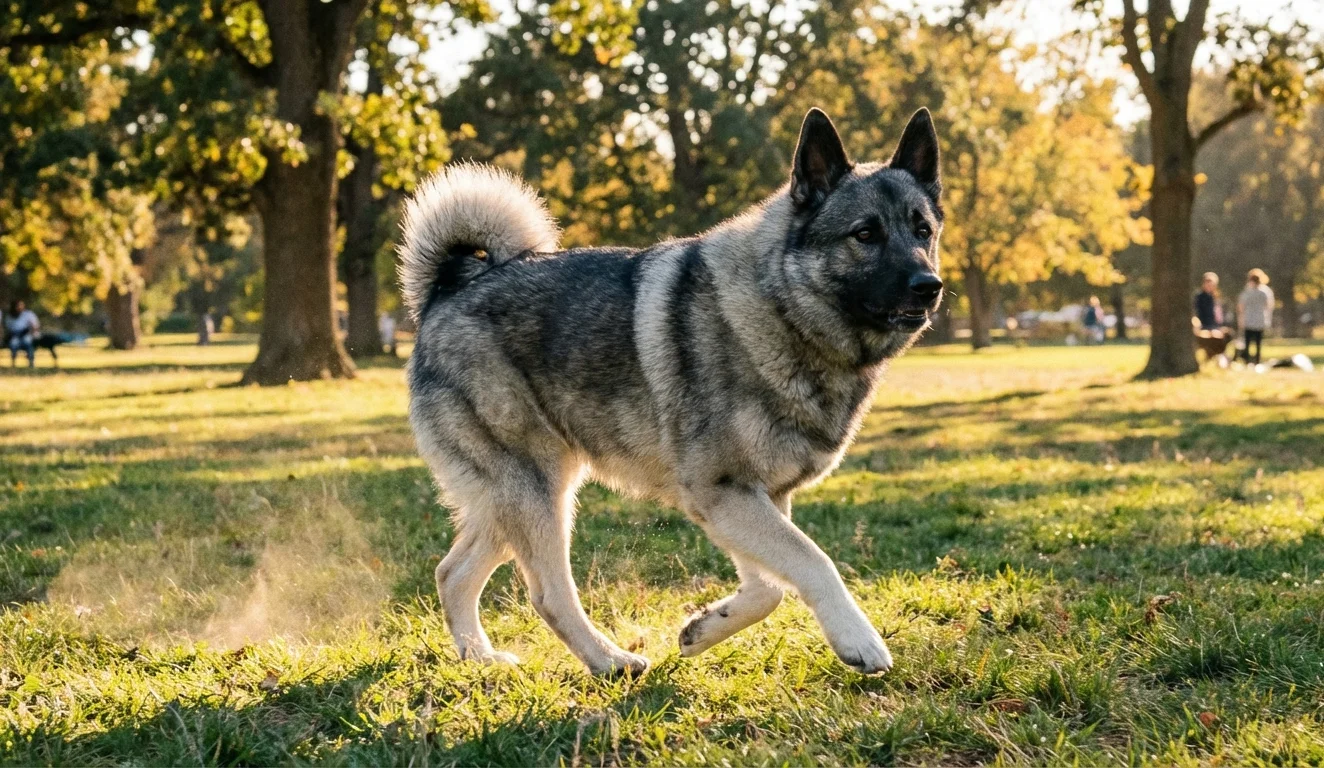
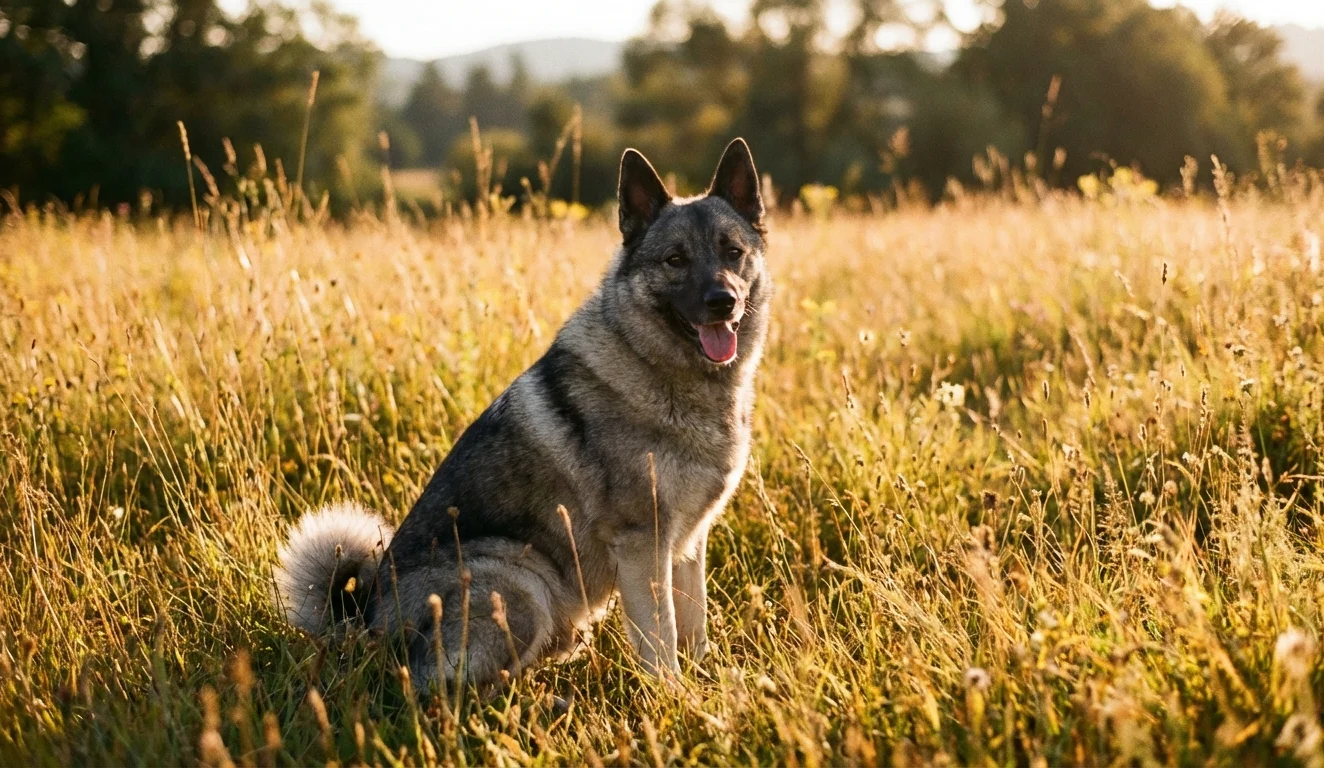
Norwegian Elkhounds are compact, sturdy dogs that look like they were built for cold weather, because they were. Males stand 20.5 inches and weigh about 55 pounds. Females stand 19.5 inches and weigh about 48 pounds. They’re square-proportioned with a deep chest, strong legs, and a dense, weather-resistant coat.
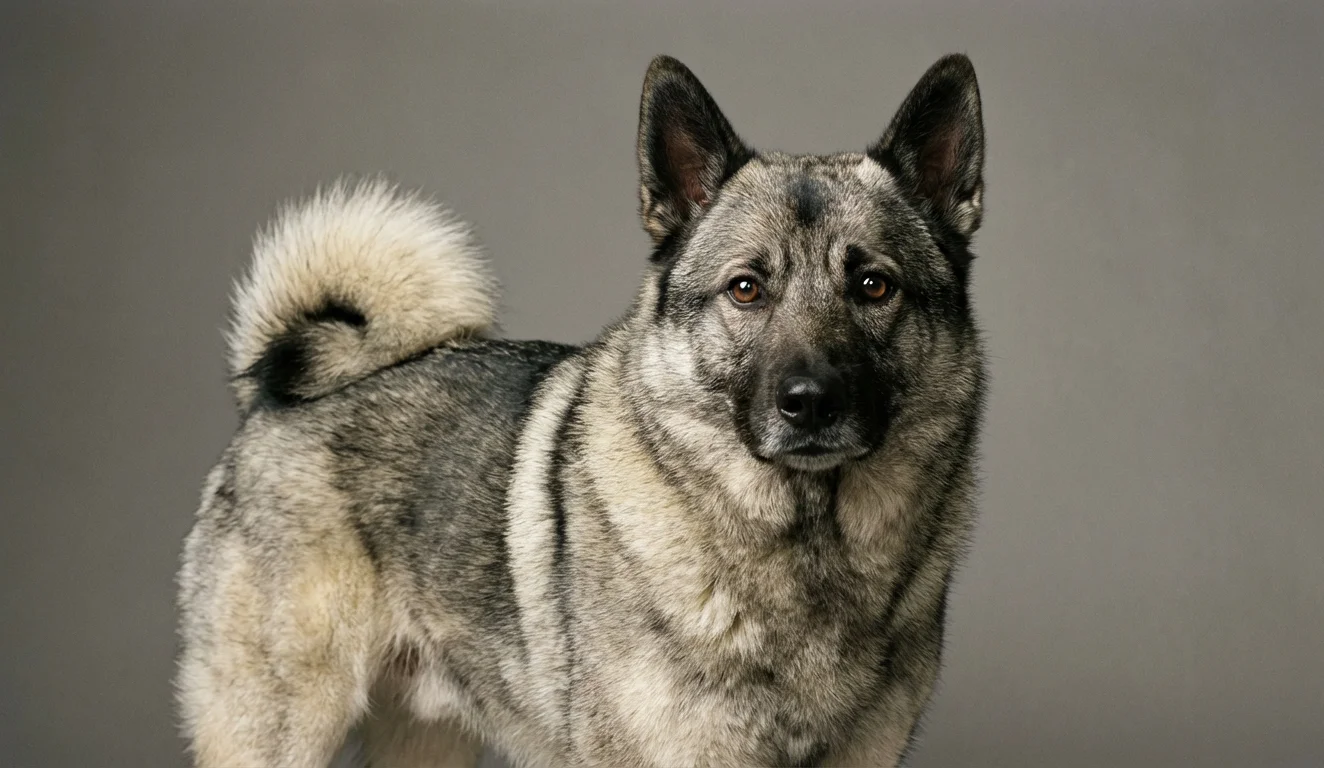
The coat is one of the breed’s most distinctive features. The outer coat is coarse, straight, and silver-gray with black-tipped guard hairs that give the dog its characteristic color. The undercoat is dense, soft, and lighter in color. The combination creates a coat that can withstand subzero temperatures and driving rain, this dog was literally made for Norwegian winters.
The face has a broad skull, triangular erect ears, and dark, intelligent eyes. There’s typically darker shading on the muzzle, ears, and forehead. The overall expression is one of alert confidence.
The tail is tightly curled over the back, a classic spitz-type feature that’s both functional (keeps the tail from dragging through snow) and distinctive. The tight curl, combined with the erect ears and wedge-shaped head, gives the Elkhound a proud, watchful appearance.
Norwegian Elkhound Temperament
The Elkhound temperament reflects thousands of years of working independently in harsh conditions. These dogs are confident, loyal, and perfectly comfortable making their own decisions. That last part is both a feature and a challenge.
What living with a Norwegian Elkhound actually looks like:
- They bark. A lot. The Elkhound was bred to bay loudly enough for a hunter to hear from a mile away in dense forest. That voice hasn’t gotten any quieter in a domestic setting. Elkhounds bark at visitors, at sounds, at perceived threats, and sometimes just because they have something to say. This is the breed’s single biggest challenge for most owners.
- They’re independent thinkers. An Elkhound doesn’t look to you for constant direction the way a Lab or Golden does. It assesses situations and makes decisions. This is great in the field. At home, it means your Elkhound may decide that your recall command is more of a suggestion than a requirement.
- They’re loyal to the family but aloof with strangers. Elkhounds bond deeply with their household and are affectionate behind closed doors. With strangers, they maintain a watchful reserve. They’re not aggressive, just not interested in being everyone’s friend.
- They have strong prey drive. Squirrels, rabbits, cats, the hunting instinct is very much alive. Off-leash trust takes a long time to build, if it’s achievable at all. Many Elkhound owners never go fully off-leash outside of fenced areas.
- They’re tougher than they look. Elkhounds are stoic dogs that don’t show pain easily. This is admirable but can delay detection of health problems. Regular vet checkups are important because your Elkhound won’t tell you when something’s wrong.
Elkhounds are good with children they’re raised with and are protective of their family in a way that’s steady rather than reactive. They typically tolerate other dogs but can be same-sex aggressive, particularly unneutered males.
Exercise Needs
Norwegian Elkhounds need 60-90 minutes of exercise per day. This is a working breed with serious stamina, these dogs were built to track moose through rough terrain for hours, and they still have that endurance.
Exercise that works for Elkhounds:
- Long, brisk walks or hikes (they’re excellent trail companions in cool weather)
- Off-leash running in a securely fenced area, emphasis on secure, given the prey drive
- Snow activities, Elkhounds come alive in cold weather. Skijoring (being pulled on cross-country skis by a dog) is a natural fit.
- Nose work and tracking games, this taps into the breed’s scenting heritage
- Fetch and tug games in the yard
Heat is the Elkhound’s kryptonite. That dense double coat that protects them at -30 degrees makes them miserable at 85 degrees. If you live in a warm climate, summer exercise must be limited to early mornings and evenings, with air conditioning available during the day. This is not a breed for Arizona.
Mental stimulation matters as much as physical exercise. A bored Elkhound with nothing to think about will create its own entertainment, which usually involves barking, digging, or dismantling something.
Grooming
The Norwegian Elkhound coat is dense, weather-resistant, and sheds an absolutely spectacular amount of fur. If you’ve owned a Husky, you have some idea of what’s coming. If you haven’t, prepare yourself.
Grooming schedule:
- Brush 2-3 times per week minimum with an undercoat rake and slicker brush
- Daily brushing during blowout season (typically twice a year, lasting 3-4 weeks each), the undercoat comes out in clumps
- Bath every 6-8 weeks: the coat has natural oils that repel dirt, so over-bathing strips those oils
- Nail trim every 2-3 weeks
- Ear check weekly: the erect ears stay well-ventilated
- Teeth brushing 2-3 times weekly
Do not shave an Elkhound’s coat. The double coat insulates against both cold and heat. Shaving disrupts this system, exposes the skin to sunburn, and the coat may not grow back correctly. During hot weather, manage heat through shade and air conditioning, not by removing the coat.
The silver-gray color of the Elkhound coat actually hides dirt reasonably well, so they tend to look clean longer than light-colored breeds. But during blowout season, you’ll find tufts of undercoat on every surface in your home. A good vacuum (budget $250-$400 for one designed for pet hair) and lint rollers are survival tools.
Norwegian Elkhound Health Issues
Norwegian Elkhounds are a generally hardy breed with a solid 12-15 year lifespan. Thousands of years of working-dog selection produced a tough, functional animal. Still, there are breed-specific conditions to be aware of.
Hip Dysplasia
The OFA reports moderate prevalence of hip dysplasia in Norwegian Elkhounds. The condition involves improper formation of the hip joint, leading to arthritis and pain. Responsible breeders screen with OFA evaluations. Treatment ranges from $1,500-$6,000 depending on severity and whether surgery is needed.
Progressive Retinal Atrophy (PRA)
PRA causes gradual vision loss and eventual blindness. The rod-cone degeneration form (rcd1) has been documented in Elkhounds, and a DNA test exists. All breeding dogs should be tested. There’s no treatment for PRA, but affected dogs adapt well to vision loss in familiar environments.
Fanconi Syndrome
A kidney disorder where the kidneys fail to reabsorb nutrients properly, leading to excessive urination, thirst, and nutrient loss. It’s documented in the breed at low-to-moderate rates. Early diagnosis through routine urinalysis improves management. Treatment costs $1,000-$3,000 for diagnosis and ongoing management.
Hypothyroidism
An underactive thyroid is relatively common in Elkhounds, causing weight gain, lethargy, coat changes, and skin problems. It’s easily diagnosed with a blood test and treated with daily thyroid medication at $20-$50 per month.
Sebaceous Cysts
Elkhounds are prone to benign sebaceous cysts, small lumps under the skin caused by blocked oil glands. They’re usually harmless but can become infected. Removal costs $200-$500 per cyst if needed. Most vets recommend monitoring rather than automatic removal.
Training
Training a Norwegian Elkhound requires patience, consistency, and a good sense of humor. These are smart dogs, they understand what you’re asking. Whether they comply is a separate question. The independence that makes them effective working dogs also makes them challenging students.
Training approach for Elkhounds:
- Positive reinforcement with food rewards. Elkhounds are food-motivated, and this is your best tool.
- Keep sessions short (10-15 minutes) and varied. Elkhounds bore quickly with repetitive drills.
- Be consistent and firm without being harsh. Elkhounds respect authority but won’t tolerate intimidation. Harsh corrections damage trust.
- Bark management is priority number one. Start “quiet” training from the day you bring your puppy home. This is a lifelong effort, you’ll reduce the barking, but you won’t eliminate it.
- Recall is the hardest command to master. The prey drive means that a squirrel across the yard is more compelling than a treat in your hand. Work on recall constantly, use a long line outdoors, and be realistic about off-leash reliability.
- Socialization is very important during 8-16 weeks. The breed’s natural reserve with strangers can become problematic shyness or suspicion without early, broad socialization.
Elkhounds can do well in obedience and rally, though they’ll never have the precision of a Border Collie or the eagerness of a Golden. They’re also good at scent work and tracking, which plays to their natural abilities.
Cost
Purchase Price
A Norwegian Elkhound puppy from a reputable breeder costs $1,000-$2,000. Show-quality puppies from champion bloodlines can reach $2,500+. The breed is relatively uncommon, so finding a breeder may require some searching, the Norwegian Elkhound Association of America maintains a breeder directory.
Elkhound rescue is limited due to the breed’s small population. When available, adoption fees run $200-$500.
Monthly Costs
| Expense | Monthly Estimate |
|---|---|
| Food (high-quality kibble) | $35-$55 |
| Preventive vet care (averaged) | $15-$30 |
| Pet insurance | $25-$45 |
| Treats and chews | $10-$20 |
| Miscellaneous (toys, supplies) | $10-$20 |
| Total | $95-$170 |
First-Year Costs
Budget $2,500-$4,000 for the first year, including purchase price, initial vet care, vaccinations, spay/neuter, supplies, and training. Professional training is worth the investment with this breed, a basic obedience course ($150-$300) gives you tools for managing the independence and barking that will define your first year.
Is a Norwegian Elkhound Right for You?
An Elkhound is a great fit if you:
- Want a hardy, independent dog with real working-dog heritage
- Live in a cool-to-moderate climate (or have excellent air conditioning)
- Are active enough to provide 60-90 minutes of daily exercise
- Can tolerate (and train around) significant barking
- Want a loyal, protective family dog that isn’t needy or clingy
- Have a securely fenced yard
An Elkhound is probably NOT right if you:
- Live in a hot climate without reliable cooling
- Have close neighbors who are sensitive to noise, the barking is substantial
- Want a dog that’s immediately friendly with everyone
- Need reliable off-leash obedience
- Have cats or small pets and can’t manage the prey drive
- Want a low-shedding dog (Elkhounds shed enormously)
The Norwegian Elkhound is a dog for people who appreciate substance over style. It’s not the most dramatic-looking breed, and it’s not going to break any obedience records. But it’s been a reliable working partner for literally thousands of years, and there’s something deeply satisfying about owning a dog whose breed history stretches back to the Viking Age. If you can handle the barking and the fur, you’ll have a companion that’s as tough and loyal as they come.
Related Breeds
If you’re considering this breed, you might also want to look at:
FAQ
Are Norwegian Elkhounds good with children?
Elkhounds are generally good with children they’re raised with. They’re sturdy enough for roughhousing and typically patient with kids. The breed’s protective instincts mean they’ll keep an eye on your children, which is reassuring. Even so, Elkhounds are independent dogs that appreciate their own space, teaching children to respect the dog’s boundaries is important. They’re better with school-age kids who understand how to interact with dogs than with unpredictable toddlers.
How much do Norwegian Elkhounds bark?
A lot. This is probably the single most important thing to know about the breed. Elkhounds were bred to bay loudly enough to direct a hunter through dense forest. That vocal instinct is fully intact in the domestic setting. They bark at strangers, at sounds, at animals, and sometimes for no identifiable reason. Training can reduce excessive barking, but the breed will always be vocal. If you live in a noise-sensitive environment, apartment, condo, close neighbors, an Elkhound is likely not a good choice.
Can Norwegian Elkhounds live in warm climates?
They can, but it requires management. The dense double coat that protects them in Norwegian winters makes them uncomfortable in heat. If you live somewhere that regularly exceeds 80 degrees, you’ll need to provide air conditioning, limit outdoor exercise to cooler hours, and be vigilant about signs of overheating. Elkhounds can adapt to warmer climates, but they’ll never be as comfortable as they would in a cooler environment. This breed is happiest where winters are real.
Are Norwegian Elkhounds hard to train?
They’re not hard to train, they’re hard to convince. Elkhounds are intelligent and learn commands quickly. The challenge is their independence: they weigh the value of complying with your request against whatever else has their attention. With consistent, positive training, an Elkhound will respond reliably in most situations. But don’t expect blind obedience. They’ll always retain a degree of “I’ll think about it.” Experienced dog owners generally find this manageable and even charming. First-time owners may find it frustrating.
What’s the difference between a Norwegian Elkhound and a Swedish Elkhound?
The Norwegian Elkhound (Gray) is the breed most people know, silver-gray coat, medium-sized, and the one recognized by the AKC. The Swedish Elkhound (Jamthund) is larger (55-65 lbs), with a slightly different build and temperament. There’s also a Norwegian Elkhound Black variant, which is smaller and less common. All three serve similar hunting functions in Scandinavia, but they’re distinct breeds with separate standards. The Norwegian Elkhound Gray is by far the most common outside Scandinavia.