Aussiedoodle Breed Guide: Beautiful, Brilliant, and Not for the Faint of Heart (2026)
Aussiedoodles are gorgeous and scary smart. They're also one of the highest-energy doodle breeds, and a lot of people aren't ready for that. Here's the honest version.
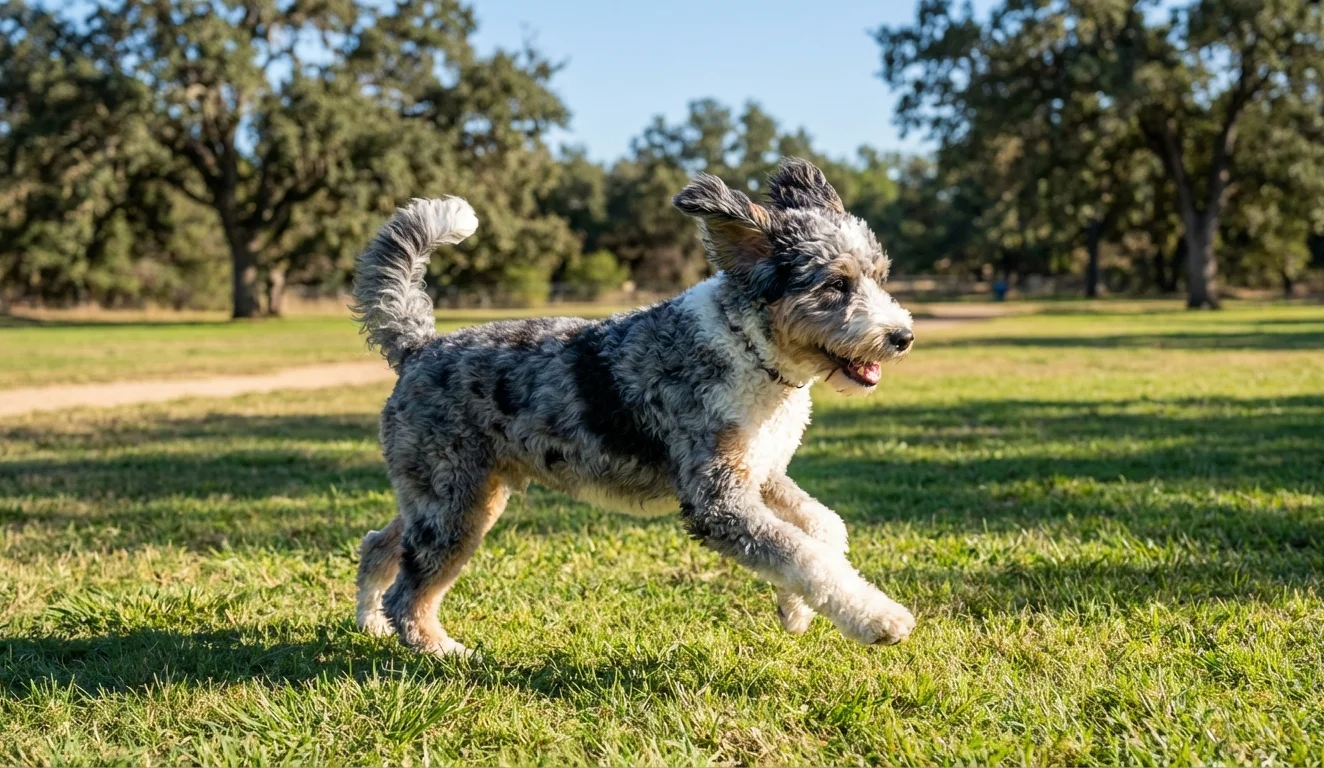
The Aussiedoodle is a cross between an Australian Shepherd and a Poodle, two of the smartest dog breeds on the planet. Aussiedoodles are known for their striking merle coats, exceptional athleticism, and intense bond with their owners. Standard Aussiedoodles weigh 40-70 lbs, and they need 90+ minutes of daily exercise.
In Short: 25–70 lbs, 10–13 years. Very high energy, needs serious daily exercise. Low-shedding (often called hypoallergenic, though no dog truly is). Watch for Hip Dysplasia and Progressive Retinal Atrophy. Good with kids, but better for experienced owners.
If you want a dog that’s smarter than some of the people you know and looks like a painting while doing agility, the Aussiedoodle is your dog. But if your idea of dog ownership is a couple of walks and some couch time, keep scrolling, seriously. This breed will eat your house.
Aussiedoodle at a Glance
| Trait | Details |
|---|---|
| Parent Breeds | Australian Shepherd + Poodle |
| Size (Standard) | 40-70 lbs, 19-24 inches |
| Size (Mini) | 15-35 lbs, 12-18 inches |
| Lifespan | 10-14 years |
| Coat | Wavy to curly, low to moderate shedding |
| Colors | Blue merle, red merle, tri-color, black, red, phantom |
| Temperament | Extremely intelligent, energetic, loyal, herding instinct |
| Exercise | 90+ minutes/day |
| Grooming | Moderate-high (professional grooming every 6-8 weeks) |
| Price Range | $1,500-$5,000 |
History of the Aussiedoodle
The Aussiedoodle emerged during the designer breed boom of the early-to-mid 2000s, following the trail blazed by Labradoodles and Goldendoodles in the 1990s. Unlike the Bernedoodle (which has a specific originator), the Aussiedoodle doesn’t have a single credited breeder, multiple breeders in the U.S. and Australia began crossing Australian Shepherds with Poodles around the same period.
The logic behind the cross was straightforward. Australian Shepherds rank as the 66th most popular breed with the AKC (2023 registration data) and are considered one of the most versatile working dogs in existence, agile, tireless, and whip-smart. But Australian Shepherds shed heavily, which limits their appeal for people with allergies or a low tolerance for tumbleweeds of fur.
Poodles bring the hypoallergenic coat, plus they’re ranked the 2nd most intelligent dog breed by Stanley Coren’s The Intelligence of Dogs. Australian Shepherds aren’t far behind at 42nd in Coren’s rankings, though many Aussie owners argue that understates their working intelligence.
The result? A dog that’s brilliant, athletic, and sheds far less than a purebred Australian Shepherd. Aussiedoodles can be registered with the Designer Breed Registry and the American Canine Hybrid Club, though they aren’t AKC-recognized (and likely won’t be, that’s not how AKC registration works for mixed breeds).
Size and Appearance
Aussiedoodles come in two primary size categories.
Standard Aussiedoodle
Standard Aussiedoodles pair an Australian Shepherd with a Standard or Moyen Poodle. These dogs weigh 40-70 lbs and stand 19-24 inches at the shoulder. Males tend to run larger, it’s not unusual for a male Standard Aussiedoodle to push 65-70 lbs.
Mini Aussiedoodle
Mini Aussiedoodles use a Miniature Poodle parent and weigh 15-35 lbs at 12-18 inches tall. Mini Aussiedoodles have surged in popularity because they pack the full Aussiedoodle personality into a more apartment-friendly package. Don’t mistake smaller size for lower energy, though, Mini Aussiedoodles are just as intense as their standard counterparts.
Aussiedoodle Coat Colors
The Aussiedoodle’s most distinctive feature is often its coat color, especially the merle patterns inherited from the Australian Shepherd side.
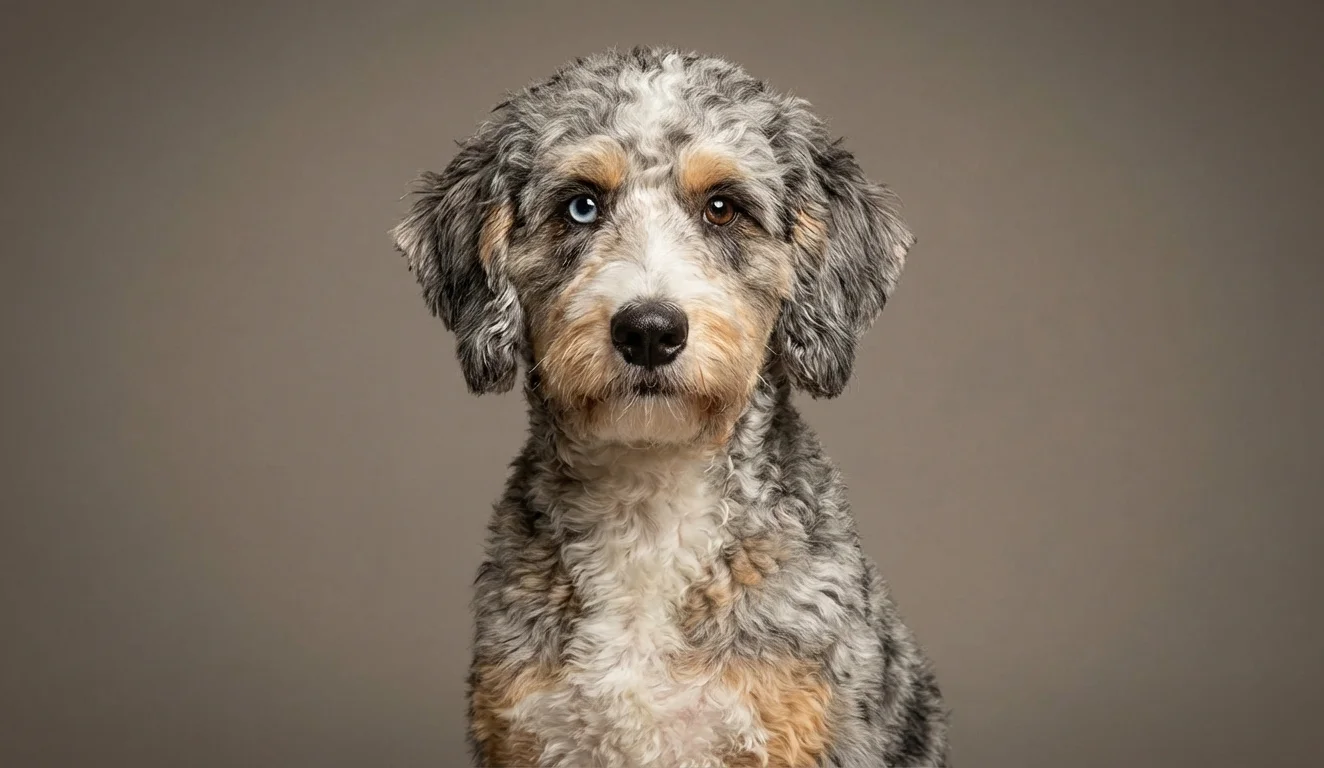
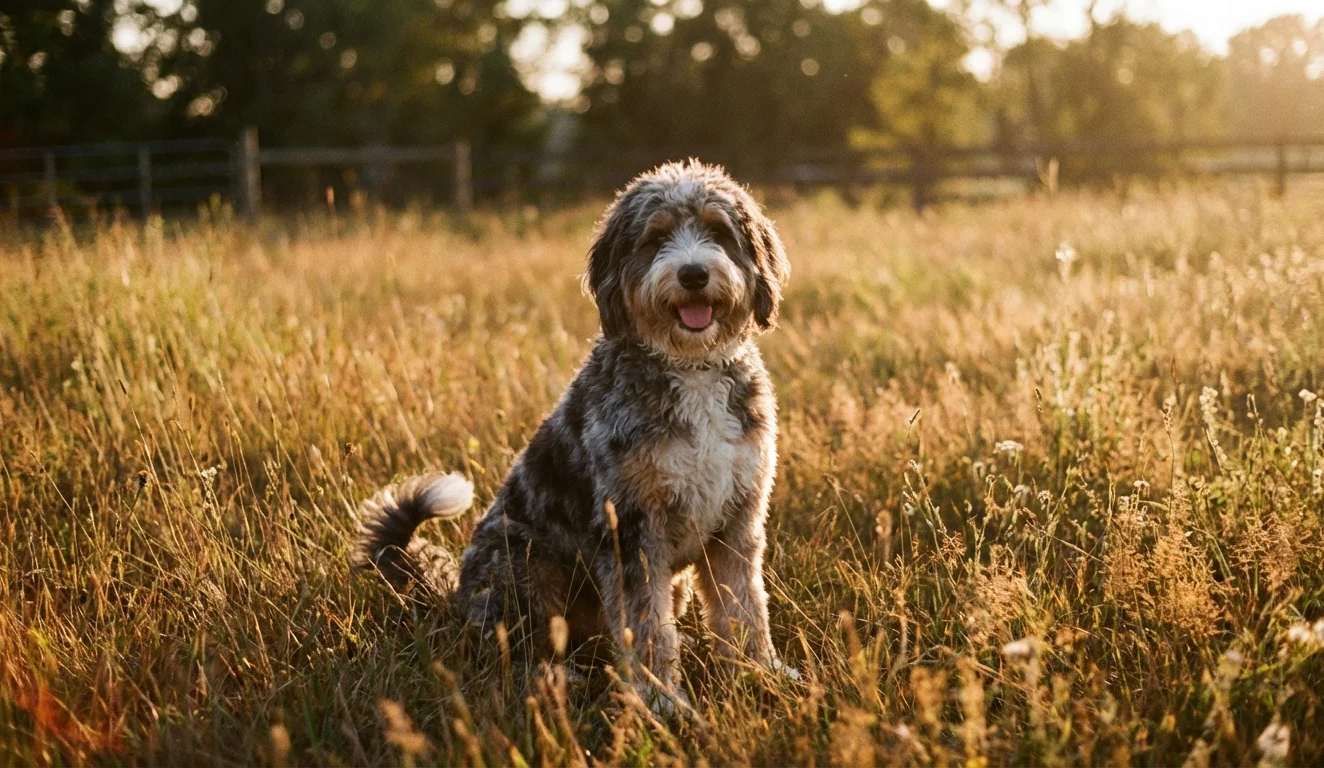
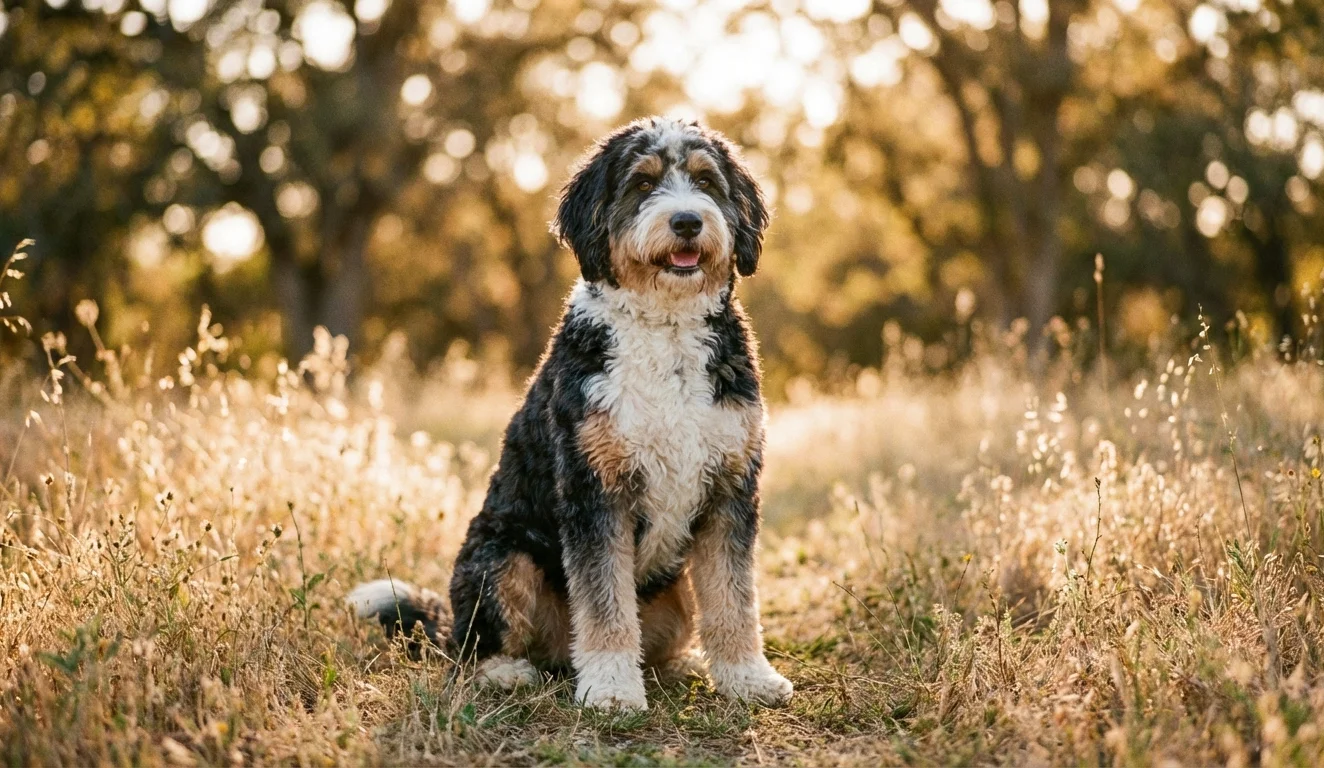
- Blue merle: a marbled mix of gray, black, and white. Blue merle is the most sought-after Aussiedoodle color and commands the highest prices.
- Red merle: a marbled mix of red/copper, cream, and white. Equally stunning and slightly less common than blue merle.
- Tri-color: black, white, and copper markings, similar to a classic Australian Shepherd pattern
- Black: solid or with white markings
- Red/chocolate: solid or with white markings
- Phantom: dark base with tan points (like a Doberman pattern)
One thing worth knowing: merle coloring has no effect on coat texture. A blue merle Aussiedoodle can have a straight, wavy, or curly coat, color and texture are controlled by different genes. Some buyers assume merle means a specific coat type. It doesn’t.
Many Aussiedoodles also inherit the Australian Shepherd’s striking heterochromia, two different-colored eyes, or eyes with mixed coloring. About 15-20% of Australian Shepherds carry the heterochromia gene according to breed surveys, and it shows up regularly in Aussiedoodles too.
Aussiedoodle Temperament
Here’s the honest truth about Aussiedoodle temperament: this is not a “chill” dog.
Aussiedoodles inherit intelligence from both parent breeds, and that intelligence needs an outlet. A mentally stimulated Aussiedoodle is an incredible companion, loyal, engaged, fun, and endlessly entertaining. An under-stimulated Aussiedoodle will redecorate your house in ways you didn’t authorize.
Key temperament traits of the Aussiedoodle:
-
Velcro dog: Aussiedoodles attach to their people with industrial-strength devotion. They’ll follow you from room to room, sit on your feet while you work, and stare at you with an intensity that’s flattering and slightly unnerving. Separation anxiety is common in Aussiedoodles left alone for extended periods.
-
Herding instinct: this is the big one that catches first-time Aussiedoodle owners off guard. The Australian Shepherd was bred to herd livestock, and that instinct doesn’t disappear in a cross. Aussiedoodles may try to herd children, other pets, cyclists, or joggers by nipping at heels or circling. This behavior isn’t aggressive, it’s genetic. But it needs to be redirected through training, or it becomes a problem.
-
High social intelligence: Aussiedoodles read human emotions remarkably well. They pick up on stress, sadness, and excitement and adjust their behavior accordingly. This makes Aussiedoodles excellent therapy and emotional support dogs.
-
Playful and goofy: despite the intensity, Aussiedoodles have a strong silly streak. They’ll invent games, bring you random objects as “gifts,” and do full-body wiggles when you walk through the door.
-
Alert but not aggressive: Aussiedoodles make decent watchdogs because they’ll bark to alert you to strangers or unusual sounds. They’re not guard dogs, though. Most Aussiedoodles warm up to new people within minutes.
Exercise Needs
This section comes with a warning: Aussiedoodles are one of the highest-energy doodle breeds. If you want a low-key companion, look elsewhere. A Goldendoodle or Bernedoodle would be a better fit.
Aussiedoodles need 90+ minutes of daily exercise, and that’s not 90 minutes of walking around the block. Aussiedoodles need real physical and mental challenges.
Physical exercise that works for Aussiedoodles:
- Hiking: Aussiedoodles are natural trail dogs with excellent stamina. A 5-10 mile hike is a Tuesday for a fit Aussiedoodle.
- Running: once fully grown (12-18 months for joint development), Aussiedoodles make outstanding running partners for 3-5 mile jogs.
- Fetch: retrieving is practically hardwired. A Chuck-It launcher and an open field will buy you 30 minutes of solid exercise.
- Swimming: most Aussiedoodles love water, though introduce it gradually.
- Dog parks: great for socialization and off-leash energy burning, assuming your Aussiedoodle has reliable recall.
Mental exercise matters just as much:
- Agility training: Aussiedoodles absolutely excel at agility. Their Australian Shepherd heritage gives them natural obstacle-course abilities, and the Poodle side brings focus and trainability. Many Aussiedoodle owners compete in AKC agility events (open to mixed breeds through the AKC Canine Partners program).
- Flyball and disc dog: team-based canine sports are a great fit for the Aussiedoodle’s energy and athleticism.
- Puzzle toys and nose work: Kong Wobblers, snuffle mats, and scent-tracking games engage the Aussiedoodle’s powerful brain.
- Training sessions: Aussiedoodles genuinely enjoy learning new commands and tricks. A 15-minute training session counts as both mental exercise and bonding time.
What happens if an Aussiedoodle doesn’t get enough exercise? Destructive chewing, excessive barking, digging, herding behavior directed at family members, and general hyperactivity. An under-exercised Aussiedoodle isn’t being “bad”, the dog is just running on a full tank with nowhere to go.
Grooming
Aussiedoodle grooming needs are moderate-to-high, depending on coat type.
Wavy coats (the most common in Aussiedoodles) need brushing 3-4 times per week and professional grooming every 6-8 weeks. Wavy-coated Aussiedoodles shed lightly, far less than a purebred Australian Shepherd, but more than a purebred Poodle.
Curly coats shed the least but mat the fastest. Daily brushing is recommended for curly-coated Aussiedoodles, and professional grooming every 6 weeks is safer than stretching to 8.
Straighter coats (less common, more likely in F1 Aussiedoodles) shed the most and need less intensive grooming, brushing 2-3 times per week is usually enough.
A few grooming notes specific to Aussiedoodles:
- Merle coloring has no bearing on coat texture or grooming needs. A blue merle Aussiedoodle and a solid black Aussiedoodle with the same coat type will need identical grooming routines.
- Ear care is non-negotiable. Aussiedoodles with floppy ears (which is most of them) are prone to ear infections. Clean ears weekly with a vet-approved solution and dry them thoroughly after swimming.
- Professional grooming costs run $50-$90 per session for a Standard Aussiedoodle, or roughly $430-$780 per year.
Aussiedoodle Health Issues
Aussiedoodles are generally healthy dogs, but they can inherit conditions from both parent breeds. Responsible breeding and health testing reduce risk significantly, always ask breeders for documented health clearances.
Hip Dysplasia
Both Australian Shepherds and Poodles carry hip dysplasia risk. OFA data shows approximately 6.1% of Australian Shepherds and 11.9% of Standard Poodles evaluated have dysplastic hips. Aussiedoodles fall within that range. OFA hip and elbow evaluations on both parents should be a minimum requirement from any breeder you consider.
Eye Diseases
This is where the Australian Shepherd genetics require extra attention. Australian Shepherds are prone to several heritable eye conditions, including:
- Collie Eye Anomaly (CEA): affects approximately 2.5-3% of Australian Shepherds according to breed health surveys
- Progressive Retinal Atrophy (PRA): causes gradual vision loss
- Cataracts: heritable juvenile cataracts occur in both parent breeds
The Canine Eye Registration Foundation (CERF) exam and genetic panel testing (including a CEA/CH DNA test) should be performed on both Aussiedoodle parents before breeding.
MDR1 Gene Mutation
This is a big one for Aussiedoodle owners. The MDR1 (Multi-Drug Resistance 1) gene mutation is carried by approximately 50% of Australian Shepherds according to Washington State University’s Veterinary Clinical Pharmacology Lab. Dogs with this mutation can have severe, life-threatening reactions to common medications including ivermectin (found in some heartworm preventatives), loperamide (Imodium), and certain anesthetics.
Every Aussiedoodle should be MDR1-tested. This is a simple cheek swab DNA test that costs about $60-$80. Share the results with your veterinarian so they can avoid prescribing problem medications. Responsible Aussiedoodle breeders test parent dogs for MDR1 before breeding.
Epilepsy
Both Australian Shepherds and Poodles have elevated rates of idiopathic epilepsy compared to the general dog population. The Australian Shepherd Health & Genetics Institute identifies epilepsy as one of the top health concerns in the breed. Epilepsy in Aussiedoodles is manageable with medication but requires ongoing veterinary care.
Merle-to-Merle Breeding Dangers
This is critical for anyone considering an Aussiedoodle: never purchase a puppy from a merle-to-merle (double merle) breeding. When two merle dogs are bred together, approximately 25% of the resulting puppies will be “double merle” (homozygous merle). Double merle dogs have a high incidence of deafness and blindness, studies show that up to 10% are completely deaf and many have severe eye defects including microphthalmia (abnormally small eyes).
Reputable Aussiedoodle breeders never breed two merle parents together. If a breeder can’t tell you the merle status of both parent dogs, walk away.
Training an Aussiedoodle
If Bernedoodles are the stubborn-but-lovable students, Aussiedoodles are the overachievers who finish the assignment before you’ve explained it.
Aussiedoodles are among the most trainable doodle breeds. The combination of Australian Shepherd work ethic and Poodle problem-solving ability creates a dog that learns quickly, retains commands well, and genuinely enjoys the training process.
Where Aussiedoodles excel:
- Agility: this is practically the Aussiedoodle’s sport. Fast, athletic, focused, and handler-oriented.
- Flyball: the relay-race format taps into the Aussiedoodle’s speed and competitive drive.
- Obedience trials: Aussiedoodles can achieve high-level obedience titles with consistent training.
- Trick training: Aussiedoodles pick up complex trick chains faster than most breeds.
- Scent work and nose work: engages the Aussiedoodle’s brain in a calming, focused way.
The most common training mistake with Aussiedoodles: not giving them a job. Aussiedoodles are working dog crosses. They need purpose. A daily training routine, a sport to practice, or even a structured “chore” (carrying a backpack on walks, finding hidden toys) satisfies the Aussiedoodle’s drive to work. Without a job, Aussiedoodles create their own, and self-assigned jobs usually involve destroying something.
Training tips for Aussiedoodle owners:
- Start training early. Aussiedoodle puppies can begin basic commands at 8 weeks old.
- Use positive reinforcement exclusively. Aussiedoodles are sensitive to tone, harsh corrections damage trust and slow progress.
- Keep sessions short but frequent: 10-15 minutes, 2-3 times daily.
- Redirect herding behavior immediately. If an Aussiedoodle nips at heels, redirect to a toy and reward the alternative behavior.
- Enroll in a structured class. Puppy kindergarten, then basic obedience, then a sport. Aussiedoodles thrive with structured progression.
Aussiedoodle Cost
Purchase Price
Aussiedoodle puppies from reputable breeders cost $1,500-$5,000. Several factors influence price:
- Color: blue merle and red merle Aussiedoodles command the highest prices, often $3,000-$5,000. Solid colors typically start lower, around $1,500-$2,500.
- Size: Mini Aussiedoodles often cost more than standards due to higher demand and more selective breeding requirements.
- Eye color: Aussiedoodles with heterochromia (two different eye colors) or striking blue eyes sometimes carry a premium.
- Health testing: breeders who perform full panels (OFA hips/elbows, CERF eyes, MDR1, genetic disease panels) have higher costs that are reflected in puppy prices. This is money well spent.
Budget warning: avoid Aussiedoodle puppies priced under $1,200. The health testing alone for both parents costs breeders $700-$1,000+. Extremely low prices often signal skipped health testing, puppy mill conditions, or outright scams.
Monthly Costs
Budget $100-$200 per month for an Aussiedoodle:
| Expense | Monthly Estimate |
|---|---|
| Food (high-quality kibble or fresh) | $40-$80 |
| Pet insurance | $30-$55 |
| Grooming | $35-$75 (averaged monthly) |
| Treats and training rewards | $10-$25 |
| Miscellaneous (toys, supplements, flea/tick) | $15-$30 |
Aussiedoodles burn a lot of calories. An active Standard Aussiedoodle may eat 2.5-3.5 cups of high-quality kibble per day, or the equivalent in fresh/raw food.
First-Year Costs
Including purchase price, initial veterinary work (vaccines, spay/neuter, MDR1 testing), supplies, and training classes, expect to spend $3,500-$7,500+ in the first year of Aussiedoodle ownership.
Aussiedoodle vs. Goldendoodle
This is one of the most common comparisons people research before choosing a doodle breed. Both are popular, both are Poodle crosses, but they’re very different dogs.
| Factor | Aussiedoodle | Goldendoodle |
|---|---|---|
| Energy Level | Very high (90+ min/day) | Moderate (45-60 min/day) |
| Trainability | Extremely high, needs a “job” | High, eager to please |
| Herding Instinct | Yes, may nip/circle | No |
| Temperament | Intense, focused, velcro | Easygoing, friendly, adaptable |
| Best For | Active owners, dog sport enthusiasts | Families, first-time dog owners |
| Coat Colors | Merle patterns available | Cream, gold, red, black |
| Size Range | 15-70 lbs | 15-90 lbs |
| Separation Anxiety | Common | Moderate |
| Good for Apartments | Only with significant daily exercise | More adaptable |
The honest comparison: Goldendoodles are easier dogs. They’re more forgiving of inconsistent schedules, less demanding of mental stimulation, and more adaptable to a variety of living situations. Aussiedoodles are more impressive dogs, smarter, more athletic, more trainable, but they demand more from their owners. Neither breed is better. They’re for different people.
If you work from home, love hiking and outdoor activities, and want a dog that’ll learn agility or flyball with you, the Aussiedoodle is the pick. If you want a friendly, adaptable family dog that’s happy with a daily walk and some backyard play, the Goldendoodle is probably the safer choice.
Is an Aussiedoodle Right for You?
Let’s be straightforward here, because Aussiedoodle returns to shelters and rescues are rising, and most of those returns trace back to owners who underestimated the breed’s needs.
An Aussiedoodle is a great fit if you:
- Lead an active lifestyle, hiking, running, outdoor activities are regular parts of your week
- Can provide 90+ minutes of daily exercise (not just on weekends, every day)
- Want a dog smart enough to compete in agility, flyball, obedience, or other canine sports
- Work from home or have flexible hours (Aussiedoodles don’t handle long absences well)
- Enjoy training and are willing to keep it up throughout the Aussiedoodle’s life, not just puppyhood
- Can handle a dog with herding instincts and know how to redirect that behavior
- Want a deeply bonded, velcro-style companion
An Aussiedoodle is NOT right if you:
- Work 8-10 hours away from home with no dog care plan
- Prefer a low-key, relaxed dog that doesn’t need much stimulation
- Are a first-time dog owner looking for an easy starter breed (consider a Goldendoodle instead)
- Don’t have time or interest in structured training or dog sports
- Want a dog that’s happy with a quick 20-minute walk
- Live in a small apartment with no yard and limited access to parks or trails
The right Aussiedoodle owner already knows who they are, they’re the person who read ‘90+ minutes of exercise per day’ and thought ‘that’s just my Tuesday.’ If that’s you, this dog will be the best thing that ever happened to you. If it’s not, a Goldendoodle or Bernedoodle would love you just as much with half the cardio requirement.
Related Breeds
If you’re considering this breed, you might also want to look at:
Frequently Asked Questions About Aussiedoodles
Are Aussiedoodles good family dogs?
Aussiedoodles can be excellent family dogs for active families, but they come with a caveat that other doodle breeds don’t. The Australian Shepherd herding instinct can cause Aussiedoodles to nip at children’s heels or try to “herd” kids during play. This behavior isn’t aggressive, it’s hardwired, but it needs to be addressed through consistent training and redirection. Families with children under 5 should supervise Aussiedoodle interactions closely. For families with older, active kids who can participate in training and exercise, the Aussiedoodle is a fantastic match.
Do Aussiedoodles bark a lot?
Aussiedoodles tend to be more vocal than some other doodle breeds because Australian Shepherds were bred to use their voice while herding. Aussiedoodles commonly bark to alert owners to doorbells, strangers, or unusual sounds, and they may bark during play or when excited. Excessive barking in Aussiedoodles is usually a sign of under-stimulation, a tired, mentally engaged Aussiedoodle is a quiet Aussiedoodle. Training a “quiet” command early and providing adequate daily exercise (90+ minutes) significantly reduces nuisance barking.
What is the MDR1 gene and why does it matter for Aussiedoodles?
The MDR1 (Multi-Drug Resistance 1) gene mutation affects approximately 50% of Australian Shepherds, according to Washington State University’s Veterinary Clinical Pharmacology Lab, and can be passed to Aussiedoodle offspring. Aussiedoodles with this mutation can have severe, potentially fatal reactions to common medications including ivermectin, loperamide (Imodium), and certain anesthetics and sedatives. Every Aussiedoodle should be MDR1-tested via a simple cheek swab DNA test (about $60-$80), and the results should be shared with your veterinarian to ensure safe medication choices throughout the Aussiedoodle’s life.
How big do Aussiedoodles get?
Standard Aussiedoodles typically reach 40-70 lbs and stand 19-24 inches at the shoulder, with males trending toward the higher end of that range. Mini Aussiedoodles weigh 15-35 lbs and stand 12-18 inches tall. Aussiedoodle size depends primarily on the Poodle parent, Standard Poodle crosses produce larger Aussiedoodles, while Miniature Poodle crosses produce minis. Most Aussiedoodles reach their full height by 12 months but continue filling out until 14-18 months of age.
Can Aussiedoodles be left alone?
Aussiedoodles do not handle extended alone time well. The breed’s strong attachment to their owners, combined with high intelligence and energy, makes Aussiedoodles prone to separation anxiety when left alone for more than 4-6 hours regularly. Signs of separation anxiety in Aussiedoodles include destructive chewing, excessive barking, house-training regression, and escape attempts. If your schedule requires long absences, a midday dog walker, doggy daycare, or a second pet for companionship can help, but prospective Aussiedoodle owners should honestly evaluate whether their lifestyle allows enough together-time before purchasing.