Dalmatian Breed Guide: More Than a Disney Movie and a Fire Truck (2026)
Dalmatians are gorgeous, athletic, and wildly misunderstood. Here's what the movies don't tell you about living with a spotted dog.
The Dalmatian is a medium-to-large dog that weighs 45-70 pounds, stands 19-24 inches tall, and lives 11-13 years. They’re one of the most instantly recognizable breeds on the planet thanks to that spotted coat, and also thanks to Disney, which is both the best and worst thing that ever happened to this breed.
In Short: 45–70 lbs, 11–13 years. Very high energy, needs serious daily exercise. Heavy shedder. Watch for Deafness and Urinary Stones (Urate). Good with kids, but better for experienced owners.
Here’s our honest take: the Dalmatian is one of the most surrendered breeds in America, and the reason is almost always the same. Someone sees the spots, falls in love, brings home a puppy, and then discovers that Dalmatians are high-energy athletes who need 90 minutes of exercise per day and will redecorate your house with their teeth if they don’t get it. Every time a new 101 Dalmatians remake hits theaters, shelters brace for the wave of surrenders that follows 8-12 months later. We think Dalmatians are fantastic dogs. We also think most people shouldn’t own one.
Dalmatian at a Glance
| Trait | Details |
|---|---|
| Breed Group | Non-Sporting (AKC) |
| Height | 19-24 in (males and females) |
| Weight | 45-70 lbs (males and females) |
| Life Expectancy | 11-13 years |
| Coat | Short, dense, fine, glossy |
| Colors | White with Black Spots, White with Liver Spots |
| Temperament | Dignified, Smart, Outgoing, Playful |
| Shedding | High (year-round) |
| Energy Level | Very High |
| Good With Kids | Yes (with proper socialization) |
| AKC Recognition | 1888 |
History
The Dalmatian’s exact origin is debated, but the breed likely developed in the historical region of Dalmatia (modern-day Croatia) before spreading across Europe. Early depictions of spotted dogs appear in paintings and church records dating back to the 1600s, though the dogs’ role varied widely, they were used as hunting dogs, war dogs, guard dogs, and ratters.
The breed found its niche in 18th-century England as a coach dog. Dalmatians would run alongside horse-drawn carriages for miles, guarding the horses and the carriage’s contents from thieves. Their endurance was remarkable, Dalmatians could pace a trotting horse for 20-30 miles without breaking stride. This isn’t a casual athletic ability. It’s an endurance feat that few other breeds could match. That coaching heritage explains why Dalmatians have a natural affinity for horses, which in turn explains how they ended up at firehouses.
In the era of horse-drawn fire engines, Dalmatians served as the firehouse dog, running ahead of the horses to clear the path, guarding the equipment at the scene, and keeping the horses calm. Even after fire engines went motorized, the tradition stuck. To this day, Dalmatians are the mascot of many fire departments, though their role is purely ceremonial now.
Size and Appearance
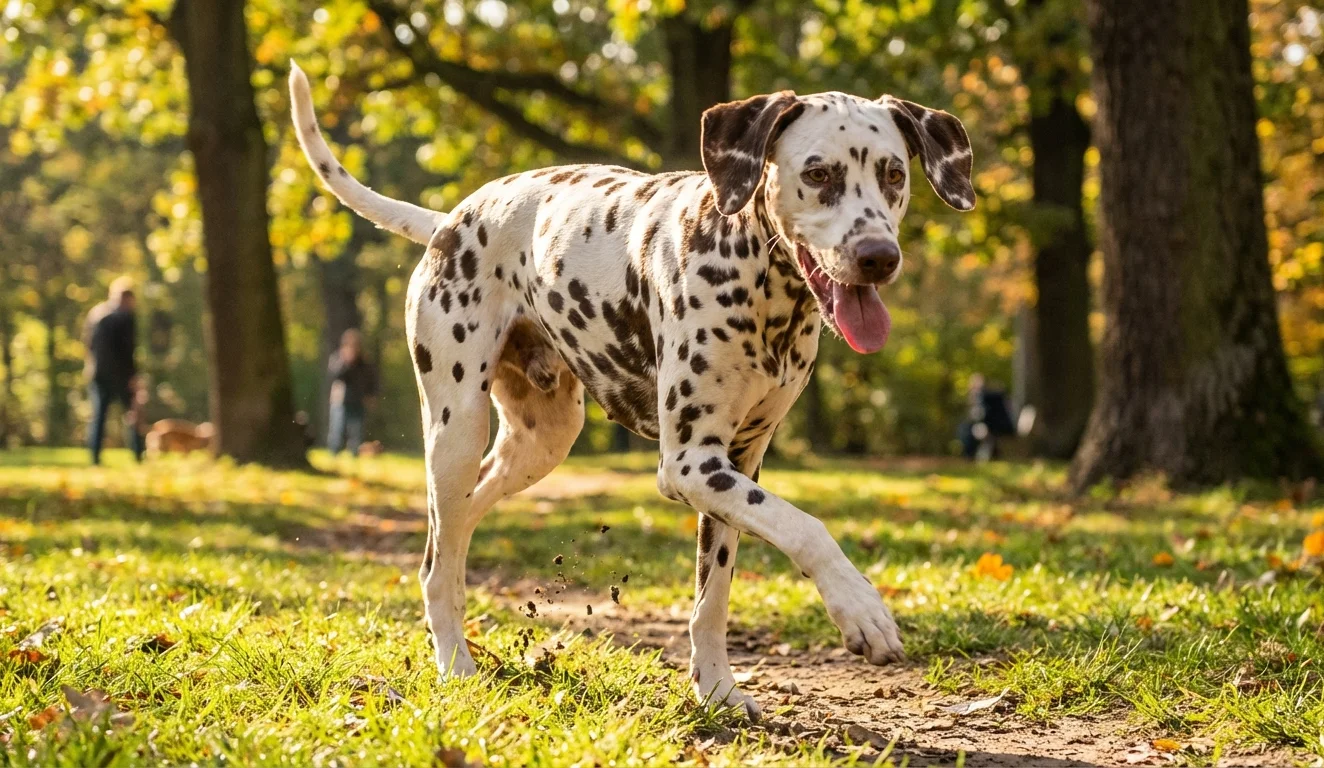
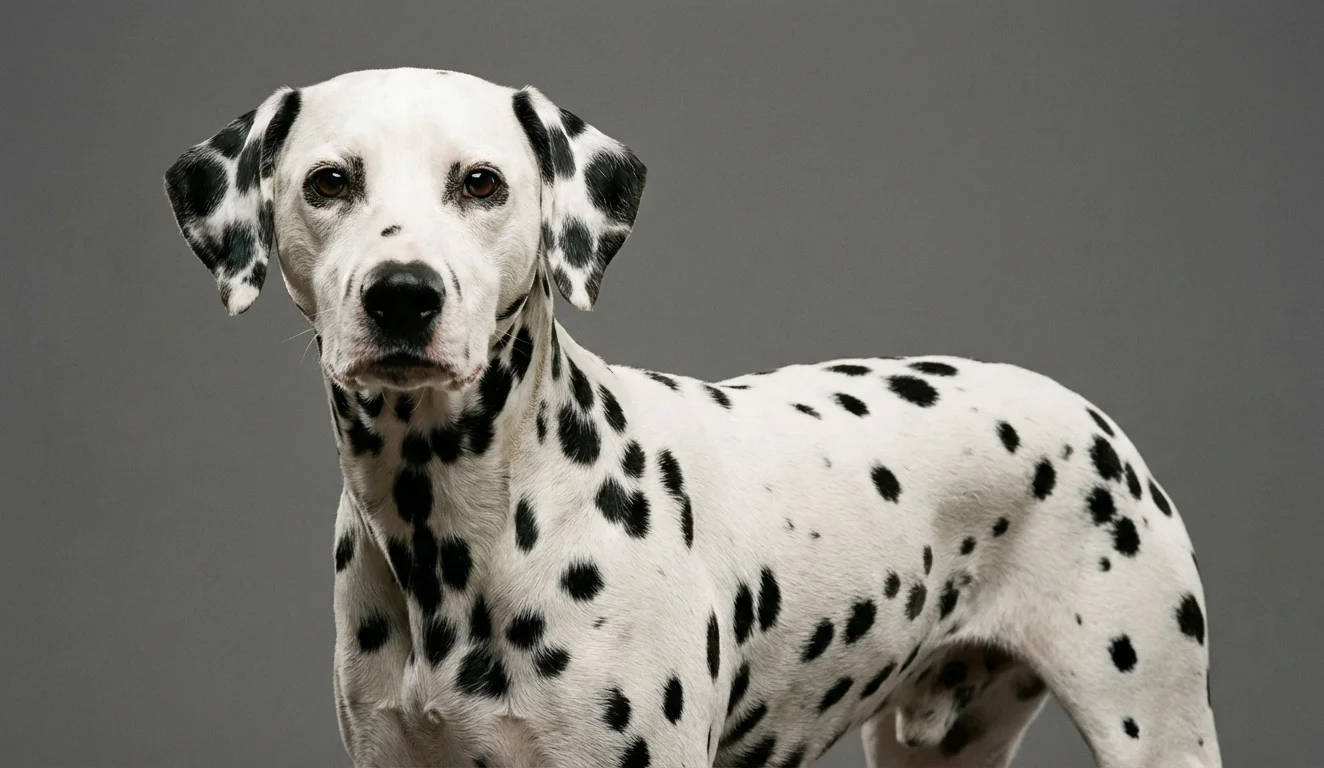
Dalmatians are built like runners, lean, muscular, and proportioned for speed and endurance. Both males and females stand 19-24 inches at the shoulder and weigh 45-70 pounds. There’s less size difference between the sexes than in many breeds.
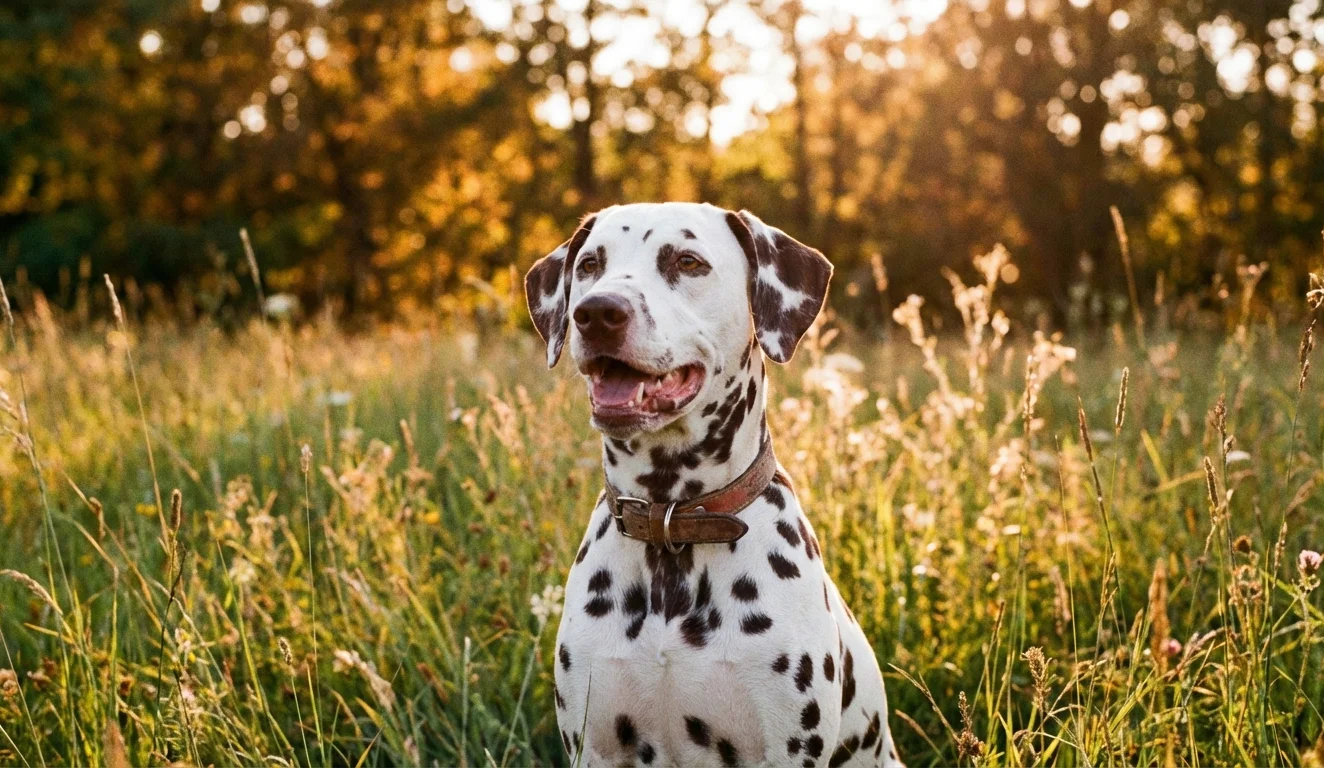
The spots are the main event, obviously. Dalmatian puppies are born completely white, and their spots develop over the first few weeks of life, continuing to appear gradually for about a year. Spots are either black or liver (dark brown) on a white background. No two Dalmatians have the same spot pattern, they’re as unique as fingerprints.
The coat itself is short, fine, dense, and glossy. It looks beautiful. It also sheds more than you’d think possible for a short-haired dog. Dalmatian hair is stiff, straight, and needle-like, which means it weaves itself into fabrics in a way that’s almost impossible to remove with a lint roller. We’re talking about hair that embeds into your couch cushions, car seats, and work clothes with a tenacity that defies physics.
Dalmatian Temperament
Dalmatians are smart, playful, and outgoing dogs with a surprising amount of emotional depth. The AKC describes them as “dignified,” which is accurate, Dalmatians carry themselves with a certain poise that you don’t see in many breeds. But underneath that dignity is a goofy, high-energy athlete who will run circles around your backyard at full speed just because it’s Tuesday.
Key Dalmatian temperament traits:
- Endurance-level energy. This breed was built to run alongside horse-drawn carriages for hours. That stamina is still there. A “quick walk” will not tire out a Dalmatian. Not even close.
- Sensitive and perceptive. Dalmatians are emotionally intelligent dogs. They read your body language accurately and react to household tension. A chaotic, argumentative home environment can make a Dalmatian anxious and reactive.
- Wary of strangers initially. Unlike Labs or Golden Retrievers, Dalmatians don’t immediately trust everyone they meet. They warm up quickly in most cases, but there’s an assessment period. This makes them decent watchdogs.
- Playful well into adulthood. Many Dalmatians retain their puppy playfulness for years. They’re fun, animated dogs that genuinely enjoy goofing around with their families.
The sensitivity piece is important and often overlooked. Dalmatians that are raised in stressful environments or trained with harsh methods can become anxious, snappish, or withdrawn. They need patient, consistent handling.
Exercise Needs
Dalmatians need 90 minutes of exercise per day. Ninety. That’s not a typo, and it’s not negotiable. This is one of the highest-energy breeds you can own, and failing to meet their exercise requirements is the #1 reason Dalmatians end up in shelters.
Best exercises for Dalmatians:
- Running. If you’re a runner, a Dalmatian is an outstanding running partner. Their coaching heritage means they can pace a human runner for miles without tiring. They’re happiest at a steady trot.
- Cycling. Many Dalmatian owners bike with their dogs using a bike attachment. This gives the dog a good pace to match without exhausting the human.
- Hiking. Long, varied-terrain hikes are great for burning both physical and mental energy.
- Agility and flyball. Dalmatians are fast, athletic, and smart enough to excel at structured dog sports.
A Dalmatian that’s getting 90 minutes of daily exercise is a joy to live with, calm indoors, responsive, engaged. A Dalmatian getting 30 minutes is a nightmare. They’ll chew, dig, bark, pace, and generally make your life difficult. This isn’t bad behavior, it’s a dog telling you something important.
Young Dalmatians (under age 3) often need even more than 90 minutes. Plan accordingly.
Grooming
Dalmatians are short-haired and don’t require professional grooming, haircuts, or anything fancy. But they shed. Oh, do they shed.
Despite the short coat, Dalmatians are heavy shedders year-round. There’s no seasonal blowout like you get with double-coated breeds, instead, it’s a constant, steady rain of short, stiff white hairs that embed in everything. Black clothing is your enemy. So is any fabric that isn’t Dalmatian-colored.
Grooming routine:
- Brush weekly with a rubber curry comb or bristle brush. This won’t stop the shedding, but it helps manage it.
- Bathe every 6-8 weeks. Dalmatians are naturally clean dogs with minimal odor.
- Nail trims every 2-3 weeks.
- Teeth brushing 2-3 times per week.
- Ear checks weekly, Dalmatians aren’t prone to ear infections, but regular checks are still good practice.
The grooming itself is easy. The cleanup is not. If you own a Dalmatian, own a good vacuum and resign yourself to white hair on every dark surface in your home.
Dalmatian Health Issues
Dalmatians have some breed-specific health concerns that prospective owners need to understand, particularly around deafness and urinary health.
Deafness
This is the big one. About 30% of Dalmatian puppies are born with some degree of hearing loss, and roughly 8% are completely deaf in both ears. The deafness is linked to the same genetics that produce the white coat and spot pattern, specifically, a lack of melanocytes (pigment-producing cells) in the inner ear.
BAER testing (Brainstem Auditory Evoked Response) can identify deaf puppies as early as 5 weeks old. Testing costs about $100-$500 per dog. Responsible breeders BAER-test every puppy in every litter. If a breeder doesn’t mention BAER testing, walk away. Unilaterally deaf Dalmatians (deaf in one ear) can live perfectly normal lives. Bilaterally deaf dogs require experienced owners who can manage a dog that can’t hear commands.
Urinary Stones (Urate)
Dalmatians have a unique metabolic quirk: they can’t efficiently process uric acid the way other breeds do. This is due to a genetic mutation that affects all Dalmatians, every single one carries it. The result is a predisposition to forming urate stones in the urinary tract, which can cause painful blockages, particularly in males.
Management involves keeping your Dalmatian well-hydrated, feeding a lower-purine diet (avoid organ meats), and monitoring urinary health. If stones develop, treatment costs $1,000-$5,000 depending on whether surgery is needed.
Hip Dysplasia
Hip dysplasia occurs with moderate frequency in Dalmatians. Treatment ranges from $1,500-$6,000. OFA screening of breeding stock reduces incidence.
Iris Sphincter Dysplasia
This eye condition, where the iris doesn’t function normally, occurs with moderate frequency and can cause light sensitivity. Treatment costs are $300-$1,000 and the condition is generally mild.
Skin Allergies
Dalmatians are moderately prone to skin allergies, which can cause itching, redness, and hot spots. Management typically involves identifying triggers and costs $500-$2,000 annually depending on severity.
Training
Dalmatians are smart dogs that learn quickly, when they want to. They’re more independent than retrievers but more biddable than Akitas, landing somewhere in the middle of the trainability spectrum. The key with Dalmatians is keeping things interesting.
Training tips:
- Positive reinforcement only. Dalmatians are sensitive. Harsh corrections create anxious, reactive dogs. Use treats, praise, and play as motivators.
- Variety matters. Dalmatians get bored with repetition faster than most breeds. Rotate through different exercises within a single training session.
- Start socialization early. The breed’s natural wariness of strangers can become problematic without proper early socialization. Expose your Dalmatian puppy to a wide variety of people and situations between 8 and 16 weeks.
- Channel the energy into structure. A Dalmatian that has a “job”, even if it’s just a daily training routine, is a calmer, happier dog.
One thing we’ve noticed: Dalmatians that get adequate exercise are dramatically easier to train. A tired Dalmatian focuses. An under-exercised one can’t sit still long enough to learn anything. If you’re struggling with training, the first question to ask is whether your dog is getting enough physical activity.
Cost
Purchase Price
A Dalmatian puppy from a reputable breeder costs $800-$2,000. Given the breed’s deafness issues, it is absolutely worth paying for a well-bred puppy from parents with full health clearances and BAER-tested puppies. Bargain Dalmatian puppies from unscreened parents are a gamble you don’t want to take.
Adoption through Dalmatian rescues is a great option and typically costs $200-$500. Given the breed’s surrender rate, there are often Dalmatians available through rescue organizations.
Monthly Costs
| Expense | Monthly Estimate |
|---|---|
| Food (high-quality, low-purine) | $40-$60 |
| Preventive vet care (averaged) | $15-$30 |
| Pet insurance | $30-$55 |
| Treats and chews | $10-$20 |
| Miscellaneous (toys, supplies) | $10-$25 |
| Total | $90-$175 |
Note: Dalmatians may have higher-than-average vet costs due to urinary stone monitoring. Budget for periodic urinalysis testing.
First-Year Costs
Expect $3,000-$5,500 for your first year, including purchase price, BAER testing confirmation, initial veterinary visits, supplies, and food.
Is a Dalmatian Right for You?
A Dalmatian is a great fit if you:
- Are an active person who exercises daily (running, cycling, hiking)
- Can commit to 90 minutes of vigorous exercise every single day
- Want a striking, athletic dog with personality and intelligence
- Understand the breed’s unique health needs, especially around urinary stones
- Can handle heavy shedding
- Have experience with dogs (not necessarily required, but helpful)
A Dalmatian might NOT be right if you:
- Saw 101 Dalmatians and want a cute spotted dog without researching further
- Work long hours with limited time for exercise
- Want a low-energy companion dog
- Can’t commit to a low-purine diet and regular urinary monitoring
- Live in a small apartment with no outdoor access
- Are looking for a breed without significant genetic health concerns
The Dalmatian is a phenomenal breed that gets a bad rap because of unrealistic expectations. They’re not difficult dogs, they’re high-energy dogs in a world that mostly wants low-energy pets. If you can match their speed, literally and figuratively, you’ll have a beautiful, smart, entertaining partner that turns heads everywhere you go. Just don’t get one because your kid watched a Disney movie.
Related Breeds
If you’re considering this breed, you might also want to look at:
FAQ
Are Dalmatians aggressive?
No. Dalmatians are not an aggressive breed. The perception comes from a spike in poorly bred Dalmatians after the 1996 movie, when puppy mills and backyard breeders produced dogs with unstable temperaments to meet demand. A well-bred, properly socialized Dalmatian is a friendly, outgoing dog. They can be reserved with strangers initially, but outright aggression is not typical of the breed.
Why are Dalmatians associated with fire stations?
It goes back to their history as coach dogs. In the horse-drawn era, Dalmatians ran alongside fire engines (which were pulled by horses), clearing the path and calming the horses. When fire engines went motorized in the early 1900s, the Dalmatian tradition continued as a mascot. Many fire departments still keep Dalmatians as station dogs today.
Are Dalmatians born with spots?
No. Dalmatian puppies are born pure white. Their spots begin appearing at about 10-14 days old and continue developing for the first year of life. The spots are present in the skin pigmentation even at birth, you can sometimes feel them as slightly different textures, but the visible coat spots take time to emerge.
What is a low-purine diet for Dalmatians?
Because Dalmatians can’t efficiently process uric acid, they benefit from a diet that’s lower in purines (compounds that break down into uric acid). This means avoiding organ meats (liver, kidney, heart), limiting red meat, and choosing foods with moderate protein levels. Many Dalmatian owners work with their vet to find a commercial food that works, or they adjust with targeted supplementation. Keeping water intake high is equally important, fresh water should be available at all times.
How much exercise does a Dalmatian really need?
We said 90 minutes, and we meant it. This breed was designed to run alongside horse-drawn carriages for hours on end. That endurance is still encoded in their DNA. Young Dalmatians (1-3 years) may need even more. A Dalmatian that gets insufficient exercise will become destructive, hyperactive, and genuinely hard to live with. If you aren’t sure you can commit to that level of daily activity, please consider a different breed.