American Pit Bull Terrier Breed Guide: The Most Misunderstood Dog in America (2026)
The American Pit Bull Terrier inspires more heated arguments than any other breed. Here's what the actual dog is like, minus the hype from both sides.
The American Pit Bull Terrier stands 17-21 inches tall, weighs 30-65 pounds, and lives 12-16 years. Those are the numbers. What those numbers don’t capture is the decades of controversy, legislation, media coverage, and deeply conflicting opinions that follow this breed everywhere it goes. No dog in America generates more arguments at dinner tables and on city council floors than the APBT.
In Short: 30–65 lbs, 12–16 years. High energy. Moderate shedding. Watch for Allergies (Skin). Good with kids, but better for experienced owners, apartment-friendly.
We’re going to be honest about this breed, all of it. The APBT is an athletic, affectionate, people-oriented dog with a genuine history of being bred for fighting. Those two things are both true simultaneously, and any breed guide that ignores either half isn’t doing you any favors. This is a dog that requires a committed, experienced owner. But when that match is right, the APBT is one of the most loyal and loving companions you’ll ever meet.
A Note on “Pit Bulls”
Before we go further: the American Pit Bull Terrier is a specific breed recognized by the UKC (United Kennel Club) and ADBA (American Dog Breeders Association). The AKC does not recognize it. The word “pit bull” in everyday conversation is an umbrella term that gets applied to at least four distinct breeds, the APBT, American Staffordshire Terrier, Staffordshire Bull Terrier, and American Bully, plus any mixed-breed dog with a blocky head and muscular body.
This matters because when you see statistics about “pit bull bites” or “pit bull attacks,” those numbers typically use the umbrella definition. Visual identification of pit bull-type dogs by shelter workers, reporters, and even animal control officers is notoriously unreliable. A 2015 study from the University of Florida found that shelter staff correctly identified pit bull-type breeds only 33-75% of the time when compared with DNA results.
This profile is about the American Pit Bull Terrier specifically. Not the umbrella.
American Pit Bull Terrier at a Glance
| Trait | Details |
|---|---|
| Breed Group | Terrier (UKC) |
| Height | Males: 18-21 in / Females: 17-20 in |
| Weight | Males: 35-65 lbs / Females: 30-55 lbs |
| Life Expectancy | 12-16 years |
| Coat | Short, smooth, single coat |
| Colors | Blue, Red, Brindle, Black, White, Fawn, Brown, Tri-color, Blue Fawn, Red Nose |
| Temperament | Loyal, Courageous, Affectionate, Energetic |
| Shedding | Moderate |
| Energy Level | High |
| Good With Kids | Yes (with proper socialization) |
| Good With Other Dogs | Varies (dog-selectivity is common) |
| First-Time Owner Friendly | No |
History
The APBT’s history is intertwined with blood sports, and there’s no honest way around that. In early 19th-century England, breeders crossed Old English Bulldogs with terriers to create dogs for bull-baiting, a spectacle where dogs were set against a tethered bull. When bull-baiting was banned in 1835, those same dogs were turned toward dog fighting, which was easier to organize in secret.
Immigrants brought these bull-and-terrier dogs to America in the mid-1800s. In the United States, they were bred larger than their English counterparts and used as farm dogs, catch dogs for semi-wild livestock, and family companions. The breed was recognized by the UKC in 1898 as the American Pit Bull Terrier. The AKC chose not to recognize the APBT due to its fighting heritage and instead created the American Staffordshire Terrier as a separate breed in 1936, though the two breeds share common ancestry and many dogs were dual-registered for decades.
The APBT’s reputation in America wasn’t always dark. In the early 20th century, they were considered the quintessential American family dog. Petey from The Little Rascals was an APBT. Sergeant Stubby, the most decorated war dog in American history, was a pit bull-type dog. The breed’s public image shifted dramatically in the 1980s when media coverage of dog fighting and a handful of high-profile bite incidents created a wave of fear that persists today.
Size and Appearance
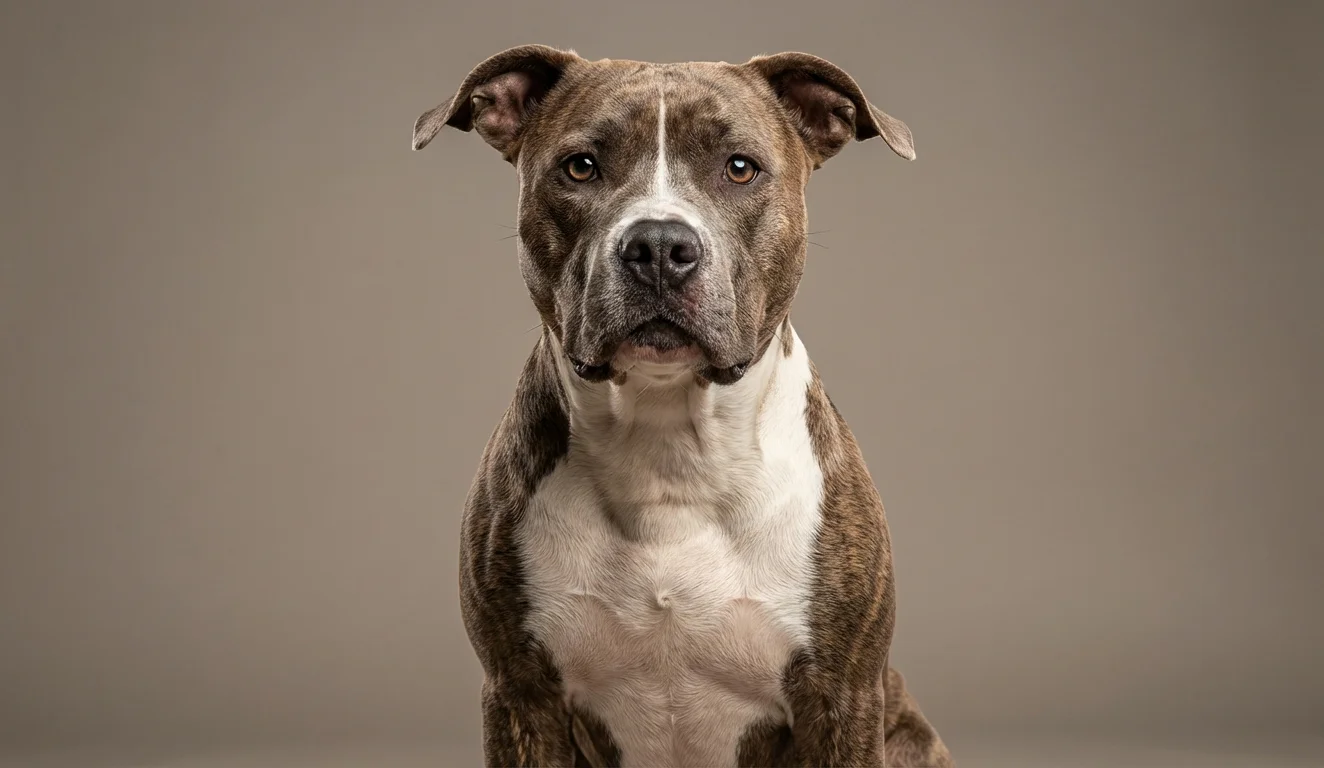
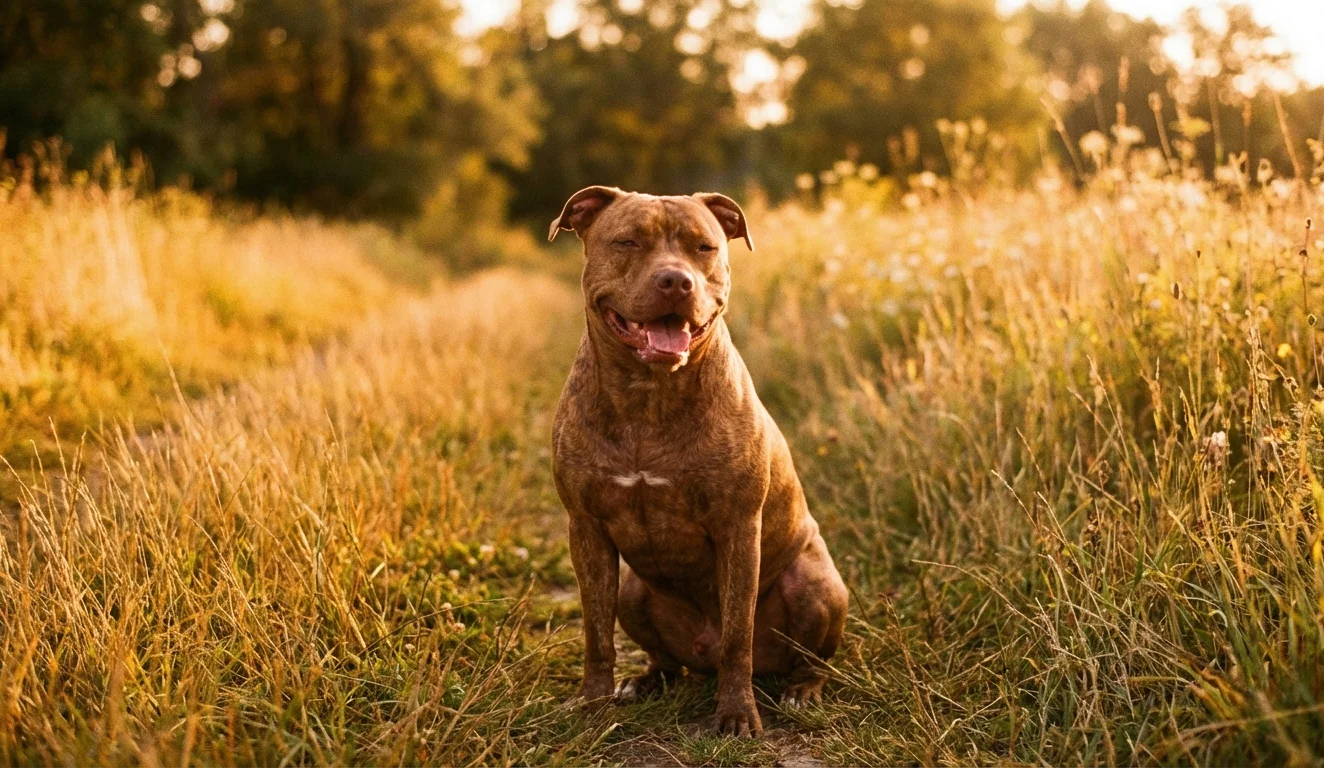
American Pit Bull Terriers are medium-sized, muscular dogs. Males typically stand 18-21 inches and weigh 35-65 pounds. Females are slightly smaller at 17-20 inches and 30-55 pounds. That’s a wide range because the breed standard emphasizes proportion over specific size, a well-built 40-pound APBT is just as correct as a well-built 60-pound one.
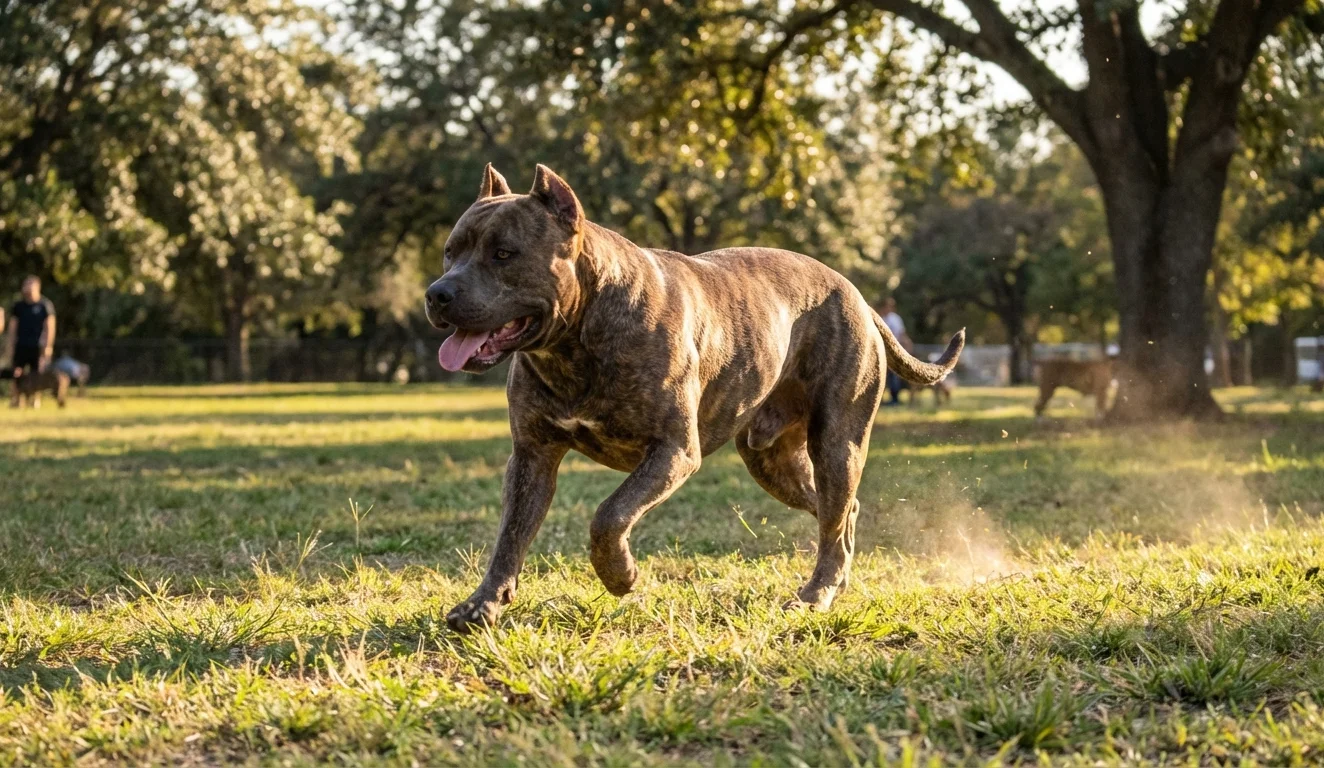
The APBT is built like an athlete. Broad chest, muscular shoulders, a tapered waist, and a short back. Their heads are medium-length and broad, not as exaggerated as the American Bully. Ears are naturally rose or half-prick, though ear cropping (which we don’t support) is still practiced by some owners.
The coat is short, smooth, and easy to maintain. APBTs come in virtually any color and pattern: blue, red, brindle, black, white, fawn, tri-color, and the popular “red nose” and “blue nose” varieties. Contrary to some backyard breeder marketing, “red nose” and “blue nose” are just color descriptions, not separate bloodlines with different temperaments.
American Pit Bull Terrier Temperament
The ATTS (American Temperament Test Society) has tested the American Pit Bull Terrier more than almost any other breed. Their pass rate? 87.4%, which is higher than Golden Retrievers, Beagles, and Collies. That might surprise people who only know this breed from news headlines.
With people, the APBT is genuinely affectionate, almost aggressively so. They’re lap dogs trapped in muscular bodies. They want to be touching you at all times. They’ll wiggle their entire back end when you come home, try to sit on you even though they weigh 50 pounds, and lick your face with an enthusiasm that borders on concerning.
Here’s where we need to be real, though. The APBT was selectively bred for dog aggression. Not all APBTs are dog-aggressive, but dog-selectivity is common in the breed, meaning many APBTs do fine with some dogs but react to others, and some APBTs cannot safely coexist with other dogs at all. This isn’t a character flaw. It’s genetics. A responsible APBT owner acknowledges this tendency and manages it, rather than pretending it doesn’t exist.
Key temperament traits:
- People-oriented to an extreme. APBTs were historically bred to be safe for handlers even in a fighting context. Human aggression was actually selected against, a dog that redirected onto its handler was removed from breeding programs. This is why the breed’s aggression toward people is actually lower than many people assume.
- High pain tolerance and tenacity. When an APBT decides to do something, it follows through. This is wonderful during training and problematic if that decision involves chasing a squirrel or getting through your fence.
- Sensitive and emotionally perceptive. Despite the tough exterior, APBTs are sensitive dogs that respond poorly to harsh treatment. They thrive on positive interactions and clear, consistent boundaries.
Exercise Needs
American Pit Bull Terriers need 60+ minutes of vigorous exercise daily. This is an athletic breed with substantial stamina, and a casual walk won’t cut it for most APBTs.
Best exercises for APBTs:
- Spring pole or flirt pole. These tap into the breed’s natural drive and provide an intense workout in a short time. A 15-minute flirt pole session can tire out an APBT better than an hour-long walk.
- Weight pull. This is a structured sport where dogs pull a weighted sled or cart. APBTs excel at it, and it’s a great outlet for their strength.
- Long runs or hikes. APBTs are fantastic running partners. Their muscular build gives them impressive endurance once conditioned.
- Structured play. Tug-of-war (with rules, you start it, you end it) is excellent exercise and reinforces impulse control at the same time.
Off-leash dog parks are generally not recommended for APBTs. Even a well-socialized APBT can be triggered by another dog’s body language, and the consequences of a fight involving a breed this strong are more serious than with smaller or less powerful dogs. Safe off-leash exercise in fenced, controlled areas is a better approach.
Grooming
APBTs are about as low-maintenance as it gets in the grooming department. The short, smooth single coat needs minimal attention.
Grooming schedule for American Pit Bull Terriers:
- Weekly brushing with a rubber curry brush or bristle brush to remove loose hair
- Baths every 4-8 weeks or as needed, their short coat dries fast
- Nail trims every 2-3 weeks
- Ear checks weekly: rose ears are less prone to infections than floppy ears, but checking is still good practice
- Teeth brushing 2-3 times per week
One grooming note specific to APBTs: skin allergies are extremely common in this breed. If you notice your APBT itching excessively, developing hot spots, or getting recurring ear infections, talk to your vet. Many APBTs need a specific diet or allergy management protocol. More on that in the health section.
American Pit Bull Terrier Health Issues
APBTs are a relatively healthy breed with a long lifespan of 12-16 years. Their genetic diversity (the breed has a broader gene pool than many purebreds) helps. But they do have some vulnerabilities.
Skin Allergies
This is the #1 health complaint among APBT owners, and it’s listed as common in prevalence. Allergies in APBTs can be environmental (pollen, dust mites), food-related, or contact-based. Symptoms include itching, red skin, hot spots, and chronic ear infections. Management costs range from $200-$2,000 per year depending on severity. Many APBT owners end up rotating proteins in their dog’s diet or using medicated shampoos as part of ongoing management.
Hip Dysplasia
Hip dysplasia occurs at moderate prevalence in APBTs. The hip joint develops abnormally, leading to arthritis and pain. Keeping your APBT lean is one of the best ways to reduce the impact of mild to moderate dysplasia. Severe cases may require surgical intervention costing $1,500-$6,000 per hip.
Hypothyroidism
A moderately common condition where the thyroid gland doesn’t produce enough hormones, leading to weight gain, lethargy, and skin problems. The good news: once diagnosed with a simple blood test, hypothyroidism is easily managed with daily medication. Lifetime treatment costs are relatively low at $200-$1,000.
Heart Disease (Aortic Stenosis)
Aortic stenosis is a narrowing of the aortic valve that makes the heart work harder to pump blood. It ranges from mild (requiring only monitoring) to severe (requiring medical intervention or surgery). Treatment costs $3,000-$8,000 in severe cases. Ask breeders about cardiac evaluations in their breeding dogs.
Cranial Cruciate Ligament (CCL) Rupture
Similar to an ACL tear in humans, CCL ruptures are moderately common in APBTs, especially those that are overweight or perform high-impact activities. Surgery (typically TPLO) costs $2,000-$6,000 and requires several months of recovery.
Training
APBTs are intelligent dogs with high trainability. They want to work with their handlers, and they respond beautifully to positive reinforcement. Here’s the caveat: they’re also strong-willed and physically powerful, which means training isn’t optional, it’s essential.
Training priorities for APBT owners:
- Socialization from day one. Early, positive exposure to different people, dogs (at a safe distance if needed), environments, and situations is critical. The window between 3-16 weeks is especially important. A well-socialized APBT is a dramatically different dog than one that was isolated.
- Impulse control. “Leave it,” “wait,” and “drop it” aren’t just nice tricks for an APBT, they’re safety skills. A 50-pound dog that lunges at something interesting is a liability if it doesn’t have solid impulse control.
- Leash manners. APBTs are strong. Teaching loose-leash walking early saves you years of being dragged down the street. A front-clip harness helps during the learning phase.
- Reliable recall. If you ever plan to let your APBT off-leash in a safe, enclosed area, recall needs to be rock-solid.
Avoid dominance-based training methods with APBTs. The “alpha dog” approach creates conflict and anxiety in a breed that genuinely wants to cooperate with you. Positive reinforcement combined with clear structure produces much better results, and a happier dog.
Cost
Purchase Price
An APBT puppy from a reputable breeder costs $500-$2,000. Prices on the higher end typically indicate health testing, temperament evaluation, and a breeder who is selective about placements.
Adoption is extremely accessible with this breed. APBTs and pit bull-type dogs make up a large percentage of shelter populations nationwide. Adoption fees typically range from $50-$300. Many shelters waive or reduce fees for pit bull-type dogs because they stay in shelters longer than other breeds.
Monthly Costs
| Expense | Monthly Estimate |
|---|---|
| Food (high-quality kibble) | $40-$65 |
| Preventive vet care (averaged) | $15-$30 |
| Pet insurance | $30-$60 |
| Treats and chews | $10-$20 |
| Allergy management (if applicable) | $20-$50 |
| Miscellaneous (toys, supplies) | $15-$25 |
| Total | $130-$250 |
First-Year Costs
Budget $2,500-$5,500 for the first year, including purchase or adoption fee, initial vet work, spay/neuter, supplies, and training classes. We’d strongly recommend professional training classes for first-time APBT owners, a good group class runs $150-$300 for a 6-8 week course, and it’s money well spent.
The BSL Factor
Breed-specific legislation (BSL) affects APBTs more than any other breed. Some cities and counties ban APBTs outright. Others require special permits, mandatory muzzling in public, or higher liability insurance. Before getting an APBT, research your local and state laws. Also check your homeowner’s or renter’s insurance, many policies exclude pit bull-type breeds or charge significantly higher premiums. This is a real, ongoing cost that APBT owners must factor in.
Is an American Pit Bull Terrier Right for You?
An APBT is a great fit if you:
- Have experience with dogs and understand canine body language
- Can commit to thorough socialization and ongoing training
- Live in an area without breed-specific legislation restricting APBTs
- Want an athletic, active companion for running, hiking, or dog sports
- Have the time and energy for 60+ minutes of daily exercise
- Are comfortable managing dog-selectivity (which may mean being the only dog in the household)
An APBT is probably NOT right if you:
- Are a first-time dog owner looking for an easy starter breed
- Already have multiple dogs and expect everyone to get along automatically
- Rent in an area with breed restrictions
- Want a dog you can take to the off-leash dog park without careful management
- Aren’t prepared for public scrutiny, people will cross the street, make comments, and judge you
Here’s what we think: the APBT pays a heavy price for human mistakes. The breed’s suffering, the dog fighting rings, the irresponsible breeding, the knee-jerk legislation, is overwhelmingly caused by people, not by the dogs themselves. A well-bred, well-socialized, properly managed APBT living with a knowledgeable owner is a wonderful companion. But the “properly managed” and “knowledgeable owner” parts aren’t optional. They’re the whole point.
Related Breeds
If you’re considering this breed, you might also want to look at:
Frequently Asked Questions
Are American Pit Bull Terriers dangerous?
Any dog can be dangerous in the wrong circumstances. The APBT is a powerful, athletic breed originally developed for dog fighting, which means it has the physical capability to cause serious harm. But the breed was simultaneously selected for human-friendliness, and the ATTS temperament test scores for APBTs (87.4% pass rate) are higher than many popular family breeds. Risk depends heavily on breeding, socialization, training, and management. The idea that APBTs are uniquely dangerous to people is not well-supported by controlled studies when breed identification is verified through DNA testing.
What’s the difference between an American Pit Bull Terrier and an American Staffordshire Terrier?
The two breeds share common ancestry and were essentially the same dog until the AKC created the American Staffordshire Terrier as a separate breed in 1936. Since then, AmStaffs have been bred primarily for conformation showing, while APBTs maintained a broader breeding focus. AmStaffs tend to be slightly stockier, and the AKC breed standard is more specific about acceptable size and conformation. Many dogs could technically be registered as both breeds. The practical differences today are subtle, breeding focus and registry are the main distinctions.
Can American Pit Bull Terriers live with other dogs?
Some APBTs live peacefully with other dogs their entire lives. Others cannot. Dog-selectivity is a breed tendency, not a guarantee, meaning your APBT might be fine with some dogs but reactive toward others. Opposite-sex pairings tend to work better. Introducing an APBT to another dog requires careful, gradual management. Never leave an APBT unsupervised with another dog, at least not until you’ve thoroughly established that the relationship is stable over a period of months.
Is breed-specific legislation effective?
This is heavily debated. Several large-scale studies, including research from the Journal of Veterinary Behavior (2013) and a thorough review by the AVMA, have found no significant reduction in dog bite rates in jurisdictions that implemented BSL. Calgary, Canada, saw greater reductions in dog bites through strict licensing and responsible ownership laws than cities using breed bans. Even so, BSL remains in effect in many U.S. cities and in some entire countries (the UK’s Dangerous Dogs Act, for example). Regardless of the policy debate, it’s a practical reality that APBT owners must research before committing.
How much exercise does an American Pit Bull Terrier need?
At least 60 minutes of vigorous exercise per day. APBTs are high-energy, muscular dogs that were built for intense physical activity. Walking alone usually isn’t enough, they benefit from running, weight pull, flirt pole work, or structured play sessions that challenge both their bodies and their minds. A tired APBT is a well-behaved APBT. An under-exercised one will find ways to burn energy that you probably won’t appreciate.