
Boston Terrier Breed Guide: The Tuxedo-Wearing Class Clown (2026)
Boston Terriers are 12-25 pounds of personality stuffed into a tuxedo. Here's what living with the American Gentleman actually looks like.
The Boston Terrier weighs 12-25 pounds, stands 15-17 inches tall, and lives 11-13 years. They’ve been called the “American Gentleman” since the late 1800s, and honestly, the nickname fits. There’s something about a dog in a permanent tuxedo that makes you take them just seriously enough, right before they slam face-first into a wall chasing a toy.
In Short: 12–25 lbs, 11–13 years. Moderate-to-high energy. Low shedding. Watch for Brachycephalic Obstructive Airway Syndrome and Cataracts. Great for families and first-time owners, apartment-friendly.
We’d argue the Boston Terrier is the most underrated small dog in America. They don’t yap nonstop like some toy breeds. They don’t need two hours of exercise. They genuinely like people, including strangers, which is more than we can say for a lot of small dogs. If you want a compact, funny, surprisingly athletic companion that won’t destroy your apartment, the Boston Terrier deserves a hard look.
Boston Terrier at a Glance
| Trait | Details |
|---|---|
| Breed Group | Non-Sporting (AKC) |
| Height | 15-17 inches |
| Weight | 12-25 lbs |
| Life Expectancy | 11-13 years |
| Coat | Short, smooth, fine |
| Colors | Black & White, Brindle & White, Seal & White |
| Temperament | Friendly, Bright, Amusing |
| Shedding | Low |
| Energy Level | Moderate-High |
| Good With Kids | Yes |
| Apartment Friendly | Yes |
| First-Time Owner Friendly | Yes |
History
The Boston Terrier is one of the few breeds that’s genuinely, fully American. The story starts around 1870 in Boston, when a dog named Judge, a cross between an English Bulldog and a now-extinct white English Terrier, was sold to a Bostonian named Robert C. Hooper. Judge became the foundation sire of the entire breed. Every Boston Terrier alive today can trace its lineage back to that one dog.
Breeders in the Boston area spent the next few decades refining Judge’s descendants, crossing them with smaller dogs to reduce size and mellow out the temperament. The original Boston Terriers were bigger and more bull-like, closer to 40 pounds. By the time the AKC recognized the breed in 1893, the Boston Terrier had already become a fixture in New England households.
The breed hit peak popularity in the 1920s and 1930s, when Boston Terriers were among the most popular dogs in the country. They’ve since settled into a comfortable spot in the top 25, which feels about right. They’re popular enough that you can find a good breeder without too much searching, but not so popular that the breed has been ruined by mass production.
Size and Appearance
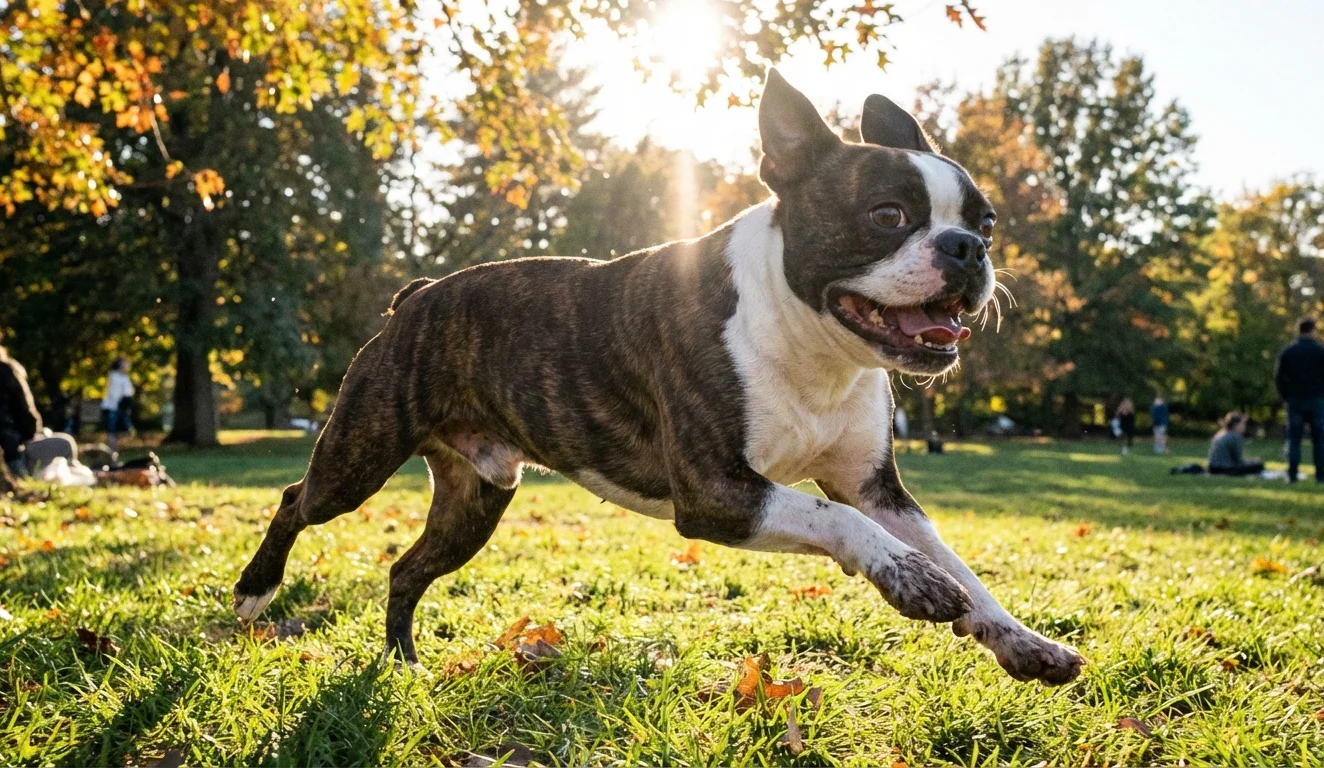
Boston Terriers are compact, muscular little dogs. The AKC recognizes three weight classes: under 15 pounds, 15-20 pounds, and 20-25 pounds. Height sits at 15-17 inches regardless of weight class.
The breed’s most striking feature is that square, flat face. Boston Terriers are brachycephalic, meaning short-skulled, which gives them that pushed-in look. It’s also the source of their biggest health concerns, but we’ll get to that.
Coat and Color
The coat is short, smooth, and fine-textured. It lies flat against the body and has a natural sheen that makes these dogs look polished without much effort. Boston Terriers come in three recognized color patterns: black and white, brindle and white, and seal and white (seal looks black but has a reddish cast in sunlight). The ideal Boston Terrier has an even white blaze between the eyes, a white muzzle band, and a white chest, that’s the “tuxedo” marking people talk about.
Boston Terrier Temperament
The AKC describes Boston Terriers as friendly, bright, and amusing. That last word does a lot of heavy lifting. Boston Terriers are genuinely funny dogs. They make weird noises, pull strange faces, and seem to know when they’re getting a laugh.
They’re also remarkably adaptable. A Boston Terrier can be perfectly happy in a studio apartment or a house with a big yard. They adjust to your energy level, active enough for a jog around the park, but completely fine with a Netflix marathon on the couch.
What to actually expect:
- People-oriented to the extreme. Boston Terriers want to be where you are. Bathroom included. They don’t do well left alone for 8-10 hours, and separation anxiety is a real thing with this breed.
- Stubborn streak. Despite their eagerness to please, Bostons have a terrier’s independent thinking. They’ll decide which commands are worth following and which ones are merely suggestions.
- Surprisingly sensitive. Yell at a Boston Terrier and you’ll get the most guilt-inducing side-eye you’ve ever seen. They respond much better to positive reinforcement. Harsh corrections can make them shut down entirely.
- Not big barkers. This is a huge selling point for apartment dwellers. Bostons are one of the quieter small breeds, they’ll alert you to someone at the door, but they won’t bark at every passing squirrel for 45 minutes.
Exercise Needs
Boston Terriers need about 45 minutes of exercise per day. That’s manageable for almost anyone. A couple of walks plus some indoor play will keep most Bostons happy.
A few important caveats though. Boston Terriers are brachycephalic, which means they don’t handle heat well at all. On hot or humid days, keep exercise sessions short and stick to early morning or evening. Watch for heavy panting, drooling, or stumbling, these are signs of overheating, and brachycephalic dogs can overheat faster than you’d expect.
Good activities for Boston Terriers:
- Brisk walks (but not in extreme heat)
- Fetch in the yard or a fenced area
- Indoor puzzle toys and training games
- Short agility sessions, Bostons are surprisingly athletic and fast
Young Boston Terriers have more energy than the breed’s reputation suggests. A one-year-old Boston is a little rocket. That energy mellows out around age 3-4, and senior Bostons (8+ years) are usually content with shorter walks and lots of lap time.
Grooming
This is where the Boston Terrier really shines as a low-maintenance breed. That short coat practically takes care of itself.
Grooming routine:
- Brush once a week with a rubber curry brush or soft bristle brush to remove loose hair
- Bath every 4-6 weeks (or when they roll in something terrible)
- Wipe facial wrinkles regularly, moisture and debris can collect in the folds and cause irritation or infection
- Clean ears weekly
- Trim nails every 2-3 weeks
- Brush teeth 2-3 times per week
Shedding is minimal. You’ll find some hair on your clothes, but nothing compared to a double-coated breed. Professional grooming isn’t necessary, a bath and nail trim at home covers it. Budget maybe $30-$50 per grooming session if you’d rather have someone else do it.
The one grooming task people forget about with Boston Terriers is the wrinkle care. That flat face creates skin folds where moisture, food debris, and bacteria collect. Wipe them out with a damp cloth or unscented baby wipe every few days. If the folds start smelling funky or looking red, that’s a sign of irritation or infection, your vet can recommend a medicated wipe.
Boston Terrier Health Issues
Boston Terriers live 11-13 years on average. They’re generally sturdy dogs, but that flat face comes with real trade-offs. We think every prospective Boston Terrier owner should understand the brachycephalic issue before buying.
Brachycephalic Obstructive Airway Syndrome (BOAS)
This is the big one. BOAS affects a significant percentage of Boston Terriers and results from the shortened skull structure compressing the airways. Symptoms include loud breathing, snoring, exercise intolerance, gagging, and in severe cases, collapse. Not every Boston Terrier will need surgical intervention, but many do. Treatment typically runs $2,000-$5,000 for corrective surgery. The Cambridge BOAS Research Group has published extensive data on this condition in brachycephalic breeds, it’s worth reading if you’re considering a Boston.
Cataracts
Cataracts are common in Boston Terriers, with hereditary juvenile cataracts being a particular concern. The condition causes the lens of the eye to become opaque, leading to impaired vision and potentially blindness. DNA testing can identify carriers of the hereditary form. Surgery to remove cataracts runs $2,000-$4,000 per eye. The Canine Health Information Center (CHIC) recommends eye exams for all Boston Terriers used in breeding.
Patellar Luxation
The kneecap slips out of position, fairly common in small breeds, and Boston Terriers see moderate rates of it. Mild cases may not need surgery. Severe cases run $1,500-$3,000 per knee. You’ll notice a skip in the dog’s gait if this develops.
Cherry Eye
That bulging red mass in the corner of the eye looks alarming, but cherry eye is treatable. It happens when the tear gland in the third eyelid prolapses. Surgery costs $500-$1,500 and has a good success rate.
Deafness
Congenital deafness affects Boston Terriers at moderate rates, particularly in dogs with more white on their heads. BAER testing (about $100-$500) can identify hearing loss in puppies as young as 5 weeks. Deaf Boston Terriers can live perfectly happy lives with hand-signal training, it’s just something to be aware of.
Training
Boston Terriers are smart and want to make you happy. That’s a good starting combination. They pick up commands quickly, and their food motivation makes treat-based training effective.
The challenge is that terrier stubbornness. A Boston will learn “sit” in five minutes and then spend the next week deciding whether or not to actually do it when asked. Consistency matters more with this breed than intensity.
Training tips for Boston Terriers:
- Keep sessions short. Ten minutes is better than thirty. Bostons have the attention span to match their size.
- Use positive reinforcement exclusively. This breed wilts under harsh corrections.
- Socialize early. Boston Terriers are naturally friendly, but puppies still benefit from exposure to different environments, people, and other dogs between 8-16 weeks.
- Work on alone time. Practice leaving your Boston Terrier alone for gradually increasing periods. Separation anxiety is easier to prevent than to fix.
- Housetrain with patience. Bostons can be slow to housetrain compared to some breeds. Crate training helps a lot here.
Cost
Purchase Price
A Boston Terrier puppy from a reputable breeder typically costs $800-$2,000. Show-quality dogs from champion lines can run higher. Be skeptical of puppies priced much below $800, that usually signals a backyard breeder or puppy mill, and with a breed this prone to health issues, the breeding program matters.
Adopting from a rescue is a great option and typically runs $200-$500. Boston Terrier rescue organizations exist in most regions of the country.
Monthly Costs
| Expense | Monthly Estimate |
|---|---|
| Food (high-quality small breed) | $25-$45 |
| Preventive vet care (averaged) | $15-$30 |
| Pet insurance | $30-$55 |
| Treats and chews | $10-$15 |
| Miscellaneous (toys, supplies) | $10-$20 |
| Total | $70-$150 |
First-Year Costs
Expect to spend $2,500-$4,500 in the first year, including the purchase price. That covers spay/neuter, initial vaccinations, puppy supplies, and those first vet visits. Pet insurance is worth seriously considering with Boston Terriers given the brachycephalic health risks. A single BOAS surgery can exceed the cost of years of insurance premiums.
Is a Boston Terrier Right for You?
A Boston Terrier is a great fit if you:
- Live in an apartment or small space and want a dog that won’t bounce off the walls
- Work from home or have a schedule that doesn’t leave the dog alone for long stretches
- Want a small dog with actual personality instead of a yappy accessory
- Prefer minimal grooming commitment
- Have kids, Bostons are gentle and patient with children
- Want a quiet breed that won’t get you evicted
A Boston Terrier might NOT be right if you:
- Live in a very hot climate and don’t have reliable air conditioning
- Want a jogging partner for long runs
- Are away from home 10+ hours a day
- Can’t afford potential veterinary costs related to brachycephalic issues
- Want a dog that obeys every command without question, Bostons have opinions
The Boston Terrier is one of those breeds where the pros dramatically outweigh the cons for the right person. They’re funny without trying to be, affectionate without being clingy (most of the time), and adaptable enough to fit into almost any living situation. Just be honest about the health stuff. That flat face is adorable, but it’s not free.
Related Breeds
If you’re considering this breed, you might also want to look at:
Frequently Asked Questions
Are Boston Terriers good apartment dogs?
Boston Terriers are one of the best apartment dogs out there. They’re small, they don’t bark much, and they don’t need a yard to be happy. A couple of daily walks and some indoor playtime will keep a Boston Terrier content. The main thing to watch is that they can be gassy, seriously, Boston Terriers are notorious for flatulence. Keep that in mind if you’re sharing a small space.
Do Boston Terriers shed a lot?
No. Boston Terriers are low shedders. That short, smooth coat drops minimal hair compared to most breeds. You’ll still find some hair on furniture and clothes, but it’s nothing a lint roller can’t handle. They’re not hypoallergenic though, so don’t expect zero allergic reactions if you’re sensitive to dog dander.
How long do Boston Terriers live?
Boston Terriers typically live 11-13 years. Some make it to 15 with good care and fortunate genetics. The biggest factors in longevity are maintaining a healthy weight, managing brachycephalic airway issues proactively, and keeping up with regular veterinary care. Heat management is also a factor, chronic overheating can stress the cardiovascular system over time.
Are Boston Terriers hard to potty train?
They can be. Boston Terriers are sometimes slower to housetrain than other breeds, and some owners report it taking 4-6 months before accidents stop completely. Crate training is the most effective approach. Take your Boston out first thing in the morning, after meals, after naps, and right before bed. Keep a consistent schedule. And don’t punish accidents, Boston Terriers take correction personally, and fear-based training will only make housetraining harder.
Do Boston Terriers get along with other dogs?
Most Boston Terriers are friendly with other dogs. They were bred as companions, not fighters (despite the breed’s origins in pit fighting, which were bred out very early). They generally do well at dog parks and in multi-dog households. Same-sex aggression can occasionally pop up in intact males, but it’s not common enough to be a breed characteristic. Early socialization helps, as it does with every breed.