
Whippet Breed Guide: The Ferrari of Dogs on a Honda Budget (2026)
Whippets can hit 35 mph and then sleep for the rest of the day on your couch. They're basically greyhounds who got the apartment-sized memo.
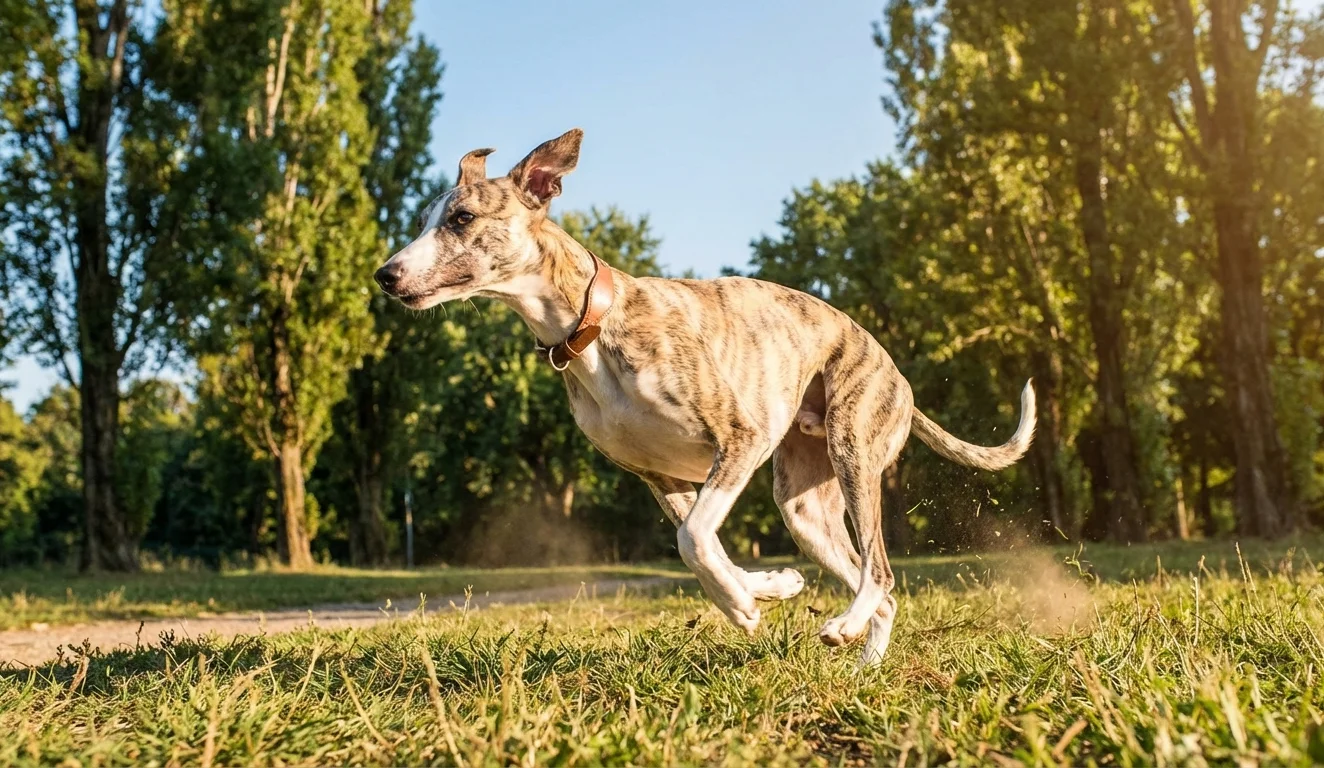
The Whippet stands 18-22 inches at the shoulder and weighs 25-40 pounds. They live 12-15 years. If you’ve ever watched a Greyhound lounging on a couch and thought, “I want that exact dog but in a slightly more portable size,” congratulations, the Whippet is your breed. They’re the Goldilocks of the sighthound world: bigger and sturdier than an Italian Greyhound, smaller and more manageable than a Greyhound, and just as capable of hitting 35 mph before collapsing dramatically onto the nearest soft surface.
In Short: 25–40 lbs, 12–15 years. High energy in bursts, low energy the rest of the time. Low shedding. Watch for Mitral Valve Disease and eye conditions. Best for active individuals or families who want a gentle, athletic, low-maintenance dog that doubles as a living blanket.
Whippets have a reputation problem, or rather, a perception problem. People see the lean, muscular build and assume they need hours of daily running. In reality, Whippets are sprinters, not marathon runners. They need about 60 minutes of exercise a day, and a decent chunk of that can be a flat-out sprint lasting roughly 90 seconds followed by a dramatic retirement to the couch. The rest of the day, they’re as lazy as any hound. They’re the fastest dogs you can comfortably keep in an apartment, and they’ll charm the socks off your neighbors while barely making a sound.
Whippet at a Glance
| Trait | Details |
|---|---|
| Breed Group | Hound (AKC) |
| Height | 18-22 in |
| Weight | 25-40 lbs |
| Life Expectancy | 12-15 years |
| Coat | Short, smooth, close |
| Colors | Any color or combination, black, white, fawn, blue, brindle, red, cream |
| Temperament | Gentle, Affectionate, Athletic |
| Shedding | Low |
| Energy Level | High (in bursts) |
| Good With Kids | Yes |
| AKC Recognition | 1888 |
History
The Whippet’s origin story is more blue-collar than you might expect from a dog that looks like it belongs in a Renaissance painting. While Greyhounds were the prized pets of English aristocracy (commoners were literally forbidden from owning them under medieval forest laws), Whippets were developed by working-class miners and mill workers in Northern England during the 18th and 19th centuries. They wanted a small, fast dog that could hunt rabbits for the dinner table and win weekend racing bets at the pub. So they crossed small Greyhounds with terriers and possibly Italian Greyhounds, and the Whippet was born.
The breed earned the nickname “the poor man’s racehorse.” On weekends, coal miners in Lancashire and Yorkshire would bring their Whippets to “rag races”, straight-track sprints where someone at the finish line would wave a rag or towel to lure the dog forward. These events became a fixture of working-class culture, complete with gambling, bragging rights, and the occasional fistfight over disputed finishes.
The AKC recognized the Whippet in 1888. Over the following century, the breed transitioned from working-class racer to show dog and family companion, but it never lost its speed. Modern Whippets still compete in lure coursing, straight racing, and agility. They’re also increasingly popular as pets, the AKC ranked them 61st in popularity in 2023, a steady climb that reflects growing awareness of just how easy and pleasant they are to live with.
Size and Appearance
Whippets are medium-sized dogs that look like they were designed by an aerospace engineer. Everything about their build is optimized for speed: deep chest (to house large lungs and heart), tucked-up waist, long legs, flexible spine, and a narrow, streamlined head. They carry virtually no excess body fat, which means, yes, you can see their ribs. This is normal. A Whippet with ribs you can’t see is probably overweight.
Males stand 19-22 inches at the shoulder. Females are 18-21 inches. Weight ranges from 25-40 pounds, though show dogs tend toward the lighter end and performance dogs can be more heavily muscled. Despite their lean look, Whippets are surprisingly muscular through the hindquarters and loin, the power that drives those 35 mph sprints has to come from somewhere.
The coat is short, smooth, and lies close to the body. It comes in literally any color or pattern. The AKC standard doesn’t disqualify any color, which is unusual and makes for a wildly diverse-looking breed. You’ll see solid blacks, solid whites, brindles, fawns, blues, reds, and every imaginable combination of patches and markings. The thin coat means Whippets get cold easily, a fleece coat in winter isn’t optional, it’s standard equipment.
Whippet Temperament
Living with a Whippet is a study in contradictions. They’re athletes who prefer napping. They’re fast enough to catch a rabbit but gentle enough to curl up with a toddler. They look dignified and regal until they start doing their “Whippet spin”, a full-body rotational celebration that happens every time you pick up their leash or open the treat bag.
What living with a Whippet is actually like:
- They’re velcro sighthounds. Whippets bond deeply with their people and want to be near you (or on you) at all times. They’re not as prone to separation anxiety as Italian Greyhounds, but they don’t love being left alone for 10-hour workdays. They’ll tolerate it better with a second dog for company.
- They’re gentle with everyone. Whippets are one of the gentlest breeds around. They’re patient with kids, polite with strangers (though sometimes shy at first), and generally non-confrontational with other dogs. Aggression is extremely rare in the breed.
- They have a serious prey drive. Squirrels, rabbits, cats (sometimes), small dogs (occasionally), anything small and fast-moving can trigger the chase instinct. This is non-negotiable sighthound behavior. A Whippet in prey-drive mode cannot hear your recall command. They’re moving at 35 mph and their brain has switched to a single channel: catch.
- They’re quiet. Whippets are one of the quietest breeds. They rarely bark, and when they do, it’s usually a soft “woof” rather than a full alert. This makes them outstanding apartment dogs. Your neighbors won’t even know you have one.
- They steal your furniture. Whippets believe all soft surfaces belong to them. Your couch, your bed, your favorite chair, these are Whippet property. Fighting this is futile. Embrace it.
Exercise Needs
Whippets need about 45-60 minutes of exercise per day, but the composition matters more than the duration. They need at least one opportunity to run, really run, full speed, several times per week. This means access to a fenced area (at least 5 feet tall, 6 feet preferred) where they can sprint.
The daily routine for most Whippet owners looks something like this: two 20-minute leash walks, plus either a backyard sprint session or a trip to a fenced dog park. On days they get to run, they’ll be couch vegetables for the rest of the day. On days they don’t, they might get a little antsy in the evening.
Lure coursing is phenomenal exercise for Whippets and taps directly into their breeding. Many local sighthound clubs offer “fun runs” where any sighthound (or sighthound mix) can chase a mechanical lure around a course. If there’s a lure coursing club near you, try it. Watching your Whippet run at full speed for the first time is a genuinely jaw-dropping experience.
One critical rule: never exercise a Whippet off-leash in an unfenced area. Their prey drive, combined with their speed, means they can be across a four-lane highway before you finish saying “come.” A long line (30-50 feet) on a harness is a reasonable compromise for open-field exercise, but it’s not the same as a secure fence.
Grooming
Whippets are absurdly low-maintenance in the grooming department.
- Weekly brushing with a rubber curry mitt or soft bristle brush, takes about 5 minutes
- Bath every 6-10 weeks (they don’t develop a strong “dog smell” due to the short coat and low oil production)
- Nail trims every 2-3 weeks: their long toes and hard nails grow quickly
- Dental care 3-4 times per week: standard brushing with enzymatic toothpaste
- Ear checks weekly: rose ears don’t trap moisture like floppy ears, so infections are uncommon
- No professional grooming needed
Shedding is minimal. Whippets have a single coat with no undercoat, so there’s no seasonal “blow” of fur. You’ll find the occasional short hair on dark clothing, but compared to, say, a Labrador or a Husky, a Whippet’s shedding is virtually invisible.
The thin coat and low body fat mean Whippets need protection from cold weather. Most Whippet owners have a wardrobe of coats for their dogs: a fleece for indoor use on cold days, a waterproof jacket for rainy walks, and an insulated coat for winter outings. This isn’t precious or silly, it’s temperature regulation for an animal with about 2% body fat.
Whippet Health Issues
Whippets are one of the healthier purebred dogs, with a lifespan of 12-15 years and relatively few breed-specific conditions. The OFA (Orthopedic Foundation for Animals) recommends cardiac, eye, and BRAF (a genetic mutation test) screening for breeding stock.
Mitral Valve Disease
Mitral valve disease (MVD) is the most common cardiac condition in Whippets. It involves degeneration of the mitral valve in the heart, leading to a murmur that can progress to congestive heart failure. A 2015 study in the Journal of Veterinary Internal Medicine found that Whippets have a higher incidence of MVD than the general dog population, though many affected dogs live normal lifespans with monitoring. Early detection through regular cardiac auscultation is key. Treatment (when needed) costs $1,500-$5,000 annually for medications. Surgical repair, when available, runs $15,000-$20,000.
Eye Conditions
Whippets are susceptible to several eye conditions, including progressive retinal atrophy (PRA) and cataracts. PRA causes gradual vision loss and eventual blindness, there’s no treatment, but genetic testing can identify carriers. Cataracts may be age-related or hereditary and can sometimes be corrected surgically ($2,500-$4,000 per eye). Annual eye exams by a veterinary ophthalmologist are recommended, particularly for breeding dogs.
Anesthesia Sensitivity
This isn’t a disease, but it’s something every Whippet owner and veterinarian needs to know. Sighthounds metabolize anesthesia differently than other breeds due to their low body fat and unique liver enzyme activity. Standard anesthesia protocols can be dangerous for Whippets. They’re sensitive to barbiturate-based anesthetics and require adjusted dosing for most sedatives and anesthetic agents. Make sure your vet is experienced with sighthounds or consults sighthound-specific anesthesia guidelines before any procedure.
Lacerations and Skin Tears
Whippets have extremely thin skin, literally thinner than most breeds. This makes them prone to cuts, tears, and scrapes from running through brush, playing rough, or catching on sharp objects. Most lacerations are minor and can be treated at home with wound care, but deeper tears may need veterinary attention and stitches ($200-$800 depending on severity). Many lure coursing Whippets wear protective body suits during competitions.
Training
Whippets are intelligent and eager to please, by sighthound standards. If you’re coming from a Golden Retriever or Border Collie, recalibrate your expectations. Whippets learn commands quickly but apply them selectively. They’ll sit beautifully in the kitchen when a treat is involved. They might not sit at all in the backyard when a squirrel is present.
Positive reinforcement is the only training approach that works with Whippets. They’re sensitive dogs that shut down under harsh corrections. Raised voices, leash jerks, and physical corrections will damage your relationship and produce a dog that avoids you rather than one that listens to you. Use treats, praise, and play.
Recall is the hardest command to train in a Whippet, and honestly, most Whippet owners accept that reliable off-leash recall in the presence of prey is not going to happen. You can (and should) train a solid recall in low-distraction environments, but trust it only inside a fenced area. A sighthound in pursuit mode is running on 5,000-year-old software that overrides your six weeks of obedience class.
Housetraining is significantly easier than with Italian Greyhounds. Most Whippets housetrain within a few weeks with consistent scheduling. Crate training works well for the breed, they’re natural den animals and take to crates quickly, especially if the crate contains a soft blanket (and it should always contain a soft blanket).
Cost
Purchase Price
A Whippet puppy from a reputable breeder costs $1,200-$2,500. Show-quality puppies from champion lines may reach $3,000+. Since the breed has fewer genetic health issues than many purebreds, the main things you’re paying for are cardiac and eye clearances on the parents, proper socialization, and a breeder who stands behind their dogs.
Retired racing Whippets and rescue Whippets are available through breed-specific rescues for $200-$500. Whippet rescue organizations do excellent work and are a great option if you’re open to an adult dog.
Monthly Costs
| Expense | Monthly Estimate |
|---|---|
| Food (medium breed, high-quality) | $40-$70 |
| Preventive vet care (averaged) | $20-$40 |
| Pet insurance | $30-$55 |
| Treats and chews | $15-$25 |
| Miscellaneous (coats, toys, supplies) | $10-$25 |
| Total | $115-$215 |
First-Year Costs
Beyond the purchase price, first-year costs run $1,800-$3,200. This includes vaccinations, spay/neuter ($200-$500, make sure your vet uses sighthound-appropriate anesthesia), a crate, bedding, leashes and harnesses, a collection of coats for various weather conditions, initial vet exams, and microchipping. Pet insurance is a smart investment given the potential for cardiac issues later in life.
Is a Whippet Right for You?
A Whippet could be a great fit if you:
- Want a gentle, quiet, low-maintenance dog
- Have access to a fenced area for off-leash sprinting
- Live in an apartment or small house (they’re ideal indoor dogs)
- Want a running partner for short sprints but not long-distance jogs
- Have kids, Whippets are patient and gentle with children of all ages
- Prefer a dog that doesn’t bark at every passing shadow
- Don’t mind sharing your couch, bed, and personal space
A Whippet is probably not right if you:
- Have cats or small pets and can’t manage prey drive risk (some Whippets coexist with cats, but it’s not guaranteed)
- Want a reliable off-leash hiking dog
- Live in an extremely cold climate and don’t want to deal with dog coats and winter reluctance
- Want an eager-to-please, obey-every-command dog (get a Lab)
- Need a guard dog or watchdog, Whippets are lovers, not fighters
- Are gone 10+ hours a day with no other pets for company
The Whippet community has a saying: “You can’t have just one.” There’s truth to it. Whippets are happier in pairs, and there’s something about living with one that makes you immediately start browsing breeder websites for a second. They’re that good. Quiet, clean, affectionate, athletic when you want them to be, lazy when you don’t, and small enough that two of them still take up less space than one Labrador. The poor man’s racehorse has become the smart person’s ideal companion.
Related Breeds
If you’re considering this breed, you might also want to look at:
Frequently Asked Questions
Are Whippets good apartment dogs?
Outstanding apartment dogs. They’re quiet (almost never bark), clean, compact, and don’t need a backyard. Their exercise needs can be met with daily walks and weekly trips to a fenced park for sprinting. Many urban Whippet owners report that their dogs are calmer and better-behaved indoors than most toy breeds. The main consideration is stair navigation, Whippets handle stairs fine, unlike some sighthounds that need to learn them.
Do Whippets get along with cats?
It depends entirely on the individual dog. Some Whippets live peacefully with cats, especially if raised together from puppyhood. Others have strong prey drive that makes cat coexistence dangerous. If you have cats and want a Whippet, look for breeders who raise puppies around cats, or work with a rescue that cat-tests their dogs. Even cat-friendly Whippets should be supervised initially, and never assume prey drive won’t kick in with an unfamiliar cat.
How fast can a Whippet run?
Whippets can reach 35 mph, making them the fastest breed for their weight. They’re actually faster than Greyhounds over short distances when adjusted for body size. They achieve this through a double-suspension gallop, a gait where all four feet leave the ground twice per stride. Peak speed is reached in just a few strides, and a typical sprint lasts 30-90 seconds before they’re ready to call it a day.
Do Whippets need a coat in winter?
Yes. Whippets have a thin single coat and very low body fat (around 2-5%), which means they lose body heat rapidly. Most Whippets are uncomfortable below 45 degrees Fahrenheit and need an insulated coat below 35 degrees. Many owners keep a lightweight fleece for indoor use on cold days and a waterproof insulated coat for outdoor walks. This isn’t pampering, it’s preventing hypothermia in a dog that’s physically incapable of retaining heat effectively.
Are Whippets hypoallergenic?
No dog is truly hypoallergenic, but Whippets are better tolerated by many allergy sufferers than most breeds. They have a short single coat, produce less dander, and don’t have the oily skin that exacerbates allergies in some breeds. They’re not Poodle-level low-allergen, but they’re in the better half of the spectrum. If you have mild allergies, spending time with a Whippet before committing is the only reliable way to know if you’ll react.