Irish Wolfhound Breed Guide: The Tallest Dog With the Shortest Time (2026)
Irish Wolfhounds are the tallest of all dog breeds, standing 30-35 inches at the shoulder with hearts as massive as their frames, and lifespans that break yours.
The Irish Wolfhound is the tallest dog breed in the world. Males stand a minimum of 32 inches at the shoulder (many reach 34-35 inches) and weigh 105-120 pounds. Females are at least 30 inches and 90-105 pounds. They live 6-8 years. That lifespan isn’t a typo, it’s the defining tension of owning this breed. You get a dog that’s gentle enough to sleep beside a toddler, dignified enough to make strangers stop on the sidewalk, and big enough to rest its head on your kitchen counter without stretching. You just don’t get nearly enough years with it.
In Short: 105–120 lbs, 6–8 years. Moderate energy. Moderate shedding. Watch for Dilated Cardiomyopathy and Osteosarcoma. Best for experienced owners with space who understand what a 6-8 year commitment means.
Irish Wolfhounds are one of those breeds that changes you. People who’ve owned one will tell you that no other dog compares, not because Wolfhounds do tricks or fetch the paper or guard your house, but because living with something that enormous and that gentle recalibrates your understanding of what a dog can be. They’re quiet. They’re dignified. They take up your entire couch. And when they look at you with those deep, calm eyes, you stop caring about the dog hair on everything you own.
Irish Wolfhound at a Glance
| Trait | Details |
|---|---|
| Breed Group | Hound (AKC) |
| Height | Males: 32+ in / Females: 30+ in |
| Weight | Males: 120 lbs min / Females: 105 lbs min |
| Life Expectancy | 6-8 years |
| Coat | Rough, wiry, medium-length |
| Colors | Gray, Brindle, Red, Black, White, Fawn, Wheaten |
| Temperament | Calm, Courageous, Dignified |
| Shedding | Moderate |
| Energy Level | Moderate |
| Good With Kids | Yes |
| AKC Recognition | 1897 |
History
The Irish Wolfhound is one of the oldest dog breeds in existence. References to large Irish hounds appear in Roman records dating to 391 AD, when the Roman consul Aurelius wrote about seven such dogs that “all Rome viewed with wonder.” In Ireland, they were called Cu Faoil and were so prized that ownership was restricted to kings and nobles. Laws in the medieval period dictated how many wolfhounds a person could own based on their social rank.
Their original job was exactly what the name says, hunting wolves. And elk. And wild boar. They hunted by sight and ran their quarry down with terrifying speed for a dog their size. They were so effective that they essentially hunted Irish wolves to extinction by the 1700s, which left the breed without a purpose. By the mid-1800s, the Irish Wolfhound itself was nearly extinct.
Captain George Augustus Graham, a Scottish officer in the British Army, is credited with saving the breed. Starting around 1862, he gathered the remaining Wolfhound-type dogs in Ireland and crossed them with Scottish Deerhounds, Great Danes, and Borzoi to rebuild the population. The Irish Wolfhound Club was founded in 1885, and the AKC recognized the breed in 1897. Every Irish Wolfhound alive today descends from Graham’s reconstruction program.
Size and Appearance
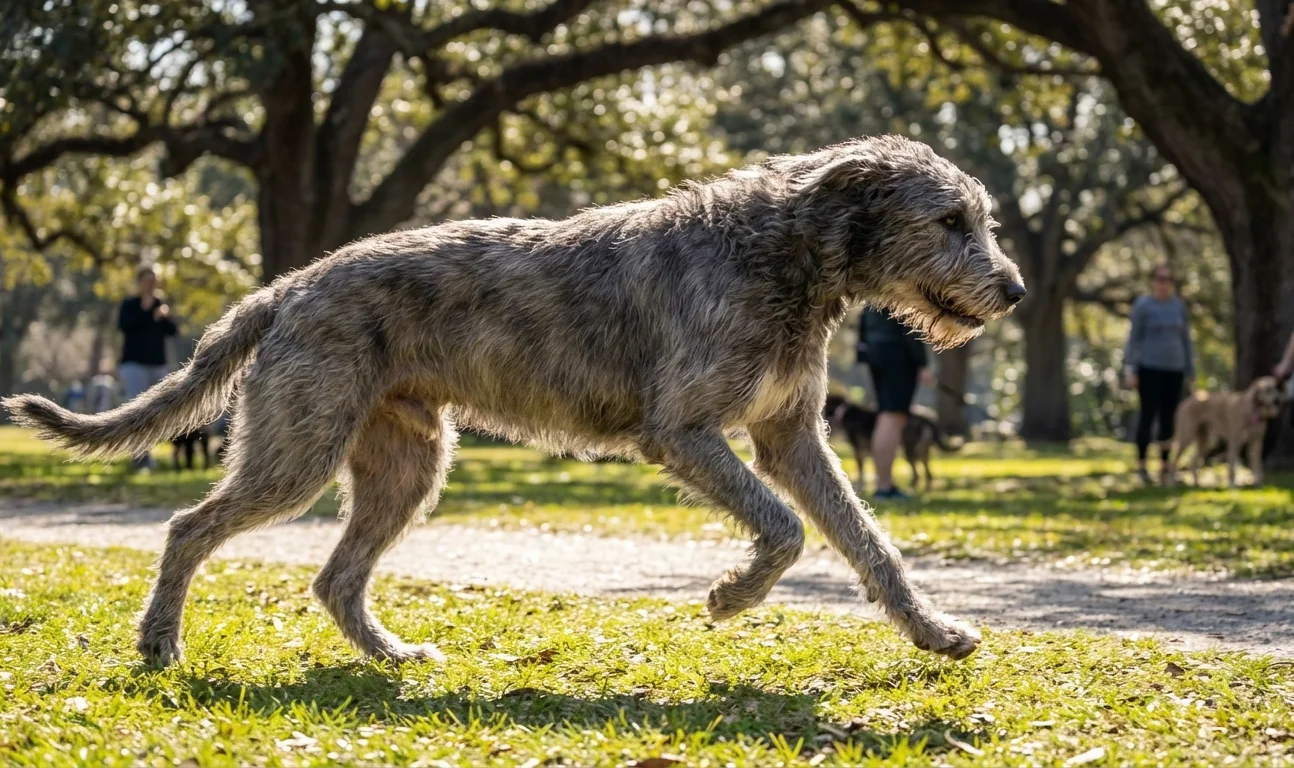
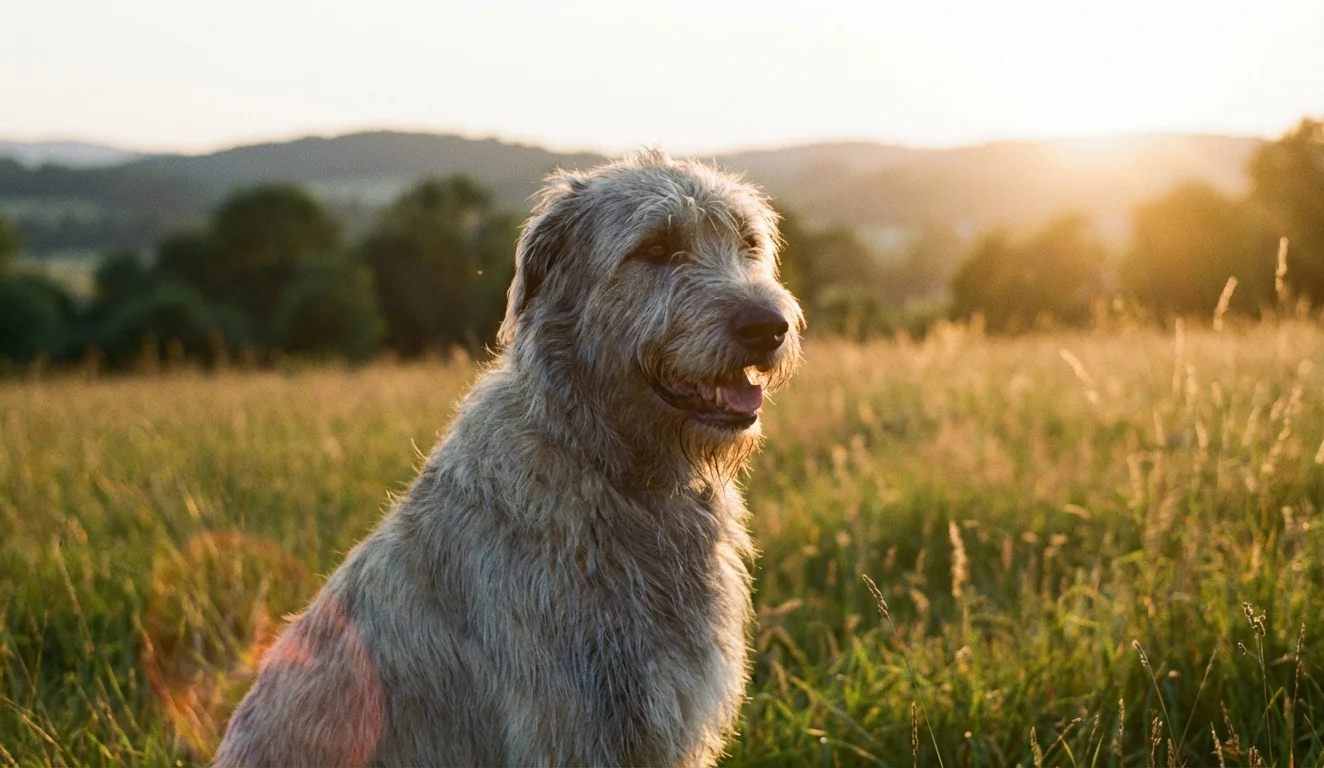
Irish Wolfhounds are tall in a way that photographs fail to capture. The AKC standard calls for males at 32 inches minimum and 120 pounds minimum, but most males are 34-35 inches and 140-180 pounds. Some reach 36 inches or more. When an Irish Wolfhound stands on its hind legs, it can easily exceed seven feet.
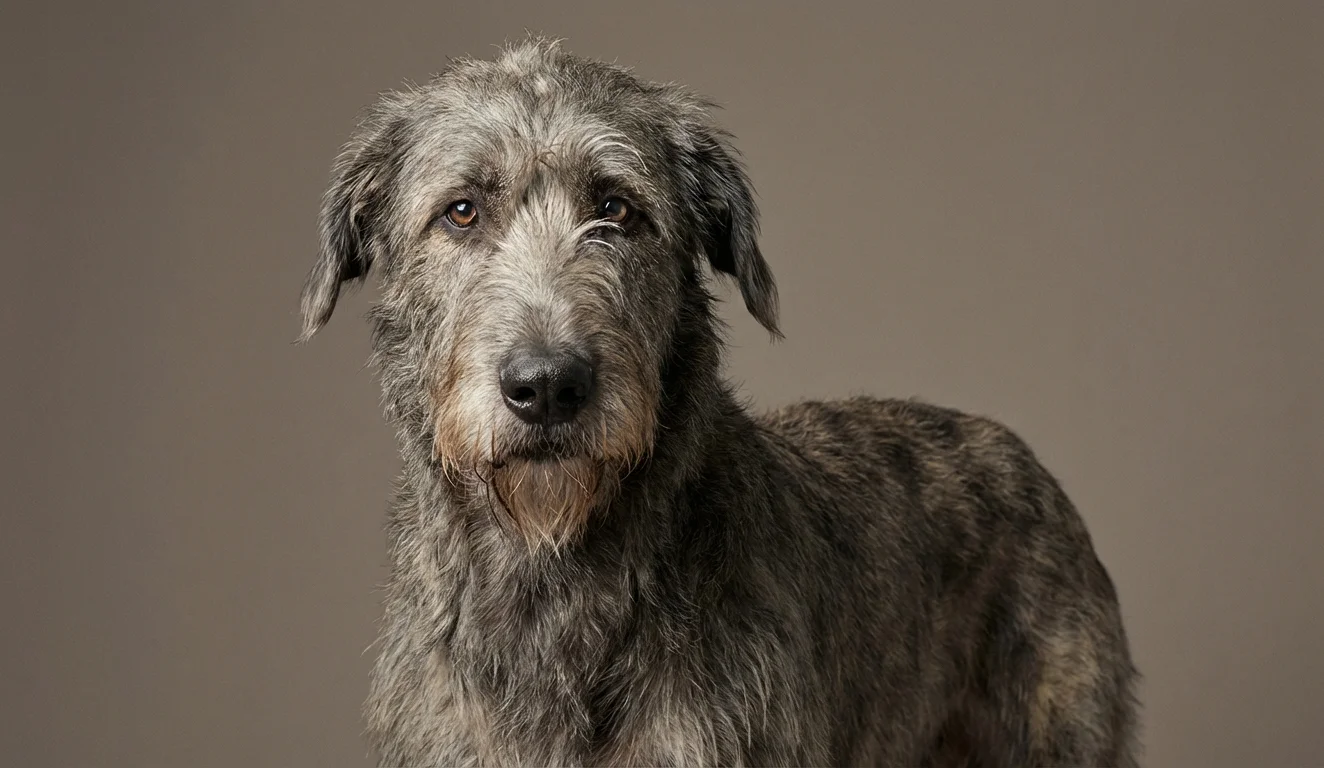
Despite the height, Wolfhounds shouldn’t look heavy or mastiff-like. They’re built for speed, long-legged, deep-chested, with a tucked-up abdomen and muscular hindquarters. Think of them as Great Danes with more substance and rougher coats. The overall impression should be of power and swiftness combined: a dog that could chase down a wolf across open ground and have enough strength to finish the job.
The coat is rough and wiry, particularly over the eyes and under the jaw, where it forms distinctive eyebrows and a beard. It’s harsh to the touch, not soft, and it needs hand-stripping rather than clipping to maintain proper texture. Colors range from gray (the most common) to brindle, red, black, fawn, and white.
Irish Wolfhound Temperament
The word that comes up most with Wolfhound owners is “gentle.” The second word is “dignified.” This is a breed that moves through life at its own pace, unbothered by small things, generous with affection, and surprisingly sensitive to the emotional temperature of the room.
What living with an Irish Wolfhound is actually like:
- They’re calm indoors. Despite their size, adult Wolfhounds are quiet, low-key house dogs. They pick a spot (usually your couch or your bed, regardless of whether you’ve invited them) and settle in. Puppies are a different story, a Wolfhound puppy going through a growth spurt is a clumsy, destructive force of nature.
- They don’t bark much. Wolfhounds are among the quietest breeds. They’ll alert-bark if someone approaches the door, but they’re not nuisance barkers. Their deep, resonant bark is impressive when it does happen.
- They’re terrible guard dogs. An Irish Wolfhound’s response to a stranger is usually polite interest or indifference. They’re not suspicious, territorial, or aggressive toward people. Their size is intimidating, but their temperament is about as threatening as a throw pillow.
- They bond deeply. Wolfhounds form strong attachments and don’t handle isolation well. They’re not the breed for someone who works 12-hour days and leaves the dog home alone. Separation anxiety is common.
- They’re good with kids. Their patience is genuine, not just tolerance. But their size means they can accidentally knock over small children just by turning around, so supervision is non-negotiable.
Exercise Needs
Irish Wolfhounds need about 40-60 minutes of exercise per day, split between walks and off-leash time in a fenced area. They’re not high-energy dogs by any stretch, but they’re not couch-only dogs either.
Puppies need extremely careful exercise management. Wolfhound puppies grow at an alarming rate, some gain 2-3 pounds per week through their first year. Their bones, joints, and growth plates are vulnerable during this period. The Irish Wolfhound Club of America recommends no forced exercise (running alongside a bike, long hikes, repetitive jumping) until at least 18-20 months old. Free play in a yard on soft ground is the safest option for puppies.
Adult Wolfhounds enjoy a good run in a fenced area. The key word is “fenced”, these are sighthounds, and if they spot a rabbit or squirrel, they’ll chase it. They can hit 35 mph, and once they’re in pursuit, they’re not coming back when you call. A six-foot fence is the minimum for a Wolfhound yard, and even that’s marginal for some individuals.
Grooming
Irish Wolfhounds are moderate-maintenance groomers. The wiry coat doesn’t mat as badly as a soft-coated breed, but it does need regular attention.
- Brush 2-3 times per week with a slicker brush and metal comb
- Hand-strip or pluck dead coat 2-3 times per year (clipping softens the coat texture and is frowned upon by breed purists, but it won’t harm the dog)
- Bathe every 6-8 weeks: this is a production given the dog’s size. Plan to use your walk-in shower or a self-service dog wash
- Trim the beard and eyebrows as needed to keep them from getting food-crusted
- Nail trims every 2-3 weeks
- Check and clean ears weekly
Shedding is moderate year-round, with heavier shedding in spring and fall. You’ll find wiry gray hairs on your clothing, furniture, and in your food. It’s the price of admission.
Irish Wolfhound Health Issues
This section is hard to write. Irish Wolfhounds have one of the shortest lifespans of any breed, and the health challenges are significant. A 2011 health survey by the Irish Wolfhound Club of America found a median lifespan of just 6.5 years. If you’re considering this breed, go in with your eyes open.
Dilated Cardiomyopathy (DCM)
DCM is the leading killer of Irish Wolfhounds. Studies vary, but prevalence estimates range from 25-40% of the breed population. A 2017 study published in the Journal of Veterinary Internal Medicine found that by age 4.5, approximately 24% of Irish Wolfhounds had developed echocardiographic evidence of DCM, and the number climbed with age. The heart muscle weakens, the chambers enlarge, and eventually the heart can’t pump effectively. Treatment costs $3,000-$10,000 and focuses on management (pimobendan, ACE inhibitors, diuretics) rather than cure. Annual cardiac screening via echocardiogram is strongly recommended starting at age 2.
Osteosarcoma (Bone Cancer)
Irish Wolfhounds have one of the highest rates of osteosarcoma of any breed. It typically appears in dogs over age 5 and most often affects the long bones of the legs. The first sign is usually sudden lameness. Treatment involves amputation of the affected limb followed by chemotherapy ($5,000-$12,000), but even with treatment, median survival is only 10-12 months. This is the second leading cause of death in the breed.
Bloat (Gastric Dilatation-Volvulus)
Like all deep-chested giant breeds, Irish Wolfhounds face a high risk of bloat. The stomach fills with gas, potentially twists, and blood supply is cut off. Without emergency surgery, it’s fatal within hours. Surgery costs $2,500-$7,500. Prophylactic gastropexy, surgically tacking the stomach to the abdominal wall, is widely recommended by Wolfhound breeders and can be done at the time of spay/neuter.
Pneumonia
Irish Wolfhounds are unusually susceptible to pneumonia compared to other breeds. A 2016 study in the Journal of Veterinary Internal Medicine identified a genetic predisposition in the breed. Symptoms include coughing, lethargy, fever, and difficulty breathing. Treatment costs $1,500-$5,000 depending on severity and hospitalization needs.
Liver Shunt (Portosystemic Shunt)
Irish Wolfhounds have a higher-than-average incidence of portosystemic liver shunts, where blood bypasses the liver. This can be congenital or acquired. Surgical correction costs $3,000-$8,000. Genetic testing of breeding stock has helped reduce the incidence.
Training
Irish Wolfhounds are intelligent but independent. They were bred to make decisions on the hunt without human direction, and that independence shows up in training. They understand what you’re asking, they just might not see the point of doing it repeatedly.
Positive reinforcement works well. Harsh methods will cause a Wolfhound to shut down entirely. They’re sensitive dogs that respond to tone of voice and want to please their people, but they’re not going to obsessively repeat behaviors for treats the way a Labrador will.
Leash training is critical and needs to start early. A 150-pound sighthound that lunges at a squirrel will pull you off your feet. Teach loose-leash walking before they outgrow your ability to physically manage them, which happens around 4-5 months.
Socialization should expose Wolfhound puppies to a wide range of surfaces, sounds, people, and environments. Their size means that a fearful adult Wolfhound is unmanageable, you can’t pick up and carry a 140-pound dog that’s panicking. Build confidence early through positive exposure.
Cost
Purchase Price
An Irish Wolfhound puppy from a reputable breeder costs $1,500-$3,000. Show-quality puppies from health-tested parents can reach $3,000-$5,000. This is a breed where cutting corners on the breeder is a particularly bad idea, a well-bred Wolfhound from health-tested lines might live 8-9 years, while a poorly-bred one might not see 5.
Monthly Costs
| Expense | Monthly Estimate |
|---|---|
| Food (giant breed formula) | $80-$150 |
| Preventive vet care (averaged) | $25-$60 |
| Pet insurance | $60-$120 |
| Treats and chews | $15-$30 |
| Miscellaneous (toys, supplies) | $15-$30 |
| Total | $195-$390 |
First-Year Costs
Between the purchase price, giant-breed crate ($150-$300), puppy vaccinations and deworming, spay/neuter (with prophylactic gastropexy), microchip, and initial supplies, expect first-year costs of $4,500-$9,000 beyond the purchase price. Pet insurance is strongly recommended for this breed, a single osteosarcoma diagnosis or DCM treatment can cost $10,000+.
Is an Irish Wolfhound Right for You?
An Irish Wolfhound could be a great fit if you:
- Want a calm, gentle, dignified dog that’s genuinely good with children and other pets
- Have a home with space, a fenced yard is strongly preferred, and that fence needs to be at least six feet tall
- Accept and understand the short lifespan (this is the hardest part, and it needs to be an informed decision, not a surprise)
- Can afford giant breed ownership costs and potential medical expenses
- Are home enough to provide companionship, Wolfhounds need their people
- Appreciate a dog that’s quiet, unhurried, and emotionally attuned to you
An Irish Wolfhound is probably not right if you:
- Want a dog that’ll be with you for 12-15 years
- Need a guard dog or protection dog (they look the part, but they won’t play it)
- Live in a small apartment without yard access
- Are on a tight budget, between food, vet bills, and insurance, this is one of the most expensive breeds to own
- Want an off-leash hiking companion (sighthound instincts make reliable off-leash recall extremely difficult)
- Can’t handle heavy emotional loss, losing a Wolfhound at 6 or 7 years old is devastating, and it happens more often than anyone wants to admit
The Irish Wolfhound community has a saying: “Heartbreak on four legs.” They mean it with love. These dogs give you something no other breed quite matches, a presence, a calm, a way of being that feels ancient and earned. The trade-off is that you never get enough time. People who’ve owned one say they’d do it again in a heartbeat. People who’ve owned two say they couldn’t imagine life without one.
Related Breeds
If you’re considering this breed, you might also want to look at:
Frequently Asked Questions
How big do Irish Wolfhounds get?
The AKC standard sets minimums at 32 inches and 120 pounds for males, 30 inches and 105 pounds for females. But “minimum” is the key word, most males are 34-35 inches and 140-180 pounds. Some individuals exceed 36 inches at the shoulder and 200 pounds, though dogs at the extreme end of the size range often have more health problems. When standing on their hind legs, a large male Wolfhound can reach seven feet or more.
Are Irish Wolfhounds good with cats?
It depends entirely on the individual dog and how it’s raised. Irish Wolfhounds are sighthounds, they were bred to chase and kill prey by sight. Some Wolfhounds coexist peacefully with household cats (especially if raised together from puppyhood), while others will chase anything that runs. The Irish Wolfhound Club of America recommends careful introduction and supervision. Even a Wolfhound that’s fine with your cat indoors may chase a neighbor’s cat that bolts across the yard.
Do Irish Wolfhounds need a lot of exercise?
Less than you’d think. Adult Wolfhounds are content with 40-60 minutes of daily exercise, a couple of walks and some off-leash time in a fenced area. They’re moderate-energy dogs that enjoy lounging as much as moving. The bigger concern is exercise restriction for puppies: Wolfhound puppies should avoid forced exercise (running, jumping, stairs) until their growth plates close at 18-20 months. Over-exercising a growing Wolfhound puppy can cause serious orthopedic problems.
How much do Irish Wolfhounds eat?
An adult Irish Wolfhound eats 4-8 cups of food per day, depending on their size, activity level, and the calorie density of the food. That translates to roughly $80-$150 per month for a quality giant breed formula. Wolfhound puppies need giant breed puppy food specifically, the controlled calcium-to-phosphorus ratio helps manage their rapid growth rate and reduces the risk of developmental bone disorders.
Why do Irish Wolfhounds have such short lifespans?
The short answer is size. Giant breeds age faster at a cellular level than smaller dogs. A 2013 study published in The American Naturalist found that large dogs age at an accelerated rate and that “their lives seem to unwind in fast motion.” In Wolfhounds specifically, dilated cardiomyopathy and cancer (especially osteosarcoma) are the primary causes of death. Responsible breeders are working to extend lifespans through cardiac screening, cancer research, and genetic diversity programs, but progress is slow.