Great Pyrenees Breed Guide: A 100-Pound Dog with a Mind of Its Own (2026)
The Great Pyrenees is a gentle, independent guardian that weighs up to 100+ pounds and was literally bred to make decisions without human input. That's either a feature or a bug depending on your personality.
The Great Pyrenees is a large to giant working breed that weighs 85-100+ pounds (males often exceed 115 pounds), stands 25-32 inches tall, and lives 10-12 years. Originally bred to guard livestock in the Pyrenees Mountains between France and Spain, this is a dog that spent centuries making independent decisions on mountainsides, and they haven’t stopped.
In Short: 85–130 lbs, 10–12 years. Low energy indoors, alert outdoors. Heavy shedder with seasonal blowouts. Watch for Hip Dysplasia and Bloat. Best for experienced owners with space and patience for an independent thinker.
The Great Pyrenees is a paradox wrapped in a massive white coat. Indoors, they’re calm, gentle, and happy to spend hours sprawled across your floor like a polar bear rug. Outdoors, especially at night, they transform into a vigilant guardian who barks at anything that moves, sniffs, or exists within a two-mile radius. If you want a dog that comes when called every time, listens to every command, and defers to your judgment, this is absolutely not your breed. But if you want a calm, majestic, fiercely loyal companion who happens to think they know better than you most of the time? Welcome to Pyr ownership.
Great Pyrenees at a Glance
| Trait | Details |
|---|---|
| Breed Group | Working (AKC) |
| Height | Males: 27-32 in / Females: 25-29 in |
| Weight | Males: 100-130 lbs / Females: 85-115 lbs |
| Life Expectancy | 10-12 years |
| Coat | Long, thick double coat with weather-resistant outer layer |
| Colors | White, White with markings of Gray, Badger, Reddish Brown, or Tan |
| Temperament | Patient, Calm, Strong-Willed |
| Shedding | Very Heavy |
| Energy Level | Low to Moderate |
| Good With Kids | Yes (gentle with family) |
| AKC Recognition | 1933 |
History
The Great Pyrenees has been guarding livestock in the Pyrenees Mountains for at least 3,000 years, with fossil remains of similar dogs dating back to 1800 B.C. These dogs were bred by Basque shepherds to live with flocks of sheep, not herd them, but protect them from wolves, bears, and livestock thieves. The dog stayed with the flock, often for days at a time without human supervision, and made its own decisions about threats. This origin story explains about 90% of the breed’s personality.
By the 17th century, the Great Pyrenees had caught the attention of French nobility. Louis XIV declared them the Royal Dog of France in 1675, and they became fashionable guard dogs at French chateaux. General Lafayette brought Great Pyrenees to the United States in 1824, gifting two males to J.S. Skinner, who wrote about them enthusiastically. But the breed didn’t gain a real foothold in America until the 1930s.
The AKC recognized the Great Pyrenees in 1933. Today, they’re still used as working livestock guardian dogs on farms and ranches across the US, while simultaneously being popular as family companions. That dual identity, working guardian and family pet, creates some of the biggest misunderstandings about the breed. A Pyr raised on a ranch and a Pyr raised in a suburban home are the same dog genetically, but the expectations around them couldn’t be more different.
Size and Appearance
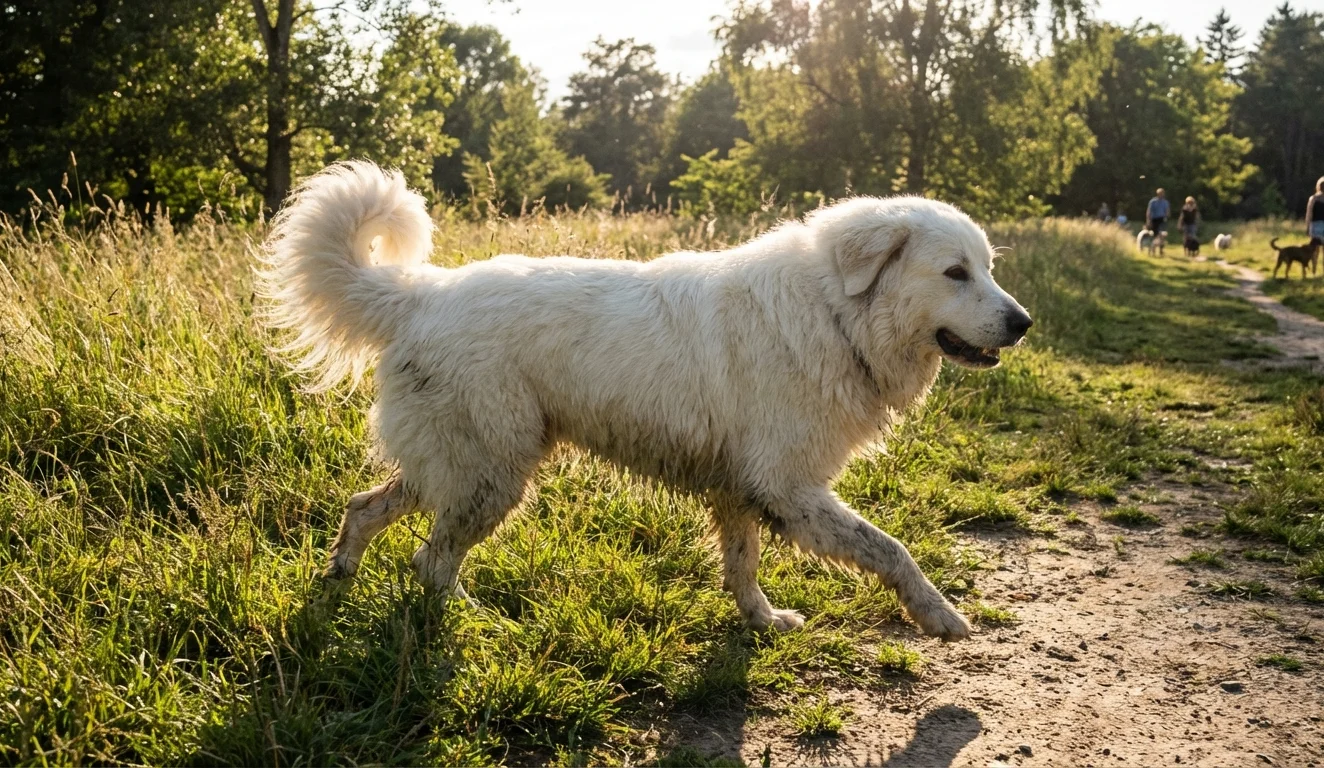
Great Pyrenees are big, and they look even bigger than they are. Males stand 27-32 inches at the shoulder and weigh 100-130 pounds. Females are 25-29 inches and 85-115 pounds. But that thick white coat adds substantial visual bulk, a wet Great Pyrenees is a noticeably smaller dog than a dry one.
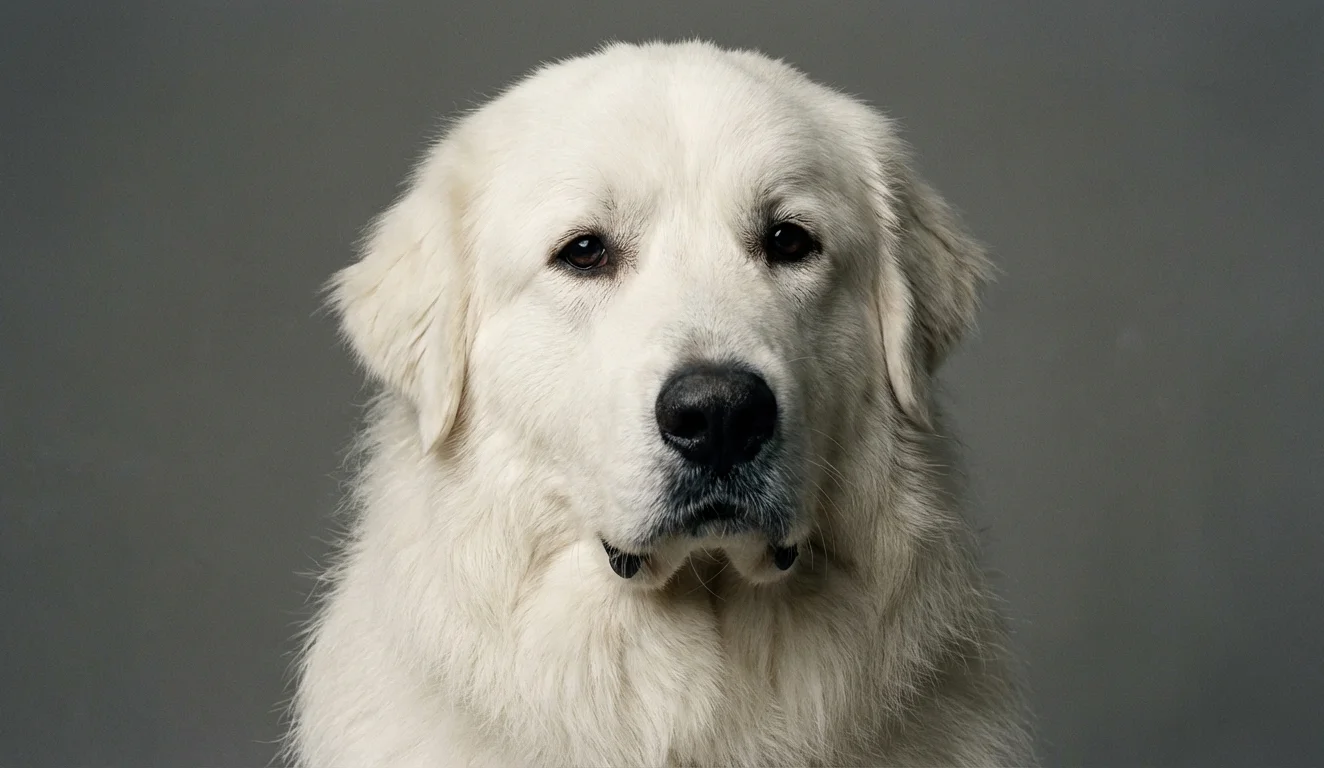
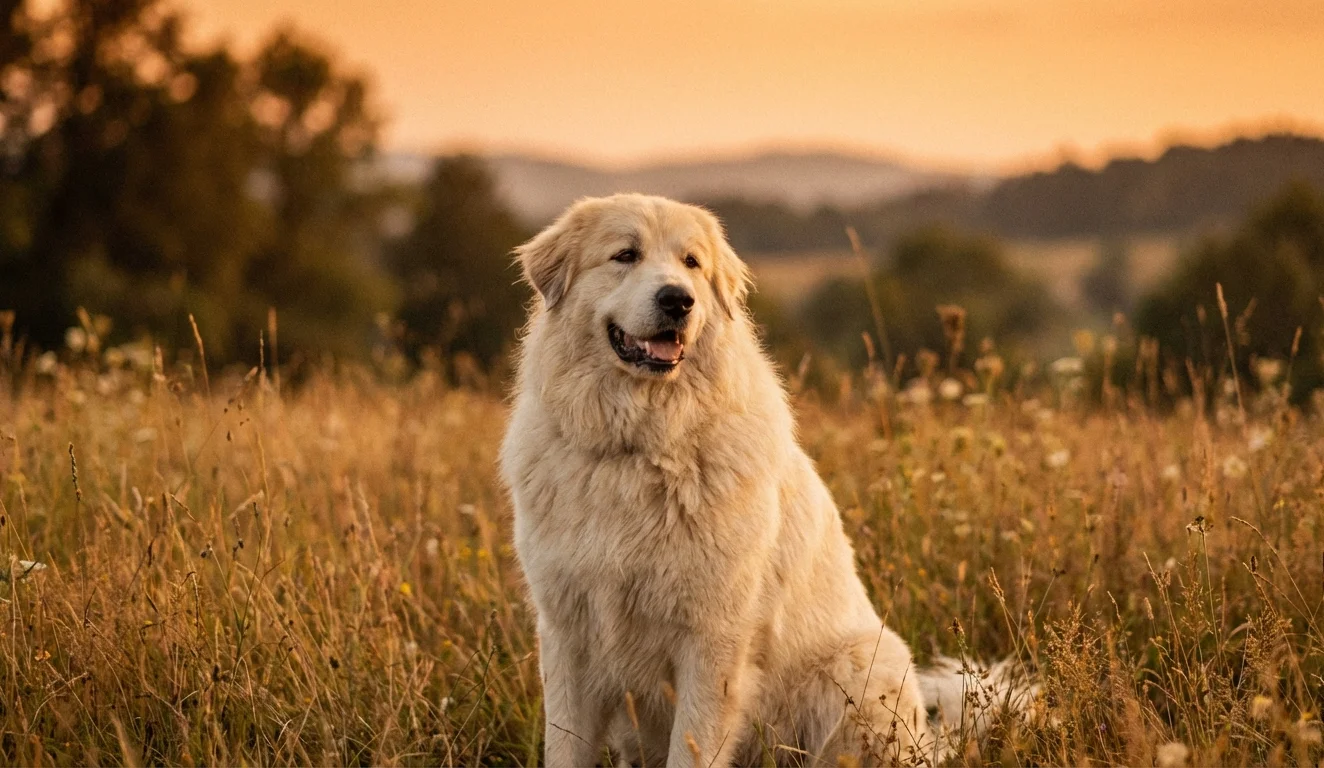
The overall impression is one of elegant strength. Pyrs have a wedge-shaped head with a slightly rounded crown, dark brown almond-shaped eyes that convey intelligence and calm, and medium-sized V-shaped ears that lie flat against the head. The expression should be what the breed standard calls “contemplative”, and it genuinely is. Great Pyrenees always look like they’re thinking about something important.
Their coat is the breed’s most striking feature. A thick, weather-resistant outer coat of long, flat hair covers a dense woolly undercoat. The coat is predominantly white, though markings of gray, badger, reddish brown, or tan are common, usually concentrated around the face, ears, and base of the tail. Some Pyrs are solid white. Others look like someone lightly dusted them with cinnamon. The double dewclaws on the rear feet are a distinctive breed trait, most breeds have them removed, but in the Great Pyrenees they’re required by the breed standard and served to provide extra traction on mountain terrain.
Great Pyrenees Temperament
The breed standard says “confident, gentle, and affectionate.” Pyr owners would add: “stubborn, nocturnal, and convinced they’re always right.”
Great Pyrenees were bred to guard without human direction. That breeding created a dog that’s calm, patient, and genuinely gentle with the creatures in their care, but also one that evaluates situations independently and acts on their own judgment. When a Pyr ignores your recall command, they’re not being disobedient in the way a teenage Lab might be. They’ve assessed the situation, determined that what you’re asking doesn’t align with their current priorities, and made an executive decision. It’s infuriating and oddly impressive at the same time.
What Pyr ownership actually looks like:
- Barking. So much barking. Great Pyrenees are nocturnal barkers. In their working context, nighttime is when predators are most active, so Pyrs are hardwired to patrol and alert after dark. In a suburban context, this means your neighbors will hear about every passing car, distant siren, and suspicious leaf. This is the number one reason Pyrs end up in rescue.
- The Pyr paw. Great Pyrenees have a signature move where they place a massive paw on your arm, lap, or face. It’s their way of demanding attention, and it’s surprisingly forceful. That paw is roughly the size of a human hand.
- They’re gentle with small creatures. Pyrs that are raised with children, cats, and small dogs are typically wonderful with them. That guardian instinct extends to anyone they consider part of their flock.
- Escape artistry runs deep. Great Pyrenees are notorious for getting out of fences. A six-foot fence is a suggestion. They’ll dig under, climb over, or simply lean against a weak section until it gives. If you have a Pyr, your fence needs to be Pyr-proof, which is its own engineering challenge.
Exercise Needs
Great Pyrenees need about 30-45 minutes of moderate exercise per day. They’re not high-energy dogs in the traditional sense, they won’t pester you for fetch marathons. But they do need daily walks and mental stimulation, and they absolutely need outdoor time to satisfy that patrol instinct.
Good exercises for Great Pyrenees:
- Leashed walks. One or two moderate walks per day. Pyrs walk at a dignified pace and prefer to stop and observe things along the way. Speed is not their priority.
- Yard time with purpose. A large, securely fenced yard where the Pyr can patrol is ideal. They’ll walk the perimeter, check the fence line, and monitor the neighborhood. This is exercise for them even if it doesn’t look like much.
- Cart pulling. Great Pyrenees were used as pack animals in the mountains, and many enjoy carting or pulling activities as adults. It’s low-impact and plays to their strength.
- Cool-weather hikes. Pyrs are mountain dogs, and they love a good trail walk in cooler temperatures. Avoid heat, that thick coat is a serious liability above 75 degrees.
The biggest exercise mistake people make with Pyrs is under-exercising them and then wondering why they bark all night. A Pyr that gets adequate physical activity and mental engagement during the day is significantly calmer at night. Not quiet, let’s be realistic, but calmer.
Grooming
The Great Pyrenees coat is designed to be self-maintaining in a mountain environment, but in your living room, it requires regular attention. Brush at least twice a week with a slicker brush and an undercoat rake. This prevents matting, particularly behind the ears, on the chest, and in the “pants” area around the rear legs.
The coat blows out heavily twice a year, and during those blowout periods, you’ll need to brush daily. The volume of fur a Great Pyrenees can produce during a spring blowout is genuinely astonishing, you could knit a second dog from what comes off the brush in a single session.
Baths every 6-8 weeks or as needed. Despite the white coat, Pyrs actually stay surprisingly clean, their outer coat has a slight oily texture that repels dirt. Many Pyr owners report that dried mud literally falls off the coat on its own. Trim nails every 2-3 weeks, paying special attention to the double dewclaws on the rear legs, which don’t wear down naturally and can curl into the pad if neglected.
Never shave a Great Pyrenees. That double coat insulates against both cold and heat, and shaving can permanently damage the coat texture. It also removes their sun protection, Pyrs have pink skin under that white fur, and they’re susceptible to sunburn.
Great Pyrenees Health Issues
The Great Pyrenees is a reasonably healthy breed for its size, with a lifespan of 10-12 years. That’s solid for a dog that regularly exceeds 100 pounds. But they have some breed-specific health concerns you should be aware of.
Hip Dysplasia
The OFA reports that Great Pyrenees have a moderate incidence of hip dysplasia, where the hip joint doesn’t develop properly, leading to arthritis and mobility issues. This is common in large and giant breeds. Treatment ranges from weight management and physical therapy for mild cases to total hip replacement for severe cases, costing $1,500-$7,000. Breeders should provide OFA hip evaluations for both parents.
Bloat (Gastric Dilatation-Volvulus)
Like all deep-chested giant breeds, Great Pyrenees are at elevated risk for bloat, a life-threatening emergency where the stomach fills with gas and can twist on itself. Symptoms include a distended abdomen, unproductive retching, excessive drooling, and restlessness. Emergency surgery costs $2,000-$7,500. Preventive gastropexy during spay/neuter costs $400-$800 and is worth serious consideration.
Patellar Luxation
The OFA notes moderate prevalence of patellar luxation in the breed, where the kneecap dislocates from its normal position. Mild cases may not require intervention, but surgical correction for severe cases runs $1,500-$3,500 per knee.
Osteosarcoma (Bone Cancer)
Great Pyrenees, like many giant breeds, have an elevated risk of osteosarcoma. This aggressive bone cancer typically appears in the leg bones of dogs over 7 years old. Symptoms include persistent lameness and swelling. Treatment, which usually involves amputation followed by chemotherapy, costs $5,000-$10,000. Early detection improves outcomes but doesn’t change the overall prognosis dramatically. Median survival time with treatment is about 10-12 months.
Degenerative Myelopathy
A progressive neurological disease affecting the spinal cord, causing gradual loss of coordination and mobility in the hind legs. DNA testing can identify carriers. There’s no cure, but physical therapy can slow progression. Testing costs about $50-$150, and management runs $200-$500 monthly for physical therapy.
Training
Training a Great Pyrenees is an exercise in managing expectations. They’re intelligent. They understand what you’re asking. They just don’t always agree that it’s a good idea. This isn’t the same as a stubborn bulldog who doesn’t get it, the Pyr gets it just fine. They’ve simply made a different decision.
What works with Great Pyrenees:
- Patience. More patience. Getting frustrated with a Pyr accomplishes nothing. They’ll either ignore your frustration or shut down entirely. Calm persistence is the only approach that works.
- Reward-based training. Pyrs are moderately food-motivated, but they respond better to praise and calm approval than to frantic enthusiasm. Think “respectful appreciation” rather than “party.”
- Accepting good enough. A Great Pyrenees with solid recall, reliable basic commands, and good leash manners is a well-trained Pyr. If you’re hoping for off-leash obedience, you’ll be disappointed.
- Early socialization is critical. A Great Pyrenees that isn’t exposed to a variety of people, animals, and situations as a puppy can become overly suspicious and reactive. Their guardian instinct needs guidance, not suppression.
The bark is the hardest training challenge. You can teach a Pyr the “quiet” command, and they’ll learn it, but expecting them to stop barking at nighttime noises entirely is like expecting a retriever not to retrieve. You’re fighting 3,000 years of breeding. Management (bringing them inside at night, white noise machines for neighbors) is more realistic than elimination.
Cost
Purchase Price
A Great Pyrenees puppy from a reputable breeder costs $1,200-$2,500. Working-line Pyrs from farms may be available for less, sometimes $500-$1,000, though they may not come with health clearances.
Great Pyrenees are one of the most common breeds in shelters, particularly in rural areas. Rescue adoption typically costs $200-$500. Many of these dogs are young adults surrendered because their owners weren’t prepared for the barking, the size, or the independence.
Monthly Costs
| Expense | Monthly Estimate |
|---|---|
| Food (high-quality, large/giant breed) | $70-$120 |
| Preventive vet care (averaged) | $25-$50 |
| Pet insurance | $45-$80 |
| Treats and chews | $15-$30 |
| Miscellaneous (toys, supplies) | $15-$30 |
| Total | $170-$310 |
First-Year Costs
Budget $3,500-$7,000 for your first year with a Great Pyrenees. This includes purchase price, initial vet visits, vaccinations, spay/neuter, a heavy-duty crate (they outgrow standard large crates), and the inevitable fence reinforcement project.
Is a Great Pyrenees Right for You?
A Great Pyrenees is a great fit if you:
- Have a large, securely fenced yard (six-foot minimum, reinforced at the base)
- Live in a rural or semi-rural area where nighttime barking won’t cause neighbor disputes
- Want a calm, gentle companion who’s wonderful with kids and small animals
- Appreciate independent thinking and can find humor in a dog that occasionally overrules you
- Don’t mind heavy shedding and a fur-covered house
- Have experience with large, independent breeds
A Great Pyrenees is probably NOT right if you:
- Live in an apartment, condo, or house with close neighbors (the barking will be a problem)
- Want a dog that comes when called reliably off-leash
- Live in a hot climate without excellent cooling options
- Want a dog-park dog (Pyrs can be dog-selective, particularly with unfamiliar dogs approaching their space)
- Expect immediate obedience to commands
- Aren’t prepared for the costs of giant breed ownership
Great Pyrenees people are a specific type. They appreciate the breed’s calm dignity, love the guardian instinct, and have made peace with the barking and the independence. If that sounds like you, a Pyr will be one of the most devoted, gentle, impressive dogs you’ll ever share your life with. Just make sure your fence is solid.
Related Breeds
If you’re considering this breed, you might also want to look at:
FAQ
Why does my Great Pyrenees bark so much at night?
It’s not a behavioral problem, it’s breed programming. Great Pyrenees were bred to guard livestock from nocturnal predators, and alerting to nighttime disturbances is literally their job. You can reduce it by bringing them inside at night, providing adequate exercise during the day, and teaching the “quiet” command. You cannot eliminate it entirely. If nighttime barking is a dealbreaker for you or your neighbors, this breed is not a good match.
Can Great Pyrenees live in warm climates?
They can, but it requires accommodation. Great Pyrenees have a thick double coat designed for mountain winters, and they’re heat-sensitive. In warm climates, limit outdoor time during peak heat, provide shade and constant water access, keep your home well air-conditioned, and exercise only during cooler parts of the day. Never shave the coat, it provides insulation from heat as well as cold.
Are Great Pyrenees good with other dogs?
Generally yes, especially with dogs they’ve been raised with or that are smaller than them. Their guardian instinct tends to make them protective of household pets rather than aggressive. But Pyrs can be territorial with unfamiliar dogs that approach their property, and same-sex aggression can occur. Introductions should be done carefully and on neutral ground.
How much does a Great Pyrenees eat?
An adult Great Pyrenees eats 4-6 cups of high-quality dry food per day, split into two meals. Despite their size, they’re not the heaviest eaters among giant breeds, their metabolism is relatively efficient. Feeding two smaller meals rather than one large one helps reduce bloat risk. Budget $70-$120 per month for quality food.
Do Great Pyrenees wander?
Yes. Great Pyrenees have a strong instinct to patrol a large territory, and if your fence has any weakness, they’ll find it. This isn’t running away, it’s a dog expanding its patrol range. Electronic fences are generally ineffective with this breed because their pain tolerance and determination exceed the correction. Physical fencing, at least six feet tall with buried wire or concrete at the base, is the only reliable containment.