
St. Bernard Breed Guide: 180 Pounds of Drool, Love, and Short Life (2026)
St. Bernards are gentle giants that weigh up to 180 pounds and have hearts even bigger than that. But the short lifespan is something you need to prepare for.
The St. Bernard is a giant breed that weighs 120-180 pounds, stands 26-30 inches tall, and lives 8-10 years. That last number is the one that stops people. Eight to ten years is not a lot of time with a dog, and it’s the hardest truth about this breed. You’re going to fall in love with a dog the size of a small couch, and you’re going to have to say goodbye sooner than you want to.
In Short: 120–180 lbs, 8–10 years. Moderate energy. Heavy shedder, expect fur everywhere. Watch for Hip Dysplasia and Elbow Dysplasia. Good with kids, but better for experienced owners.
We still think St. Bernards are worth it. There’s something about a 160-pound dog with the temperament of a sleepy teddy bear that defies logic, they shouldn’t be this gentle, this patient, this good with kids at that size. But they are. The St. Bernard is proof that the biggest dogs are often the softest ones. Just know what you’re signing up for: the vet bills, the drool (so much drool), the food costs of feeding a dog that outweighs most adult humans, and a lifespan that will break your heart.
St. Bernard at a Glance
| Trait | Details |
|---|---|
| Breed Group | Working (AKC) |
| Height | Males: 28-30 in / Females: 26-28 in |
| Weight | Males: 140-180 lbs / Females: 120-140 lbs |
| Life Expectancy | 8-10 years |
| Coat | Long (rough) or short (smooth), dense double coat |
| Colors | Red & White, Brown & White, Brindle & White |
| Temperament | Playful, Charming, Patient, Calm |
| Shedding | Very Heavy |
| Energy Level | Moderate |
| Good With Kids | Yes (excellent) |
| AKC Recognition | 1885 |
History
The St. Bernard takes its name from the Great St. Bernard Hospice, a traveler’s refuge located at the treacherous Great St. Bernard Pass in the Swiss Alps. Monks at the hospice began breeding large mountain dogs around the 17th century to help with rescue operations. Snow, avalanches, and disorienting whiteout conditions made the pass deadly, and these dogs proved invaluable at finding lost travelers buried in snow.
The most famous St. Bernard in history was Barry, who served at the hospice in the early 1800s and is credited with saving over 40 lives during his career. Barry’s body is preserved at the Natural History Museum of Bern. The iconic image of a St. Bernard with a brandy barrel around its neck? That’s mostly myth, invented by an 1820 painting by Edwin Landseer. The monks never actually strapped barrels to their dogs, but the image stuck and became one of the most recognizable breed associations in dog culture.
The original hospice dogs were smaller and more athletic than today’s St. Bernards. The breed was crossed with Newfoundlands in the 1800s (after avalanches killed many of the hospice dogs), which introduced the longer coat and the larger, heavier body type we see now. Modern St. Bernards are far bigger than their working ancestors, and far less capable of the mountain rescue work they’re famous for.
Size and Appearance
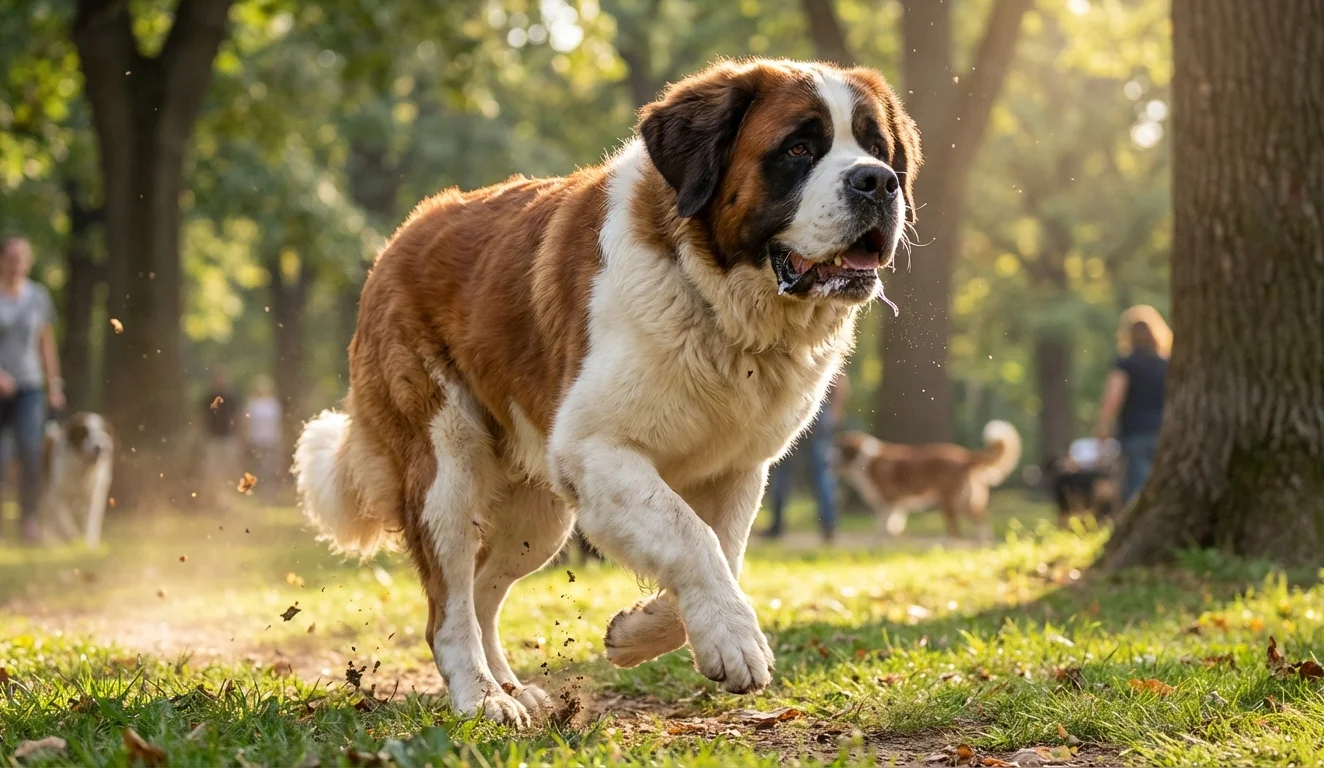
There’s no subtle way to describe a St. Bernard’s size. They’re enormous. Male St. Bernards stand 28-30 inches at the shoulder and weigh 140-180 pounds, though some individuals exceed 200. Females are slightly smaller at 26-28 inches and 120-140 pounds. That “slightly smaller” is relative, a 130-pound female St. Bernard is still one of the largest dogs you’ll encounter.
St. Bernards come in two coat varieties: rough (long-haired) and smooth (short-haired). The rough coat is the version most people picture, long, dense, and slightly wavy. The smooth coat is shorter and lies flat against the body. Both have a thick undercoat. Colors are always white with markings in red, brown, or brindle, often with a dark face mask.
The head is massive. Wide skull, deep-set eyes, wrinkled brow, hanging jowls, it’s a face built for drooling, and the St. Bernard does not disappoint in that department. Those jowls collect saliva and release it in long strings that end up on your walls, your clothes, your guests, and any surface within head-shaking distance. If drool bothers you, this is the wrong breed. Period.
St. Bernard Temperament
The St. Bernard’s temperament is their greatest selling point. The AKC calls them “playful, charming, and inquisitive,” but we’d put it more simply: St. Bernards are big, gentle, patient dogs that genuinely like people.
What living with a St. Bernard is really like:
- Calm indoors. Despite their size, St. Bernards are remarkably chill inside the house. They’re content to lie on the floor near you (or on top of your feet) and snooze. They’re not pacing, barking, or bouncing off walls. A well-exercised St. Bernard is basically a very large, warm rug.
- Incredible with children. St. Bernards have a legendary patience with kids. They tolerate ear-pulling, tail-grabbing, and general toddler chaos with a level of calm that’s hard to find in any breed. Supervision is still important, not because the dog is aggressive, but because a 160-pound dog can knock a small child over just by turning around.
- Watchful but not aggressive. St. Bernards are naturally alert and will bark to let you know someone’s at the door. But they’re not guard dogs. Their size alone is a deterrent, most people don’t want to test a dog that weighs more than they do, but a St. Bernard is far more likely to greet an intruder with a wagging tail than a snarl.
- Stubborn in a gentle way. St. Bernards aren’t defiant. They just move at their own pace, and that pace is slow. When a 170-pound dog decides it doesn’t want to walk any further, you’re not going to physically convince it otherwise.
Our honest opinion: the St. Bernard has one of the best temperaments of any large breed. If they lived to 14, they’d probably be the most popular dog in America.
One caveat: St. Bernards go through an adolescent phase (roughly 6-18 months) where they have the energy of a puppy in the body of a mid-sized adult. A 100-pound St. Bernard adolescent who hasn’t learned manners yet is a wrecking ball. Early training during this period saves furniture and prevents bad habits from becoming permanent.
Exercise Needs
St. Bernards need about 45 minutes of moderate exercise per day. That’s less than most working breeds, which makes sense, the modern St. Bernard is built for calm companionship, not endurance athletics.
Good exercises for St. Bernards:
- Daily walks. Two moderate walks per day (20-25 minutes each) suit most St. Bernards well. Keep the pace comfortable, they’re not built for jogging.
- Yard play. A fenced backyard where your St. Bernard can mosey around, sniff things, and play at their own pace is ideal.
- Short swimming sessions. Many St. Bernards enjoy water, and swimming is excellent low-impact exercise for a breed prone to joint issues.
- Cart pulling. Some St. Bernard owners train their dogs in cart pulling or weight pulling, which taps into the breed’s working heritage and provides structured exercise.
Critical warning about heat: St. Bernards are extremely heat-sensitive. That massive body, thick double coat, and brachycephalic tendency (flatter face compared to many breeds) make overheating a real danger. In summer, exercise during the coolest parts of the day, early morning and late evening. Always have water available. If it’s above 80 degrees, keep outdoor sessions short.
Over-exercising a growing St. Bernard puppy can damage developing joints. For the first 18-24 months, stick to gentle play and short walks. No running on hard surfaces, no jumping in and out of vehicles, and no forced exercise that stresses growing bones and cartilage.
Grooming
St. Bernards require regular grooming, and the level of effort depends on coat type.
Rough (long-haired) St. Bernards need brushing 3-4 times per week to prevent matting, especially behind the ears, under the legs, and around the tail. During seasonal blowouts (spring and fall), daily brushing is necessary. The shedding is intense, we’re talking tumbleweeds of undercoat rolling across your floors.
Smooth (short-haired) St. Bernards are somewhat easier, needing brushing 2-3 times per week, but they still shed heavily. Don’t choose a smooth St. Bernard thinking you’ll avoid the hair. You won’t.
Drool management is its own category. St. Bernard owners keep towels in every room. After eating or drinking, a St. Bernard’s jowls will be loaded with slobber that gets deposited on walls, furniture, and unsuspecting guests. Some owners keep a “drool rag” on hand at all times. It sounds absurd until you live with it and realize it’s just part of the deal.
Baths are challenging purely because of the dog’s size. Many owners opt for professional grooming for bath time (expect to pay more for a giant breed). At home, an outdoor hose-down in warm weather works fine.
Nail trims every 2-3 weeks, ear checks weekly, and dental care round out the routine.
One grooming note specific to St. Bernards: watch the skin folds around the face and jowls. Moisture gets trapped in those wrinkles and can lead to skin infections if not dried regularly. A quick wipe-down of the face folds after meals and water breaks helps prevent bacterial buildup.
St. Bernard Health Issues
The St. Bernard’s health profile is, unfortunately, one of the breed’s biggest drawbacks. Giant breeds in general have shorter lifespans and more health challenges, and the St. Bernard is no exception.
Hip Dysplasia
Hip dysplasia is common in St. Bernards, one of the most affected breeds, in fact. The condition causes abnormal development of the hip joint, leading to arthritis, pain, and mobility loss. Treatment ranges from $1,500-$6,000 per hip. OFA hip clearances on both parents are a must.
Elbow Dysplasia
Elbow dysplasia is also common in the breed. Like hip dysplasia, it causes abnormal joint development but in the front legs. Treatment costs $1,500-$4,000. Both conditions are worsened by obesity, which is another reason to keep your St. Bernard lean.
Bloat (Gastric Dilatation-Volvulus)
Bloat is common in St. Bernards due to their deep chest. The stomach fills with gas and can twist, cutting off blood supply, it’s a life-threatening emergency. Symptoms include a distended abdomen, pacing, drooling more than usual (which is saying something), and unproductive retching. Emergency surgery costs $2,000-$7,500. Many St. Bernard owners discuss prophylactic gastropexy with their vet.
Dilated Cardiomyopathy (DCM)
DCM is a heart condition where the heart muscle weakens and can’t pump blood efficiently. It has moderate prevalence in St. Bernards and can be fatal. Treatment and management cost $3,000-$10,000. Annual cardiac screening is recommended.
Osteosarcoma (Bone Cancer)
St. Bernards have a moderate risk of osteosarcoma, an aggressive bone cancer that typically affects the legs. Treatment often involves amputation followed by chemotherapy, costing $5,000-$10,000. It’s one of the most common causes of death in giant breeds.
The health reality is sobering. Pet insurance is strongly recommended for St. Bernards, the breed’s predisposition to expensive conditions makes it a financially prudent choice.
Training
St. Bernards are moderately trainable. They’re not going to win obedience competitions against Border Collies, but they can learn everything a good family dog needs to know. The key is starting early, before they weigh 150 pounds.
Training priorities for St. Bernards:
- Leash manners. A St. Bernard that pulls on leash is a genuine safety hazard. At 170 pounds, they can drag most adults. Start leash training early and be consistent. A front-clip harness helps enormously while they’re learning.
- Basic obedience. Sit, stay, come, down, leave it. Get these solid by 6 months while your St. Bernard is still a manageable size.
- No jumping. A St. Bernard puppy that jumps on people is cute. A 160-pound adult St. Bernard that jumps on people can send someone to the hospital. Train this out early.
- Socialization. St. Bernards are naturally friendly, but their size can make them intimidating to others. Well-socialized St. Bernards that remain calm around strangers, other dogs, and new environments are safer and happier.
St. Bernards respond well to positive reinforcement but can be slow to comply, not because they don’t understand, but because urgency isn’t in their vocabulary. Keep sessions short (10-15 minutes), use high-value treats, and accept that your St. Bernard will do things at Saint Bernard speed.
Cost
Purchase Price
A St. Bernard puppy from a reputable breeder costs $1,500-$3,500. Show-quality puppies from health-tested parents cost more. Given the breed’s health concerns, spending more on a well-bred puppy from parents with full OFA clearances often saves money in the long run. Adoption from breed rescues typically runs $300-$600.
Monthly Costs
| Expense | Monthly Estimate |
|---|---|
| Food (high-quality, giant breed) | $80-$150 |
| Preventive vet care (averaged) | $25-$50 |
| Pet insurance | $50-$100 |
| Treats and chews | $15-$30 |
| Miscellaneous (toys, supplies, drool towels) | $15-$30 |
| Total | $150-$375 |
St. Bernards are one of the most expensive breeds to maintain. The food bill alone can rival a teenager’s grocery budget. Giant breed formulas are pricier, and you’ll go through a lot of it.
First-Year Costs
Budget $4,500-$8,000 for your first year. The purchase price is significant, but the ongoing costs of feeding, insuring, and equipping a giant breed add up quickly. You’ll need an XL crate, an XL bed, heavy-duty leash and harness, and a vehicle large enough to transport a dog that weighs more than a Great Dane.
Is a St. Bernard Right for You?
A St. Bernard is a great fit if you:
- Want a calm, gentle, family-oriented dog and have space for one
- Have a home with room, St. Bernards don’t need a mansion, but they need more than a studio apartment
- Can handle the financial commitment of a giant breed
- Are prepared for the drool (we can’t stress this enough)
- Accept a shorter lifespan and the emotional weight that comes with it
- Have experience with large dogs or are committed to puppy training classes
A St. Bernard might NOT be right if you:
- Live in a hot climate without excellent air conditioning
- Want a long-lived dog (the 8-10 year lifespan is hard for many families)
- Can’t afford the food, vet, and insurance costs of a 150+ pound dog
- Are physically unable to manage a very large dog on leash
- Are bothered by drool (not “a little bothered”, if drool is a dealbreaker, this breed is a dealbreaker)
- Live in an apartment or small home with narrow doorways and tight spaces
The St. Bernard is one of those breeds that inspires lifelong devotion in the people who own them. Every Saint owner we’ve talked to says the same thing: the only bad part is that they don’t live long enough. If you can open your home (and your drool tolerance) to a dog this size and this gentle, the years you get will be some of the best of your life.
Related Breeds
If you’re considering this breed, you might also want to look at:
FAQ
How much does a St. Bernard eat per day?
An adult St. Bernard typically eats 6-10 cups of high-quality dry food per day, split into two meals. Puppies eat more relative to their current weight because they’re growing rapidly. Giant breed puppy formulas with controlled calcium and phosphorus ratios are important for proper bone development. Expect to spend $80-$150 per month on food alone. Free-feeding is not recommended, measure portions to prevent obesity, which worsens joint problems.
Are St. Bernards good apartment dogs?
Not really. While St. Bernards are calm indoors and don’t need a huge yard, their sheer physical size makes apartment living impractical. A 170-pound dog needs room to turn around, stretch out, and move without knocking things over. Narrow hallways, small elevators, and tight staircases become real obstacles. They also drool on everything within reach, which in an apartment means everything you own. A home with a yard and wide doorways is a much better fit.
Do St. Bernards drool a lot?
Yes. We cannot overstate this. St. Bernards are among the heaviest drooling breeds, and the drool is constant, not just after eating or drinking. They drool when they’re excited, when they’re relaxed, when they smell food, and sometimes for no apparent reason at all. Strings of saliva hang from their jowls and get flung across the room when they shake their heads. If you’re considering a St. Bernard, visit one in person first and see if you can handle it.
How long do St. Bernards live?
The average St. Bernard lifespan is 8-10 years, which is typical for giant breeds. Some individuals live to 11 or 12, but that’s the exception. The shorter lifespan is driven by the breed’s predisposition to cancer (particularly osteosarcoma), heart disease, and joint conditions. Keeping your St. Bernard at a healthy weight, providing appropriate (not excessive) exercise, and staying current on veterinary screening can help maximize their years.
Are St. Bernards good with other pets?
Generally, yes. St. Bernards are one of the more tolerant breeds for multi-pet households. Their calm, patient temperament extends to other animals, and they’re rarely aggressive or territorial. The main concern is their size, a St. Bernard playing with a small dog could accidentally injure it just by being clumsy. Supervised introductions and awareness of the size difference are key.