Leonberger Breed Guide: The Gentle Giant With a Lion's Mane (2026)
The Leonberger is a 170-pound dog designed to look like a lion. It's also one of the sweetest, most patient giants you'll ever meet.
The Leonberger stands 25.5-31.5 inches tall, weighs 90-170 pounds, and lives about 7 years. That last number is the one you need to sit with. Seven years. Some Leonbergers make it to 9 or 10, and some don’t make it to 6. The breed’s heartbreakingly short lifespan is the price of admission, and anyone considering a Leonberger needs to accept that upfront. What you get in return is one of the most magnificent, gentle, and loving dogs ever created, a massive, lion-maned working dog that’s somehow as sweet-natured as a Golden Retriever and as patient as a Saint Bernard.
In Short: 90–170 lbs, ~7 years. Moderate energy, calm house dog, active outdoors. Heavy shedder with seasonal blowouts. Watch for Hip Dysplasia, Osteosarcoma, and Bloat. Best for experienced owners with space who want a gentle giant and can accept a short lifespan.
The Leonberger was literally designed to look like a lion, that’s the breed’s origin story, and we’ll get to it. But the lion comparison extends beyond appearance. There’s a regal quality to a well-bred Leonberger, a calm confidence that’s rare even among giant breeds. These dogs don’t bark at every noise. They don’t flinch at chaos. They just… exist, with a steady, reassuring presence that makes everything around them feel calmer. If a Great Dane is the class clown of giant breeds and a Saint Bernard is the gentle philosopher, the Leonberger is the benevolent king.
Leonberger at a Glance
| Trait | Details |
|---|---|
| Breed Group | Working (AKC) |
| Height | Males: 28-31.5 in / Females: 25.5-29.5 in |
| Weight | Males: 110-170 lbs / Females: 90-140 lbs |
| Life Expectancy | ~7 years (range: 5-9) |
| Coat | Long, dense, water-resistant double coat with distinctive mane |
| Colors | Lion yellow, Golden, Red, Red-brown, Sand (all with a black mask) |
| Temperament | Gentle, Playful, Friendly, Patient |
| Shedding | Very Heavy |
| Energy Level | Moderate |
| Good With Kids | Excellent |
| Apartment Friendly | No |
| Drooling | Moderate |
History
The Leonberger was created in the 1830s-1840s by Heinrich Essig, a politician and dog breeder in the city of Leonberg, Germany. Essig’s stated goal was to create a dog that resembled the lion on the Leonberg city crest, a marketing concept as much as a breeding program. He reportedly crossed Saint Bernards with Newfoundlands and Great Pyrenees, then selected for the lion-like coloring and mane that define the breed today.
Whether Essig’s origin story is entirely accurate is debated by breed historians. Some suspect he incorporated existing farm dogs from the Leonberg region into his breeding program. Regardless, by the 1850s, Essig was producing distinctive, massive dogs with thick manes and lion-yellow coloring that caught the attention of European royalty and celebrities. Napoleon III, Tsar Alexander II, and composer Richard Wagner all reportedly owned Leonbergers. The breed became a prestige dog for the European aristocracy.
World Wars I and II devastated the breed. German dogs were conscripted for military use, and breeding programs collapsed. By the end of World War I, only 25 Leonbergers reportedly remained. Dedicated breeders rebuilt the population after each war, but the bottlenecks took a genetic toll. The AKC recognized the Leonberger in 2010. Today, the breed remains relatively rare, there are roughly 3,000-4,000 registered Leonbergers in the United States, compared to hundreds of thousands of Labs and Golden Retrievers.
Size and Appearance
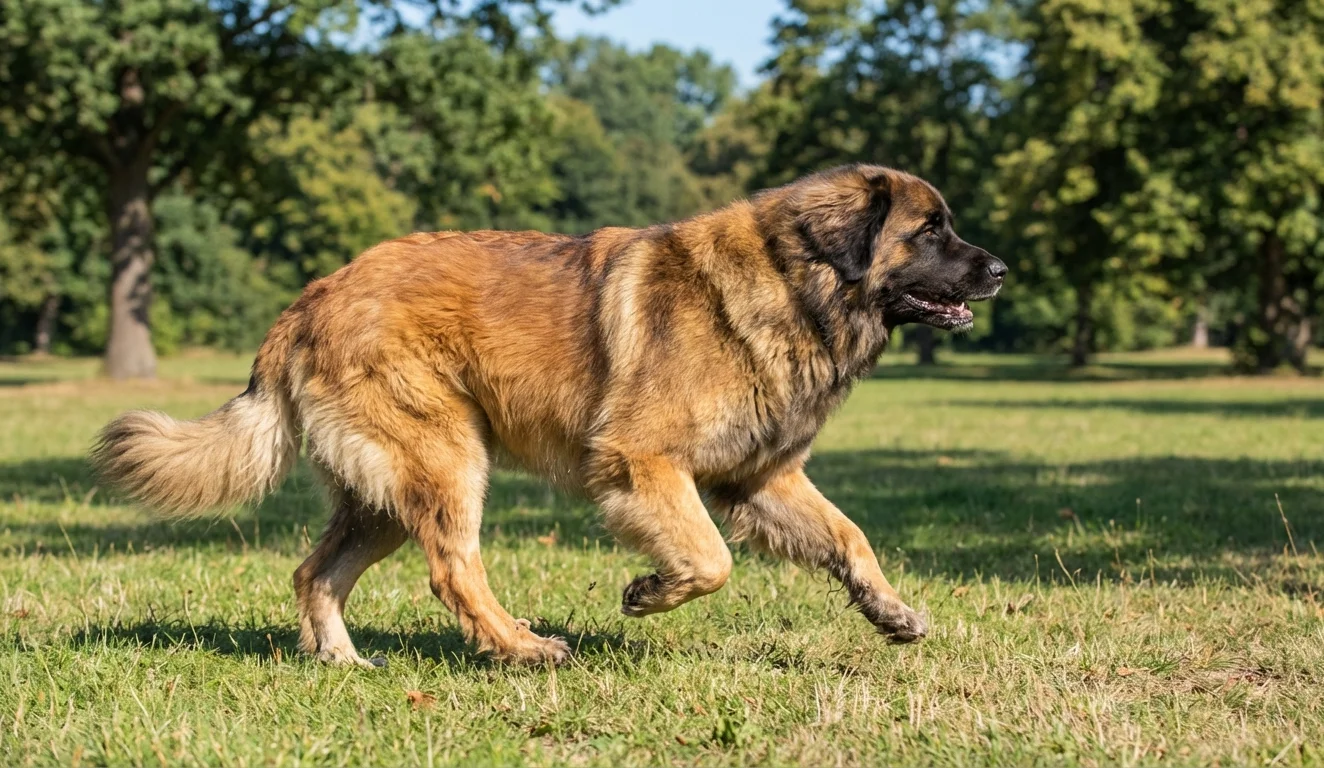
Leonbergers are massive. Males stand 28-31.5 inches at the shoulder and weigh 110-170 pounds. Females are 25.5-29.5 inches and 90-140 pounds. To put this in perspective: a large male Leonberger can weigh more than an adult human and stand chest-high when on all fours. On their hind legs, they’re taller than most people.
Despite their size, Leonbergers are not clumsy. They move with a surprising grace and fluidity, and the AKC standard calls for a “ground-covering, even gait”, these dogs were bred to work, and their movement reflects it. The build is balanced and muscular without being bulky.
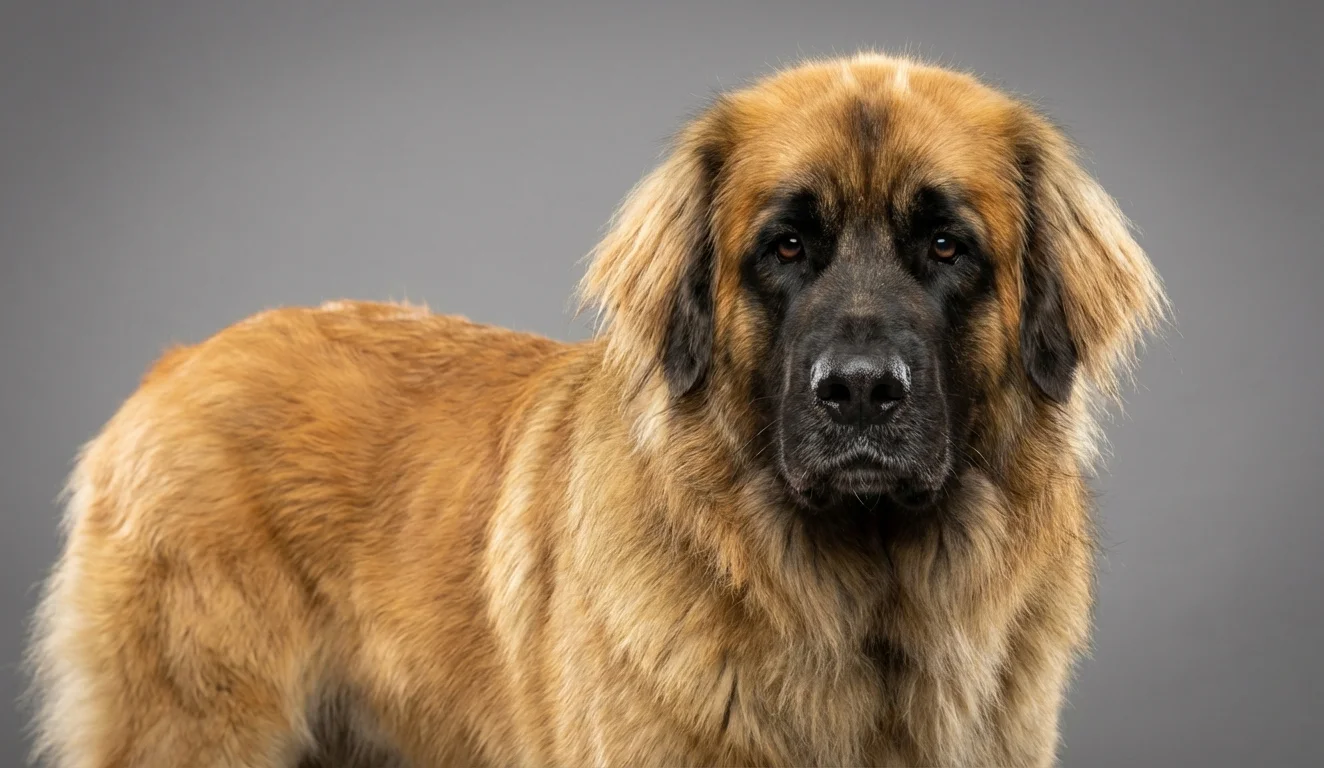
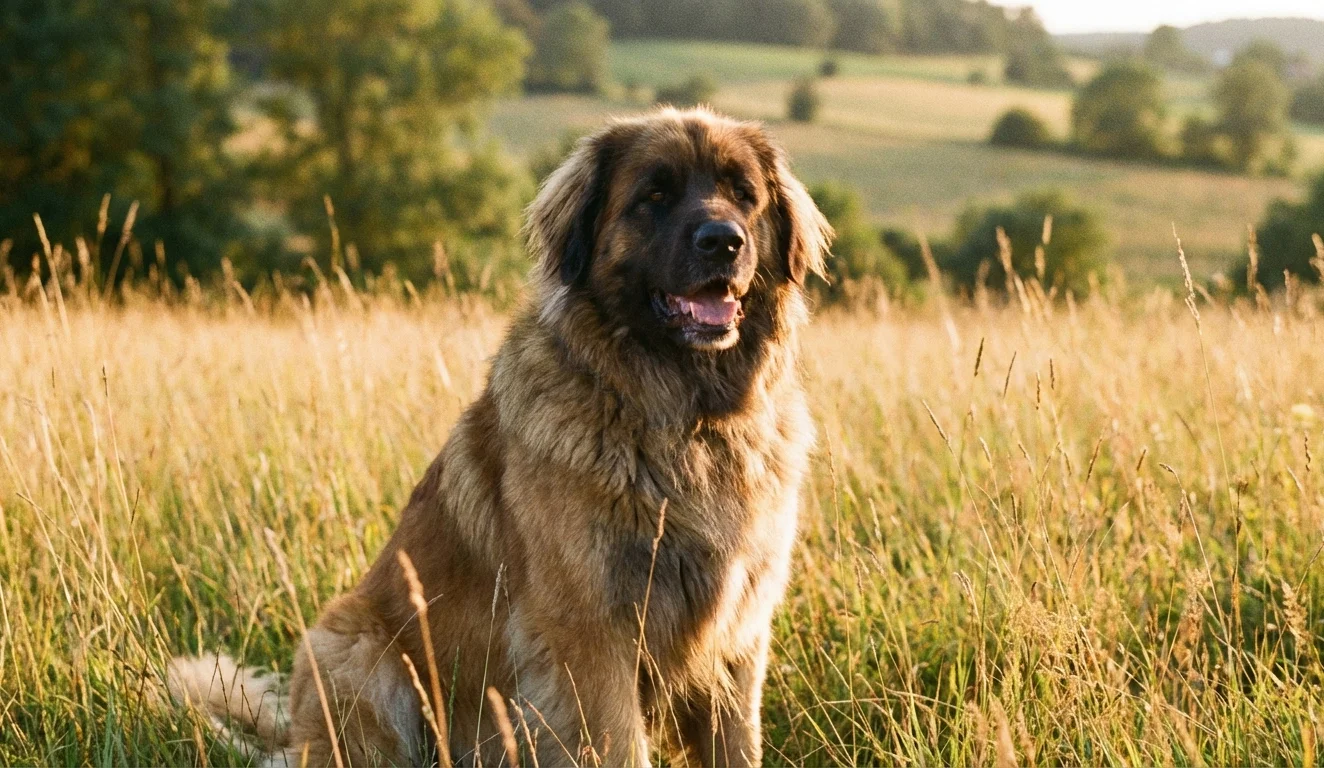
The coat is the breed’s crowning feature, literally. Males develop a substantial mane around the neck and chest, giving them the lion-like appearance that Essig was after. The coat is medium to long, dense, and water-resistant, with a soft undercoat. Colors range from lion yellow to golden to red-brown, always with a black mask on the face. The black mask is a breed requirement and gives the Leonberger its distinctive, expressive face.
The head is proportionate to the body (which means it’s quite large), with a broad skull, a medium-length muzzle, and dark, intelligent eyes that convey warmth and gentleness. The ears are medium-sized and pendant. The tail is long and well-furred, carried down at rest and with a slight curve.
The sexual dimorphism in Leonbergers is significant, males are substantially larger than females and have more impressive manes. If you want the full lion effect, you want a male. If you want a (relatively) more manageable giant, females are the way to go.
Leonberger Temperament
The Leonberger temperament is the breed’s masterpiece. For a dog this large, the Leonberger’s gentleness, patience, and emotional intelligence are remarkable.
What living with a Leonberger actually looks like:
- They’re astonishingly gentle. A 150-pound Leonberger will interact with a toddler with the same careful softness it uses with a kitten. The breed has an innate sense of its own size and adjusts its behavior accordingly. This gentleness isn’t trained, it’s hardwired.
- They’re calm inside, active outside. Leonbergers are excellent house dogs. Despite their size, they’re not destructive or restless indoors. They’ll find a spot (a large spot) and settle. Outside, they’re playful and enjoy exercise, but they’re not frantic about it.
- They love water. The Newfoundland in the Leonberger’s heritage gave it a genuine love of swimming. Leonbergers are strong swimmers with water-resistant coats. Many Leo owners find that their dog gravitates to any body of water, lakes, pools, even mud puddles.
- They’re sensitive and emotionally attuned. Leonbergers pick up on household emotions and respond to them. A stressed household will produce a stressed Leonberger. A calm household produces a calm, content dog. This sensitivity makes them excellent therapy dogs.
- They mature slowly. Leonbergers don’t fully mature mentally or physically until about 3-4 years of age. You’ll have a 140-pound adolescent on your hands for a while. This is mostly endearing, a goofy, oversized puppy, but it means puppy behaviors last longer than with breeds that mature at 1-2 years.
- They lean. Leonbergers express affection by leaning their full body weight against you. When a 150-pound dog leans into your legs, you’ll feel it. It’s their version of a hug, and most Leo owners come to love it (and brace for it).
Leonbergers are exceptional with children, the breed’s patience and gentleness with kids is legendary. They’re also typically good with other dogs and can coexist with cats. They’re not aggressive, not reactive, and not territorial.
Exercise Needs
Leonbergers need 45-60 minutes of exercise per day, which is moderate for their size. They’re not couch potatoes, but they don’t have the relentless exercise demands of herding or sporting breeds.
Good exercise for Leonbergers:
- Long walks at a moderate pace, Leonbergers are excellent walking companions
- Swimming, this is the breed’s favorite exercise by a wide margin. If you have access to a lake, pool, or beach, your Leo will be in heaven
- Hiking on moderate terrain, their size and sure-footedness make them great trail dogs in cool weather
- Cart pulling, Leonbergers were historically used as draft dogs, and many enjoy pulling carts or wagons. Carting competitions exist and are a natural fit.
- Yard play and gentle roughhousing
Important for puppies and young dogs: Leonberger puppies should not do sustained, high-impact exercise until their growth plates close, which doesn’t happen until 18-24 months in giant breeds. This means no long runs, no repetitive jumping, and no forced exercise on hard surfaces during the growth period. Let puppies self-regulate their activity through free play. Protecting those developing joints is one of the most important things you can do for a Leonberger’s long-term health.
Heat is a concern. That thick double coat and massive body generate and retain heat. Summer exercise should be limited to early mornings and evenings, with plenty of shade and water available. Swimming is ideal hot-weather exercise.
Grooming
Owning a Leonberger means accepting that dog hair is now a permanent feature of your life. The coat is long, dense, and sheds year-round, with massive seasonal blowouts that can last 3-4 weeks.
Grooming schedule:
- Brush 3-4 times per week with an undercoat rake and slicker brush, this is minimum
- Daily brushing during blowout season (spring and fall), the amount of fur that comes off a Leonberger during blowout season is genuinely shocking. We’re talking garbage bags full.
- Bath every 4-6 weeks: this is a two-person job given the dog’s size. Many Leo owners use self-service dog washes with elevated tubs ($15-$25 per visit) because their bathtub can’t accommodate a 150-pound dog.
- Check and clean ears weekly: the pendant ears trap moisture
- Nail trim every 2-3 weeks
- Teeth brushing 2-3 times weekly
Professional grooming for a Leonberger costs $80-$150 per session due to the sheer volume of dog and coat. Many Leo owners learn to do most grooming at home and save professional sessions for thorough deshedding and cleanup.
The coat should never be shaved. It insulates against both cold and heat, and shaving damages the coat’s texture and regrowth pattern.
Drooling is moderate in Leonbergers, less than a Saint Bernard or Mastiff, but more than dry-mouthed breeds. Keep a towel handy, especially after drinking and during meals.
Leonberger Health Issues
The Leonberger’s short lifespan is the breed’s greatest challenge, and it’s primarily driven by cancer and other diseases common in giant breeds. The average lifespan of approximately 7 years reflects the reality that giant dogs age faster at the cellular level than smaller dogs.
Osteosarcoma (Bone Cancer)
Osteosarcoma is the most common cancer in Leonbergers and one of the primary drivers of the breed’s short lifespan. It typically affects the long bones of the legs, causing sudden lameness and pain. By the time symptoms appear, the cancer has often already metastasized to the lungs. Treatment (amputation of the affected limb followed by chemotherapy) costs $5,000-$15,000, and median survival times post-treatment are 10-12 months. Without treatment, prognosis is measured in weeks. This is the hardest part of owning a Leonberger, the cancer risk is real and prevalent.
Hip Dysplasia
The OFA reports significant prevalence of hip dysplasia in Leonbergers, the breed consistently ranks among the most affected. The combination of rapid growth, heavy body weight, and genetic predisposition creates a perfect storm. All breeding stock should have OFA or PennHIP evaluations. Treatment ranges from $1,500-$6,000 for conservative management to total hip replacement.
Elbow Dysplasia
Elbow dysplasia is also common in the breed. The condition involves abnormal development of the elbow joint, causing lameness and arthritis. OFA elbow evaluations are recommended for all breeding stock. Surgical correction costs $2,000-$5,000 per elbow.
Gastric Dilatation-Volvulus (Bloat)
As a giant, deep-chested breed, Leonbergers are at high risk for bloat. The stomach fills with gas and can twist (volvulus), cutting off blood supply. This is a life-threatening emergency requiring immediate surgery ($2,000-$7,000). Many Leonberger owners and breeders opt for prophylactic gastropexy, surgical stomach tacking performed at the time of spay/neuter, which significantly reduces the risk. This costs $200-$400 when done alongside another procedure and is widely considered worth it for giant breeds.
Leukoencephalomyelopathy (LEMP)
A neurological condition documented in Leonbergers that causes progressive weakness and incoordination. A DNA test exists, and responsible breeders screen for it. Affected dogs deteriorate over months to years with no effective treatment. The test is relatively new, but its availability has helped breeders reduce the incidence.
Polyneuropathy (LPN)
Several forms of hereditary polyneuropathy affect Leonbergers, causing progressive weakness and muscle wasting. DNA tests exist for the known variants (LPN1 and LPN2), and responsible breeders test all breeding dogs. Affected dogs show exercise intolerance, noisy breathing, and progressive hind-end weakness.
Training
Leonbergers are trainable and generally eager to cooperate, but training a dog this large requires starting early and being consistent. A 30-pound Leonberger puppy that jumps on people is funny. A 150-pound adult that does it is a liability.
Training approach for Leonbergers:
- Positive reinforcement only. Leonbergers are sensitive, and harsh corrections damage trust. Their desire to please makes positive methods very effective.
- Start leash manners immediately. A Leonberger that pulls on leash is pulling with 100+ pounds of force. Teach loose-leash walking before the dog outweighs you.
- “Off” and “down” are priority commands. Counter-surfing at Leonberger height means nothing on your counters is safe. Teach boundary commands early and consistently.
- Socialization during 8-16 weeks is important. Leonbergers are naturally friendly, but their size means a poorly socialized Leo can be intimidating to others even without aggressive intent.
- Don’t skip adolescent training. The slow maturation means you’ll be managing puppy behaviors in a very large body for 2-3 years. Stay consistent through this phase.
Leonbergers do well in obedience, rally, water rescue competitions, carting, and therapy work. The breed’s calm, gentle nature makes them outstanding therapy dogs, there’s something uniquely comforting about a 150-pound dog carefully resting its head in a hospital patient’s lap.
Cost
Purchase Price
A Leonberger puppy from a reputable breeder costs $2,000-$4,000. The breed’s rarity means wait lists are standard, 12-24 months is typical. Breeders are few and litter sizes, while decent (6-8 puppies), don’t keep up with demand. Show-quality puppies can exceed $4,500.
Due diligence on breeders is particularly important with Leonbergers. The breed’s health challenges mean that skipping health testing is genuinely dangerous. A breeder who doesn’t do OFA hips, OFA elbows, LPN testing, and LEMP testing should not be considered.
Leonberger rescue is available through the Leonberger Club of America rescue program. Adoption fees run $300-$600 when dogs become available.
Monthly Costs
| Expense | Monthly Estimate |
|---|---|
| Food (high-quality kibble, they eat a lot) | $60-$120 |
| Preventive vet care (averaged) | $25-$40 |
| Pet insurance | $50-$90 |
| Grooming supplies/professional (averaged) | $20-$40 |
| Treats and chews | $15-$25 |
| Miscellaneous (toys, supplies) | $15-$30 |
| Total | $185-$345 |
First-Year Costs
Budget $5,000-$8,000 for the first year, including purchase price, initial vet care (giant breed puppies need more frequent growth checks), vaccinations, prophylactic gastropexy with spay/neuter, supplies (giant dog beds cost $80-$200. Giant crates cost $100-$250), and training. Pet insurance is strongly recommended, the combination of cancer risk, orthopedic issues, and bloat potential makes the Leonberger one of the most expensive breeds for unexpected vet bills. Get a policy before any diagnosis.
Food costs are significant. A 150-pound dog eats 5-8 cups of food per day. At quality kibble prices ($50-$75 for a 30-pound bag), that adds up fast. Many Leo owners supplement with raw or fresh food, which increases costs further.
Is a Leonberger Right for You?
A Leonberger is a great fit if you:
- Want one of the gentlest, most patient giant breeds in existence
- Have space, these dogs need room, both inside and out
- Can emotionally and financially handle a breed with a short lifespan and significant health risks
- Have experience with large or giant breed dogs (or are willing to learn quickly)
- Want a dog that’s exceptional with children
- Can commit to serious grooming and don’t mind epic amounts of shedding
- Have the budget for giant-breed costs (food, vet care, supplies are all scaled up)
A Leonberger is probably NOT right if you:
- Aren’t prepared for the ~7 year average lifespan, this is the hardest part of Leo ownership
- Live in an apartment or don’t have adequate space for a 170-pound dog
- Have a tight budget, Leonbergers are expensive to buy, feed, insure, and maintain
- Want a low-shedding or low-maintenance dog
- Can’t handle drool (it’s moderate but present)
- Live in a very hot climate without reliable cooling
The Leonberger is a breed of extremes: extreme size, extreme gentleness, extreme beauty, and extremely limited time. People who own them describe the experience as bittersweet, you get a companion of extraordinary quality for a span that never feels long enough. Every Leonberger owner we’ve talked to says the same thing: they’d do it again, even knowing the timeline. That’s the highest endorsement a breed can get.
Related Breeds
If you’re considering this breed, you might also want to look at:
FAQ
How big do Leonbergers actually get?
Male Leonbergers typically reach 110-170 pounds, with some individuals exceeding 170. Females are 90-140 pounds. Height ranges from 25.5 to 31.5 inches at the shoulder. On their hind legs, males can be 6 feet or taller. This is a genuinely massive dog. Before committing, consider the practical implications: can your car accommodate a 150-pound dog? Is your furniture rated for that weight? Can you physically manage this dog on a leash? These aren’t hypothetical questions, they’re daily logistics.
Why do Leonbergers have such short lifespans?
Giant dog breeds age faster at the cellular level than smaller breeds, this is a well-documented biological phenomenon. Their rapid growth, larger organ demands, and higher cancer rates all contribute. Leonbergers are additionally impacted by a relatively small gene pool (the breed nearly went extinct twice) which concentrates health risks, particularly osteosarcoma. The Leonberger Health Foundation and breed clubs worldwide are investing in longevity research, but as of 2026, the average lifespan remains around 7 years.
Are Leonbergers good with children?
Leonbergers are one of the best giant breeds for families with children. Their gentleness is instinctive, they seem to understand that children require careful handling, and they adjust their behavior accordingly. Many Leo owners report that their dog is more patient with children than with adults. The breed’s calm temperament and high pain tolerance (they don’t react negatively to accidental tail-pulling or ear-grabbing) make them safer around young kids than more reactive breeds. Supervision is always recommended with any giant breed simply because of the size differential.
How much does it cost to feed a Leonberger?
A 150-pound Leonberger eats approximately 5-8 cups of food per day, depending on activity level and the caloric density of the food. At quality kibble prices, that’s roughly $60-$120 per month. Some owners supplement with fresh, raw, or freeze-dried food, which can push monthly food costs to $150-$250. Giant-breed-specific formulas are recommended, especially during the growth period, to support proper bone and joint development. A Leonberger puppy will eat significantly more per pound of body weight than an adult because it’s growing rapidly.
Do Leonbergers drool?
Leonbergers drool moderately. They’re not Saint Bernards or English Mastiffs, you won’t be wiping ropes of drool off the ceiling. But they’re not dry-mouthed either. Expect drool after drinking, during meals, when anticipating food, and sometimes when they’re hot. Most Leo owners keep a towel nearby. If drool is something that truly bothers you, this is worth considering, but compared to other giant breeds, Leonbergers are on the lighter end of the drool spectrum.