Cardigan Welsh Corgi Breed Guide: The One With the Tail (2026)
The Cardigan Welsh Corgi is the older, calmer, and more mysterious cousin of the Pembroke. Same short legs, different dog entirely.
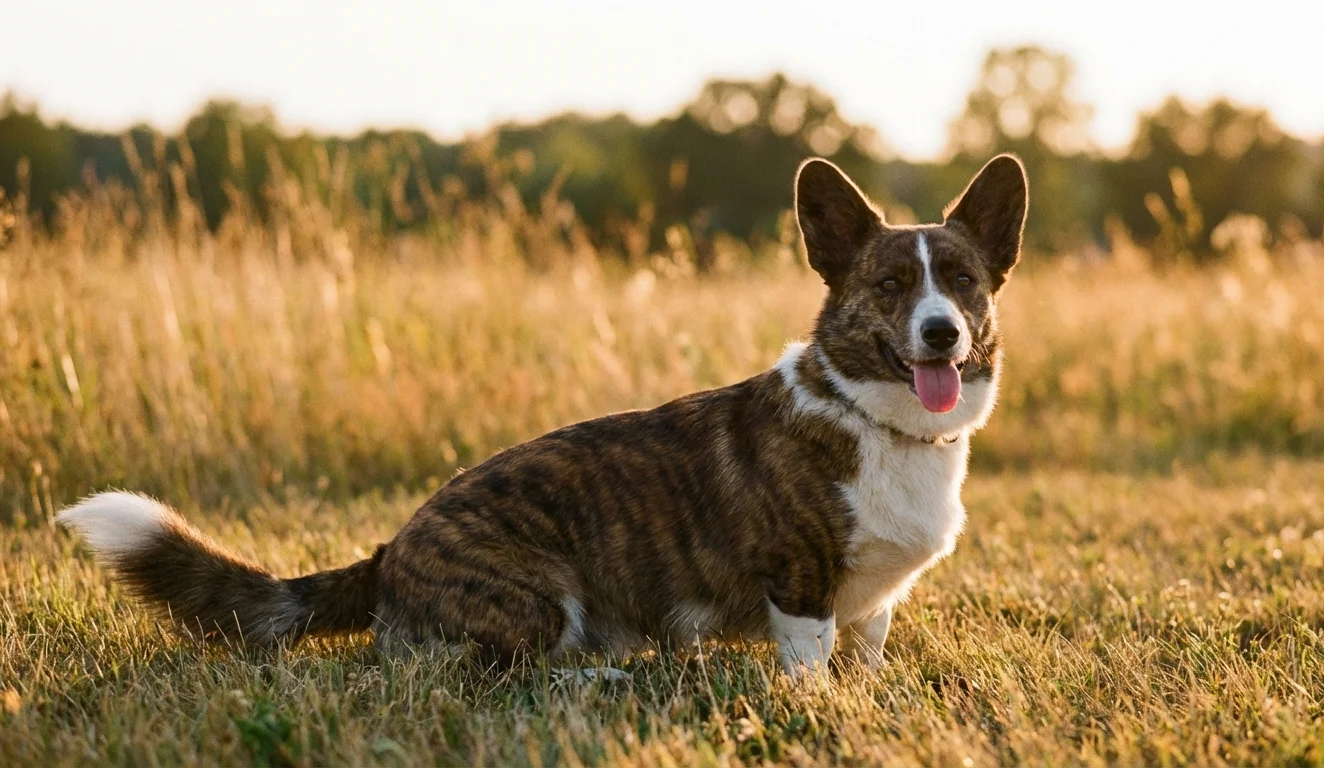
The Cardigan Welsh Corgi stands 10.5-12.5 inches tall, weighs 25-38 pounds, and lives 12-15 years. If you’re thinking, “Wait, isn’t that just a Corgi?”, sort of. The Cardigan is the older, less famous, and (we’d argue) more interesting of the two Welsh Corgi breeds. While the Pembroke Welsh Corgi became an internet sensation backed by royal endorsements, the Cardigan has been quietly doing its own thing for roughly 3,000 years. And unlike its Pembroke cousin, the Cardigan has a tail, a long, low, fox-like tail that’s one of the easiest ways to tell the two breeds apart.
In Short: 25–38 lbs, 12–15 years. Moderate energy, less frantic than a Pembroke. Heavy shedder. Watch for Hip Dysplasia and Degenerative Myelopathy. Best for families wanting a sturdy, adaptable herding dog with an even keel.
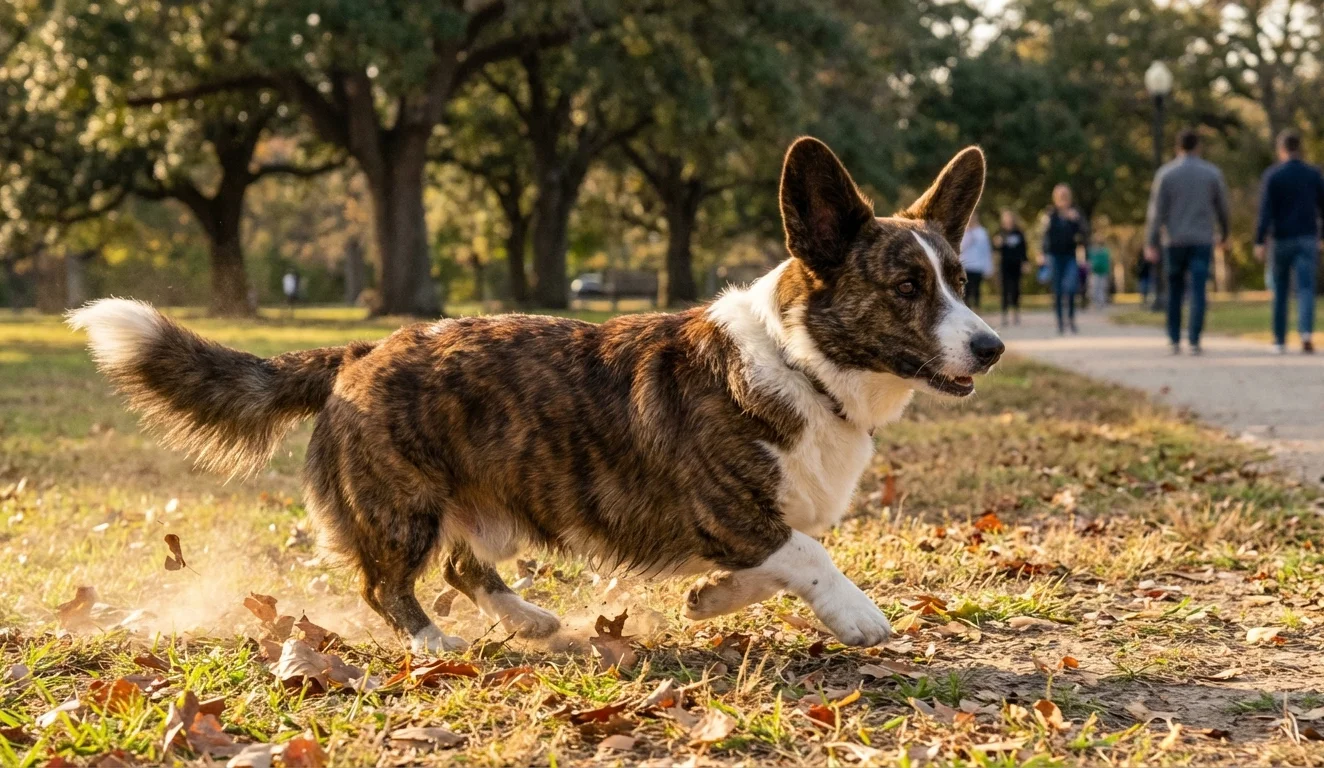
The Cardigan Welsh Corgi is what happens when you take herding-dog intelligence, stuff it into a low-rider body, and add a dash of reserved dignity. Where Pembrokes are outgoing and sometimes pushy, Cardigans are more thoughtful and measured. They’ll assess a situation before diving in. They’re still very much herding dogs, stubborn, smart, and prone to bossiness, but they tend to be a bit more “old soul” about it.
Cardigan Welsh Corgi at a Glance
| Trait | Details |
|---|---|
| Breed Group | Herding (AKC) |
| Height | 10.5-12.5 inches |
| Weight | Males: 30-38 lbs / Females: 25-34 lbs |
| Life Expectancy | 12-15 years |
| Coat | Medium-length, dense double coat |
| Colors | Red, Sable, Brindle, Black, Blue Merle (with or without tan/brindle points) |
| Temperament | Loyal, Affectionate, Adaptable, Even-Tempered |
| Shedding | Heavy (year-round with seasonal blowouts) |
| Energy Level | Moderate |
| Good With Kids | Yes |
| Apartment Friendly | Yes (with adequate exercise) |
History
The Cardigan Welsh Corgi is one of the oldest herding breeds in the British Isles, with a history stretching back approximately 3,000 years. Celtic tribes brought the breed’s ancestors to Cardiganshire, Wales around 1200 BCE, these dogs were likely related to the same ancient dog family that produced Dachshunds and Basset Hounds, which explains the shared short-legged body type.
For centuries, Cardigans served as all-purpose farm dogs in the rugged hills of western Wales. Their primary job was driving cattle to market and to common grazing lands, but they also guarded the homestead, hunted vermin, and herded geese and ponies. The short legs weren’t an aesthetic choice, they allowed the dogs to nip at cattle heels and duck under kicks, just like their Pembroke cousins.
Here’s where the history gets interesting: the Cardigan and Pembroke Welsh Corgis are actually separate breeds with different ancestry. They were developed in different parts of Wales (Cardiganshire and Pembrokeshire) from different foundation stock. They were shown as a single breed until 1934, when the AKC recognized them as separate breeds. The Cardigan earned AKC recognition in 1935. The Pembroke went on to become a global celebrity thanks to Queen Elizabeth II, while the Cardigan remained the less famous sibling, consistently ranking around 65th-70th in AKC popularity.
Size and Appearance
Cardigans are stocky, substantial dogs that feel heavier than they look. Males weigh 30-38 pounds and females weigh 25-34 pounds, all standing 10.5-12.5 inches at the shoulder. They’re generally a bit larger and heavier-boned than Pembrokes.
The body is long relative to height, the AKC standard describes the ideal proportions as approximately 1.8:1 (length to height). The chest is deep and broad, the forelegs are slightly bowed around the deep chest, and the feet are large and round. Everything about the Cardigan’s build says “I was made for all-day work on rough terrain.”
The Tail
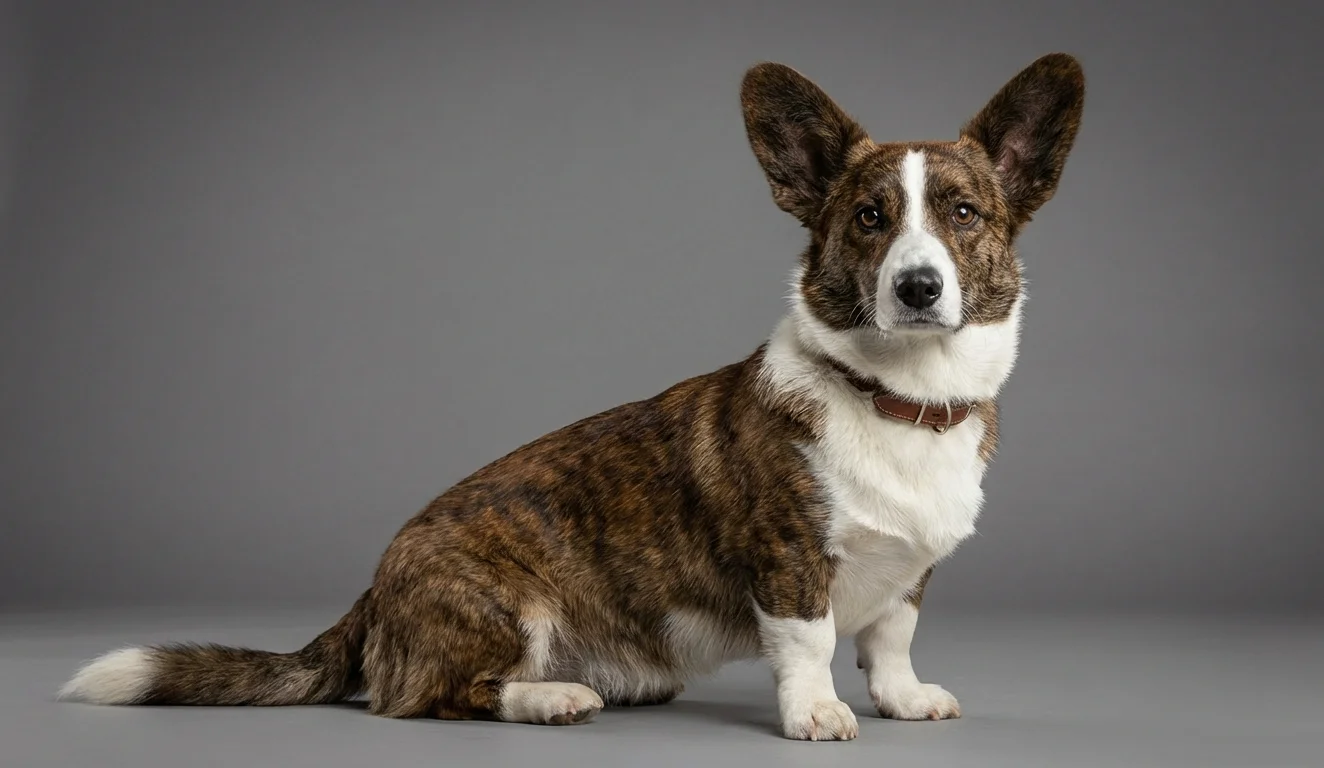
The tail is the most obvious difference between Cardigans and Pembrokes. Cardigans have a long, low-set tail that’s carried below the topline, it looks somewhat fox-like when the dog is at rest. The tail should never be curled over the back.
Colors
Cardigans come in a wider range of colors than Pembrokes, including red, sable, brindle, black (with or without tan or brindle points), and blue merle (with or without tan or brindle points). The blue merle Cardigans are particularly striking, they have a marbled pattern of gray, black, and white that can include blue eyes. White markings are common on the neck, chest, legs, muzzle, and tail tip.
Ears
Cardigan ears are large, rounded at the tips, and set wider apart than Pembroke ears. Pembroke ears are more pointed and erect. This is another quick way to tell the breeds apart.
Cardigan Welsh Corgi Temperament
Cardigans share many traits with Pembrokes, they’re intelligent, loyal, and have strong herding instincts, but the Cardigan temperament has a different flavor. Where Pembrokes are extroverts, Cardigans are more like friendly introverts. They love their people deeply but don’t necessarily need to be the center of attention at a dog park.
What living with a Cardigan actually looks like:
- They’re reserved with strangers but not unfriendly. A Cardigan will watch a new person from a distance before deciding whether to engage. This isn’t shyness, it’s assessment. Once they decide you’re okay, they warm up nicely.
- They’re more adaptable than Pembrokes. Cardigans handle new situations with a calm competence that’s reassuring. They’re less reactive, less prone to frantic barking at every noise.
- They still herd. Don’t let the calmer temperament fool you, Cardigans will absolutely try to herd children, other pets, and anything else that moves. They just do it with less frantic energy than Pembrokes.
- They’re surprisingly sensitive. Cardigans pick up on emotional cues and respond to household stress. They do better with consistent, calm handlers than with unpredictable environments.
- They have a great sense of humor. Cardigans aren’t as clownish as Pembrokes, but they have a quiet, dry sense of humor. They’ll do something subtly ridiculous and then look at you like they know exactly what they did.
Cardigans are excellent family dogs and typically do well with children of all ages. They’re also generally good with other dogs and can coexist with cats, though the herding instinct means they may try to “manage” other pets.
Exercise Needs
Cardigans need about 45-60 minutes of exercise per day, less than Pembrokes, which is one of the breed’s selling points. They’re active and enjoy physical activity, but they don’t have the same frantic energy that makes Pembrokes seem constantly wound up.
Good exercise for Cardigans:
- Daily walks at a moderate pace (they’ll keep up better than you’d expect)
- Fetch in the yard, most Cardigans enjoy retrieving
- Herding trials or herding instinct tests if you have access
- Short hikes on moderate terrain
- Puzzle toys and training games for mental stimulation
Cardigans are good candidates for dog sports like agility (watching a Corgi run an agility course never gets old), rally obedience, and nose work. They’re also surprisingly good tracking dogs.
Because of their long backs and short legs, avoid exercise that involves repeated jumping from heights, off furniture, off decks, out of cars. Use ramps where possible and keep jumping activities low-impact to protect the spine. A Corgi-height set of pet stairs costs $20-$40 and can save you thousands in vet bills.
Grooming
Cardigans are heavy shedders. If you’ve read the Pembroke Welsh Corgi profile, you know the drill: dense double coat, year-round shedding, and twice-yearly blowouts that will make you reconsider your flooring choices.
Grooming schedule:
- Brush 2-3 times per week during normal periods with a slicker brush and undercoat rake
- Daily brushing during blowout season (spring and fall, about 2-3 weeks each)
- Bath every 4-6 weeks
- Nail trim every 2-3 weeks: with those short legs, the nails may not get enough ground contact to wear naturally
- Ear check weekly: those big ears stay well-ventilated but should still be monitored
- Teeth brushing 2-3 times weekly
Blue merle Cardigans don’t shed any differently than other colors, despite what some sellers might claim. All Cardigans shed heavily. Full stop.
A good vacuum cleaner is a non-negotiable purchase for Cardigan ownership. Budget $200-$400 for a model that handles pet hair well. You’ll use it almost daily.
Cardigan Welsh Corgi Health Issues
Cardigans live 12-15 years and are generally a healthy breed, but they share some health concerns with other dwarf breeds (those with chondrodysplasia, the genetic trait that causes short legs).
Intervertebral Disc Disease (IVDD)
Like all dwarf breeds, Cardigans are at elevated risk for IVDD, herniated or ruptured spinal discs. The long back and short legs put extra stress on the spine. Symptoms range from mild pain to hind-leg paralysis. Surgery costs $3,000-$8,000. Prevention focuses on weight management and avoiding high-impact jumping. Using ramps for furniture and car access is highly recommended.
Hip Dysplasia
The OFA reports significant prevalence of hip dysplasia in Cardigan Welsh Corgis, the breed consistently ranks among the top 20 most-affected breeds. Screening through OFA evaluations is a must for breeding stock. Treatment ranges from $1,500-$6,000 depending on severity.
Degenerative Myelopathy (DM)
A progressive neurological disease that causes gradual loss of coordination in the hind limbs. The SOD1 gene mutation is well-documented in the breed, and a DNA test is available. Responsible breeders test for it. There’s no cure, but physical therapy can slow progression. Treatment costs $500-$2,000 for therapy and management.
Progressive Retinal Atrophy (PRA)
PRA causes gradual vision loss. A DNA test exists (rcd3-PRA is the Cardigan-specific form), and reputable breeders screen for it. Ask for test results on both parents.
Training
Cardigans are intelligent and trainable, with a slightly more cooperative attitude than some other herding breeds. They’re still Corgis, though, which means they’ll think about whether your request makes sense before they comply.
Training strategies for Cardigans:
- Positive reinforcement with food and praise. Cardigans are food-motivated (almost too motivated, watch the weight) and responsive to gentle praise.
- Keep sessions interesting. Cardigans don’t need constant variety the way terriers do, but they’ll lose interest if you drill the same exercise endlessly.
- Address herding behavior early. Teach “leave it” and redirect nipping at ankles before it becomes a habit.
- Socialization is particularly important for Cardigans given their reserved nature. Broad exposure to people, dogs, and situations during the 8-16 week window helps prevent the reserve from becoming shyness.
- Crate training works well for Cardigans and gives them a secure space of their own.
Cardigans are less likely than Pembrokes to bark excessively, but they’re still herding dogs with opinions. “Quiet” training from an early age is worthwhile.
Cost
Purchase Price
A Cardigan Welsh Corgi puppy from a reputable breeder costs $1,200-$2,500. Blue merle puppies often command higher prices ($2,000-$3,000+) due to their striking appearance and relative rarity. Show-quality puppies from champion bloodlines can exceed $3,500.
Cardigan rescue is available but limited. The Cardigan Welsh Corgi National Rescue Trust places dogs when available, with adoption fees typically $250-$500.
Monthly Costs
| Expense | Monthly Estimate |
|---|---|
| Food (high-quality kibble) | $25-$45 |
| Preventive vet care (averaged) | $15-$25 |
| Pet insurance | $25-$45 |
| Treats and chews | $10-$15 |
| Miscellaneous (toys, supplies) | $10-$20 |
| Total | $85-$150 |
First-Year Costs
Budget $2,500-$4,500 for the first year, including purchase price, puppy veterinary care, vaccinations, spay/neuter, supplies (including ramps, budget $40-$80 for furniture ramps), and training classes. Pet insurance is recommended given the IVDD risk, one spinal surgery costs as much as a decade of premiums.
Is a Cardigan Welsh Corgi Right for You?
A Cardigan is a great fit if you:
- Want a Corgi with a slightly calmer, more measured temperament than the Pembroke
- Can handle heavy shedding (and we mean heavy)
- Have 45-60 minutes daily for exercise and mental stimulation
- Want a loyal, intelligent family dog that’s good in apartments or houses
- Appreciate a dog with an “old soul” personality that still has a playful streak
- Are willing to invest in spine-protective measures (ramps, weight management)
A Cardigan is probably NOT right if you:
- Have severe allergies or strong feelings about dog hair on everything
- Want a dog that’s immediately friendly with everyone it meets
- Aren’t prepared for the herding instinct (nipping, bossiness)
- Want a very high-energy, athletic dog for running or intensive sports
- Would struggle with the potential for expensive back problems
The Cardigan Welsh Corgi is the thinking person’s Corgi. It’s not quite as flashy or internet-famous as the Pembroke, but it’s a wonderfully complete dog, loyal, smart, funny, and built to be a genuine companion rather than a social media prop. If you meet one, give it a minute to warm up to you. It’s worth the wait.
Related Breeds
If you’re considering this breed, you might also want to look at:
FAQ
What’s the difference between a Cardigan Welsh Corgi and a Pembroke Welsh Corgi?
They’re separate breeds with different ancestries, though they were shown as one breed until 1934. The most visible differences: Cardigans have long tails (Pembrokes have docked tails or natural bobtails), larger and more rounded ears, and come in a wider range of colors including blue merle and brindle. Cardigans are slightly larger (25-38 lbs vs. 25-30 lbs for Pembrokes) and have a more reserved temperament. Pembrokes tend to be more outgoing and energetic, while Cardigans are calmer and more measured. Both shed heavily and share some health concerns related to their long-backed, short-legged build.
Are Cardigan Welsh Corgis good apartment dogs?
Yes, Cardigans can do well in apartments. They’re medium-energy dogs that don’t need a yard to be happy, as long as they get their 45-60 minutes of daily exercise through walks and play. Their moderate size (25-38 lbs) makes apartment living practical. The main concern is shedding (you’ll be vacuuming frequently) and occasional barking, though Cardigans are generally less vocal than Pembrokes.
Do Cardigan Welsh Corgis get along with cats?
Cardigans can coexist with cats, especially if they’re raised together from a young age. The herding instinct may cause the Cardigan to try to “manage” the cat’s movements, which some cats tolerate and others decidedly do not. Early socialization with cats helps, and most adult Cardigans learn to respect the household feline’s boundaries. Still, the initial introduction period requires supervision and patience.
Are Cardigan Welsh Corgis rare?
Relatively, yes. The Cardigan consistently ranks around 65th-70th in AKC breed popularity, while the Pembroke ranks in the top 15. You’re less likely to find Cardigan breeders in your area, and wait lists of 6-12 months are common. The upside of this relative rarity is that Cardigan breeders tend to be dedicated and knowledgeable, with strong health-testing programs. You’re more likely to find a well-bred Cardigan than a well-bred Pembroke simply because the breed hasn’t attracted the same commercial breeding interest.
How much do Cardigan Welsh Corgis shed?
A lot. Cardigans have a dense double coat that sheds year-round, with two heavy blowout periods in spring and fall. During blowouts, you’ll brush out handfuls of undercoat daily for 2-3 weeks. The rest of the year, regular brushing 2-3 times weekly keeps it manageable, but you’ll still find hair on your clothes, furniture, and in places you didn’t think hair could reach. If shedding is a dealbreaker, this isn’t your breed. No amount of grooming eliminates it, you manage it, you don’t prevent it.