American Staffordshire Terrier Breed Guide: The Most Misunderstood Dog in America (2026)
The American Staffordshire Terrier is a muscular, loyal family dog that can't catch a break from breed stigma. Here's what the breed is actually like when you look past the headlines.
The American Staffordshire Terrier (AmStaff) is a medium-to-large, muscular terrier that weighs 40-70 pounds, stands 17-19 inches tall, and lives 12-16 years. Originally bred from crosses between bulldogs and terriers in 19th-century England, they were brought to America where they became farm dogs, family companions, and, for a brief stretch, the most popular dog in the country. Petey from The Little Rascals? That was an AmStaff.
In Short: 40–70 lbs, 12–16 years. Moderate energy. Low-maintenance coat, minimal shedding. Watch for Hip Dysplasia and heart conditions. Best for active families who want a loyal, people-focused dog and can handle breed-specific legislation headaches.
Let’s get the elephant in the room addressed up front: the AmStaff lives under a cloud of breed stigma. They’re frequently confused with the American Pit Bull Terrier (they’re related but registered as separate breeds), lumped into the catch-all “pit bull” category, and banned or restricted in some municipalities. None of this reflects the actual temperament of a well-bred, well-socialized AmStaff, but it does affect your insurance rates, your housing options, and the way strangers look at you on walks. If you’re considering this breed, you need to go in with your eyes open about the practical challenges that come with ownership.
American Staffordshire Terrier at a Glance
| Trait | Details |
|---|---|
| Breed Group | Terrier (AKC) |
| Height | Males: 18-19 in / Females: 17-18 in |
| Weight | Males: 55-70 lbs / Females: 40-55 lbs |
| Life Expectancy | 12-16 years |
| Coat | Short, stiff, glossy single coat |
| Colors | Any color, solid, parti, or patched (AKC allows all) |
| Temperament | Confident, Good-Natured, Smart, Loyal |
| Shedding | Low to Moderate |
| Energy Level | Moderate |
| Good With Kids | Yes, historically nicknamed “nanny dog” |
| AKC Recognition | 1936 |
History
The AmStaff’s story starts in 19th-century England, where bulldogs were crossed with terriers to create dogs that combined the bulldog’s power with the terrier’s agility and drive. These crosses were originally used for bull-baiting and, after that was banned in 1835, for dog fighting. It’s an ugly part of the breed’s history, and there’s no sugar-coating it.
When these dogs came to America in the late 1800s, the breed took a different path. American breeders focused on producing a larger, heavier dog suited for farm work, family life, and general companionship. The breed became wildly popular, AmStaffs appeared on World War I recruiting posters, starred in film and television, and were a fixture of American family life through the mid-20th century. The AKC recognized the breed in 1936, deliberately choosing the name “Staffordshire Terrier” (later adding “American”) to distance the breed from its fighting origins.
The tide turned in the 1980s and ’90s when irresponsible breeding and media coverage created the “pit bull panic.” The AmStaff got swept up in it despite being a distinct AKC-registered breed with generations of breeding for temperament. Today, groups like the American Temperament Test Society report that AmStaffs pass temperament testing at rates comparable to Golden Retrievers, around 85.5%, according to ATTS data. The breed’s bad reputation has far more to do with bad owners than bad dogs.
Size and Appearance
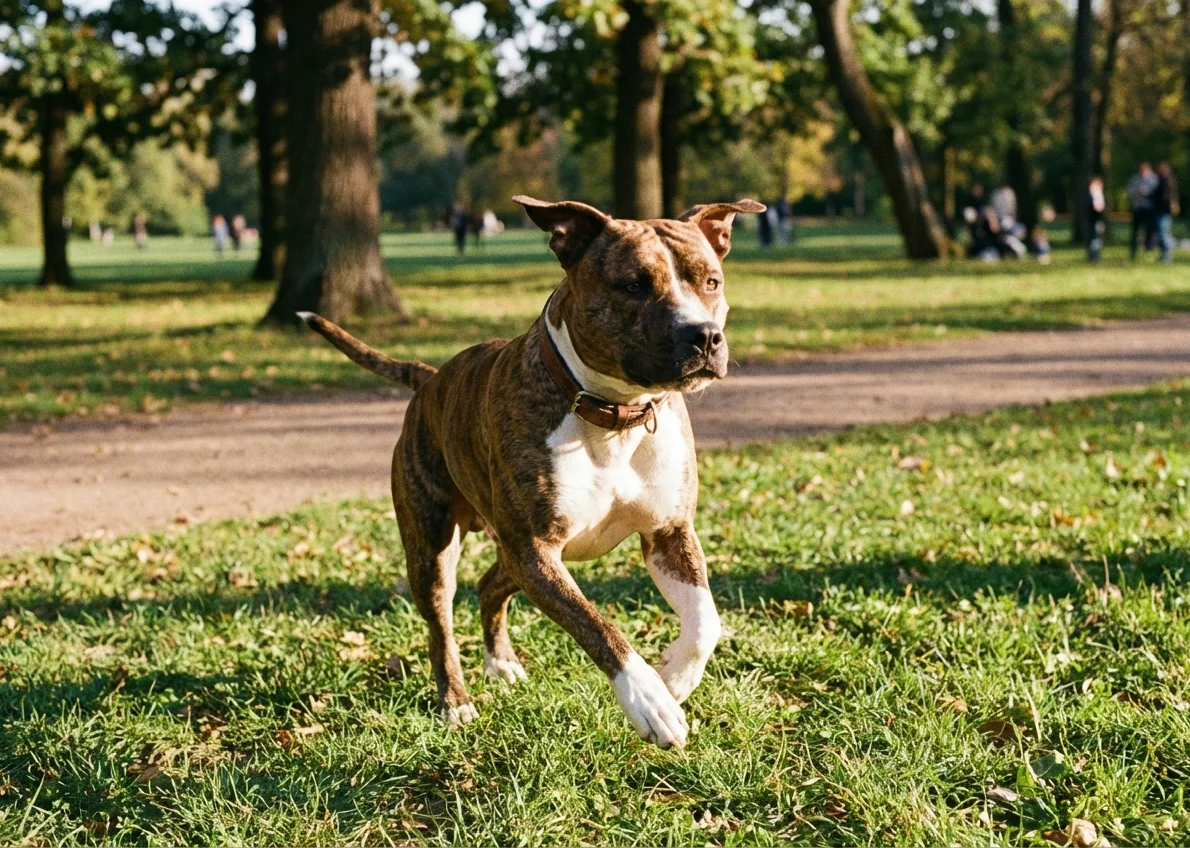
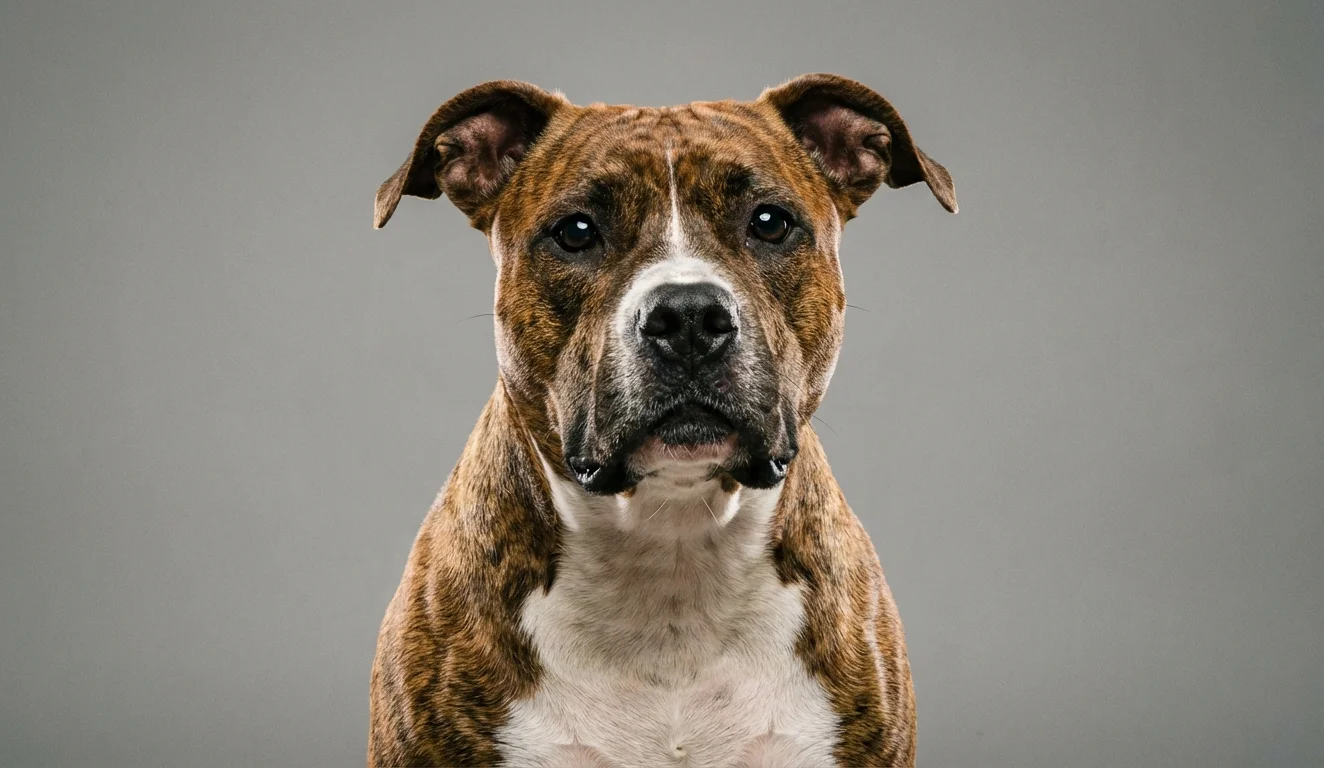
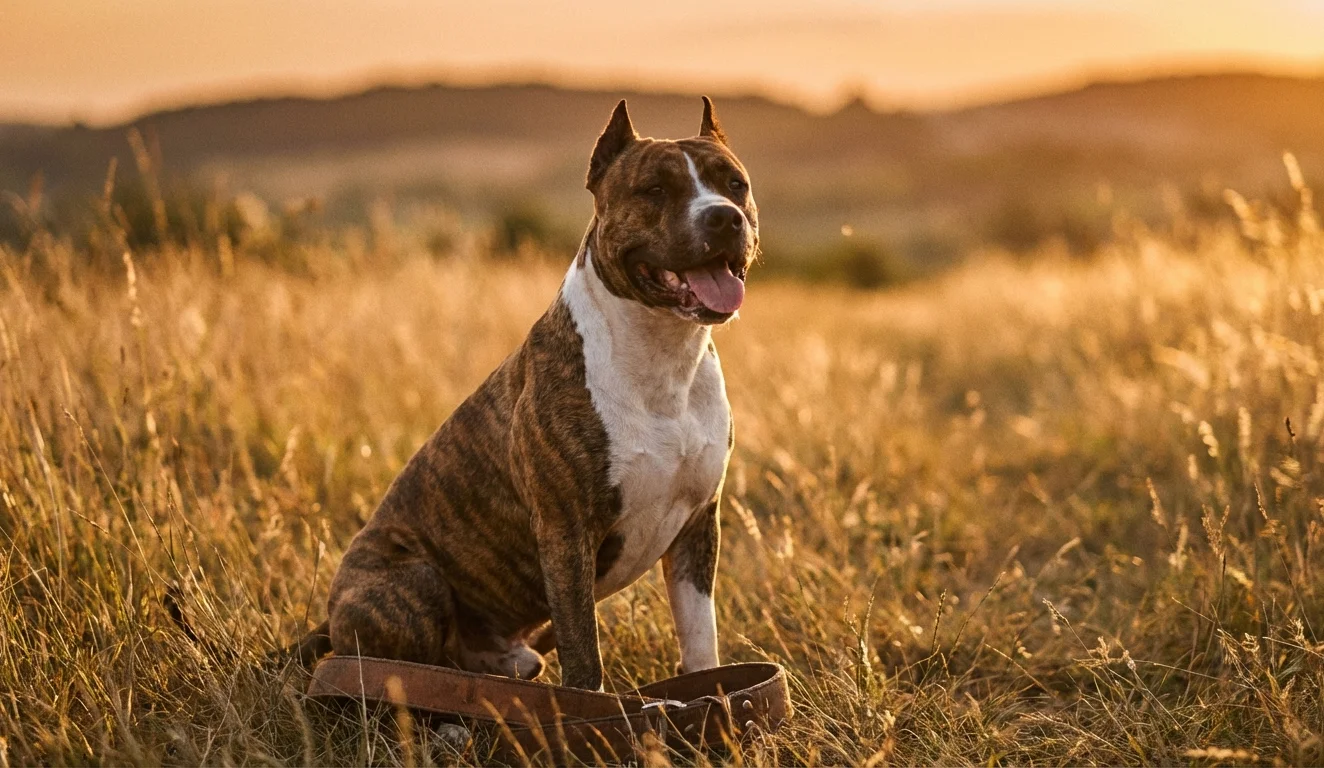
AmStaffs are built like small tanks. Males stand 18-19 inches and weigh 55-70 pounds. Females are 17-18 inches and 40-55 pounds. Despite being classified by many as “medium,” they feel bigger than their measurements suggest because of how densely muscled they are. An AmStaff at 60 pounds is packed tighter than most breeds at 80.
The breed has a broad, wedge-shaped head with pronounced cheek muscles, a medium-length muzzle, and high-set ears that can be either cropped or natural (natural is increasingly preferred). Their eyes are dark, round, and set low, they have an expressive face that communicates exactly what they’re thinking. Their body is stocky with a broad chest, well-sprung ribs, and a short tail that tapers to a point.
Their coat is short, stiff, and glossy. It lies close to the body and comes in just about every color and pattern you can imagine, solid, parti-color, patched, brindle, you name it. The AKC standard only penalizes dogs that are more than 80% white, solid white, or liver-colored. Grooming this coat is about as simple as it gets in the dog world.
American Staffordshire Terrier Temperament
The AKC calls the AmStaff “confident, smart, and good-natured,” and honestly that’s pretty spot-on. These are dogs that genuinely love people, not just their people, but often everyone they meet. An AmStaff with proper socialization will greet strangers with a wagging tail and a full-body wiggle that makes their muscular frame look almost comical.
What you need to know about AmStaff temperament:
- People-oriented to the extreme. AmStaffs want to be where you are, doing what you’re doing. They’re not independent dogs that go off and do their own thing. If you’re on the couch, they’re on your lap (all 65 pounds of them). If you’re in the yard, they’re right there.
- Dog selectivity is real. While AmStaffs are typically wonderful with people, many develop dog selectivity or dog aggression as they mature, usually around 2-3 years old. A puppy that played great at the dog park may start having issues with unfamiliar dogs as an adult. This is a breed tendency, not a training failure.
- They’re sensitive. This surprises a lot of people. AmStaffs are emotionally tuned in to their owners and can be genuinely hurt by harsh corrections. They respond much better to positive reinforcement than to punishment-based training.
- High pain tolerance can mask problems. AmStaffs are stoic dogs. They’ll play through injuries that would have other breeds limping. This means you need to watch them closely for signs of discomfort because they won’t always tell you.
- Prey drive varies. Some AmStaffs are fine with cats and small animals. Others aren’t. This is highly individual, but erring on the side of supervised introductions is smart.
Exercise Needs
AmStaffs need about 60-90 minutes of exercise per day. They’re not as high-energy as a working breed like a Border Collie, but they’re more active than most people expect. A sedentary AmStaff will redirect that energy into chewing furniture, digging holes, and generally making creative decisions about your property.
Good exercises for AmStaffs:
- Walks and jogs. Two 30-45 minute walks at a brisk pace work well. Many AmStaffs make decent jogging partners once they’re past their growth phase (wait until at least 18 months to avoid joint damage).
- Fetch and tug. AmStaffs tend to love both. Their jaw strength makes tug a particularly satisfying game for them, and a good 20-minute tug session will tire them out faster than you’d expect.
- Spring poles and flirt poles. These capitalize on the breed’s natural drive and athleticism. A spring pole (a rope-and-bungee setup attached to a tree) lets an AmStaff play tug independently.
- Nose work. They have solid scenting ability, and mental exercise tires this breed out as effectively as physical exercise.
AmStaffs are moderately heat-tolerant but shouldn’t be overexerted in extreme heat. Their short coat means they also feel the cold more than double-coated breeds, so winter walks may need a jacket when temperatures drop below 40 degrees.
Grooming
AmStaffs are one of the easiest breeds to groom. That short, stiff coat needs brushing once a week with a rubber curry brush or bristle brush to remove loose hair and distribute skin oils. Shedding is light to moderate year-round with a slight increase during spring and fall.
Baths every 6-8 weeks are usually sufficient unless your AmStaff has been rolling in something questionable (and they will, eventually). Use a gentle, pH-balanced dog shampoo. Their skin can be prone to irritation, so avoid over-bathing.
Nail trims every 2-3 weeks, ear checks weekly, and dental care round out the routine. AmStaffs are prone to dental issues, so daily brushing or dental chews are worth the effort. The whole grooming routine takes maybe 15 minutes a week outside of bath time. If you’re coming from a breed that requires professional grooming, this will feel like a vacation.
American Staffordshire Terrier Health Issues
AmStaffs are a generally healthy breed with a solid lifespan of 12-16 years for their size. But there are several conditions worth monitoring.
Hip Dysplasia
The OFA reports a moderate incidence of hip dysplasia in AmStaffs. The hip joint doesn’t develop properly, leading to arthritis, pain, and reduced mobility over time. Severity ranges from mild (managed with weight control and supplements) to severe (requiring surgical intervention). Treatment costs range from $500 for conservative management to $5,000-$7,000 for total hip replacement. Reputable breeders should have OFA or PennHIP clearances on both parents.
Cardiac Disease
AmStaffs have a breed predisposition to several heart conditions, including congenital heart defects and valve disease. The AKC recommends a cardiac evaluation as part of breed health screening. Symptoms can include exercise intolerance, coughing, and fainting. Treatment costs vary widely, $500-$1,500 for ongoing management, $5,000-$20,000+ for surgical intervention. Ask breeders about cardiac clearances.
Cerebellar Ataxia
This is a hereditary neurological condition specific to AmStaffs where the cerebellum (the part of the brain controlling coordination) degenerates. Symptoms typically appear between 3-5 years of age and include wobbling, loss of balance, and difficulty walking. There’s no cure, and it’s progressive. A DNA test exists for the NCL-A gene variant, and responsible breeders screen for it. Testing costs around $50-$150.
Skin Allergies
AmStaffs are prone to environmental and food allergies that manifest as skin irritation, itching, hot spots, and ear infections. This is one of the most common reasons AmStaff owners visit the vet. Treatment typically involves identifying triggers (allergy testing runs $200-$600), dietary changes, and medications like Apoquel or Cytopoint ($50-$150/month). Annual costs for managing allergies run $600-$2,000.
Cranial Cruciate Ligament (CCL) Tears
Their muscular build and athletic activity level make AmStaffs moderately prone to CCL tears (the dog equivalent of a torn ACL). Surgical repair, usually TPLO surgery, costs $3,500-$6,000 per knee. Maintaining a healthy weight is the best prevention.
Training
AmStaffs are smart and eager to please, which makes them more trainable than many terrier breeds. They don’t have the stubborn independence of an Akita or the “what’s in it for me” calculation of a Shiba Inu. Give an AmStaff clear direction and positive feedback, and they’ll work hard for you.
What works with AmStaffs:
- Positive reinforcement. This breed thrives on praise, treats, and play-based rewards. Their sensitivity means they shut down under harsh corrections, and a 65-pound dog that shuts down is hard to re-engage.
- Early socialization is non-negotiable. Between 8 and 16 weeks, expose your AmStaff puppy to as many people, dogs, environments, and situations as possible. Given the breed’s tendency toward dog selectivity, early positive experiences with other dogs are especially important.
- Structured activities. AmStaffs excel in obedience, rally, agility, and, particularly, weight pulling. Giving them a job channels their drive productively.
- Consistency across the household. Everyone in the family needs to enforce the same rules. AmStaffs are smart enough to figure out which family member lets them get away with things, and they’ll exploit it.
One training note specific to this breed: invest heavily in a rock-solid recall and in teaching a reliable “leave it.” Given the breed stigma, an AmStaff that doesn’t come when called or lunges toward another dog (even playfully) creates outsized problems compared to the same behavior from a Lab.
Cost
Purchase Price
An AmStaff puppy from a reputable breeder with health clearances costs $1,500-$3,000. Breeders who do cardiac, hip, elbow, and NCL-A genetic testing will be on the higher end, and that’s money well spent.
Adoption through breed-specific rescues or shelters is a strong option and typically costs $100-$400. AmStaffs and AmStaff mixes are among the most commonly found dogs in shelters nationwide. Many are well-socialized adults who ended up in rescue through no fault of their own.
Monthly Costs
| Expense | Monthly Estimate |
|---|---|
| Food (high-quality, large breed) | $50-$80 |
| Preventive vet care (averaged) | $20-$35 |
| Pet insurance | $40-$65 |
| Treats and chews | $15-$25 |
| Miscellaneous (toys, supplies) | $10-$20 |
| Total | $135-$225 |
First-Year Costs
Budget $3,000-$5,500 for the first year, including purchase price or adoption fee, initial vet visits, vaccinations, spay/neuter, and supplies. Factor in an additional $200-$500 for a quality training class, with this breed, professional training isn’t optional.
Is an American Staffordshire Terrier Right for You?
An AmStaff is a great fit if you:
- Want a loyal, people-focused dog that genuinely wants to be your shadow
- Are active and can commit to 60-90 minutes of daily exercise
- Have experience managing strong, athletic dogs (or are willing to work with a trainer)
- Understand and can manage dog selectivity responsibly
- Don’t mind being an ambassador for the breed, you’ll have conversations about “pit bulls” whether you want to or not
- Live in an area without breed-specific legislation (check your local and state laws, your homeowner’s insurance policy, and your landlord’s pet policy before committing)
An AmStaff is probably NOT right if you:
- Frequently visit off-leash dog parks and want a dog that gets along with every dog it meets
- Have housing or insurance restrictions on “bully breeds” that you can’t work around
- Want a hands-off dog that entertains itself, AmStaffs need your time and attention
- Aren’t comfortable being physically strong enough to handle a powerful dog on leash
- Travel frequently and need to board your dog (some boarding facilities won’t accept bully breeds)
The AmStaff is, at its core, a people dog trapped in a controversial body. If you can handle the practical realities of breed stigma and provide the socialization, training, and exercise this breed needs, you’ll be rewarded with one of the most affectionate, loyal, and genuinely fun dogs you’ve ever owned.
Related Breeds
If you’re considering this breed, you might also want to look at:
FAQ
Is an American Staffordshire Terrier the same as a Pit Bull?
Not exactly. The term “pit bull” is a loose category that people apply to several breeds including the American Staffordshire Terrier, American Pit Bull Terrier (APBT), Staffordshire Bull Terrier, and any mix that looks vaguely similar. The AmStaff is an AKC-registered breed with a written standard and documented pedigrees. The APBT is registered by the UKC and ADBA but not the AKC. There’s significant genetic overlap, many dogs are dual-registered as both, but they’re technically separate breeds with different breed standards. From a legal standpoint, though, breed-specific legislation often lumps them together.
Are AmStaffs good with children?
Well-bred, well-socialized AmStaffs are typically excellent with children. The breed has a historical reputation as a family dog, and their patience, sturdiness, and playful nature make them good companions for older kids. But their strength means interactions with very young children should always be supervised, not because the dog is aggressive, but because a 60-pound dog with a muscular build can accidentally knock a toddler over just by wagging its tail enthusiastically.
How much exercise does an American Staffordshire Terrier need?
Plan on 60-90 minutes daily. This can be split between walks, play sessions, and training. AmStaffs are adaptable, they don’t need marathon runs, but they do need consistent physical and mental stimulation. A tired AmStaff is a well-behaved AmStaff. A bored one will find ways to entertain itself that you won’t appreciate.
Do AmStaffs have lockjaw?
No. This is a persistent myth with zero basis in anatomy or veterinary science. No dog breed has a locking mechanism in its jaw. A 2009 study by Dr. I. Lehr Brisbin at the University of Georgia found nothing unique about the jaw structure or bite mechanics of “pit bull-type” dogs. AmStaffs do have strong jaw muscles and a tenacious grip, they’re terriers, after all, but the “lockjaw” claim is fiction.
What states or cities ban American Staffordshire Terriers?
Breed-specific legislation (BSL) varies widely. As of 2025, some municipalities in states like Iowa, Kansas, Missouri, and Ohio have restrictions. Miami-Dade County in Florida has a long-standing ban. But the trend is moving away from BSL, many states have passed preemption laws preventing local breed bans, and organizations including the AKC, AVMA, and ASPCA oppose breed-specific legislation. Always check your specific city and county ordinances, your homeowner’s or renter’s insurance policy, and your landlord’s pet policy before bringing an AmStaff home.