Nova Scotia Duck Tolling Retriever Breed Guide: The Fox-Red Trickster (2026)
The Toller is a medium-sized retriever that lures ducks with playful antics and then retrieves them. Yes, really. Here's what owning one is like.
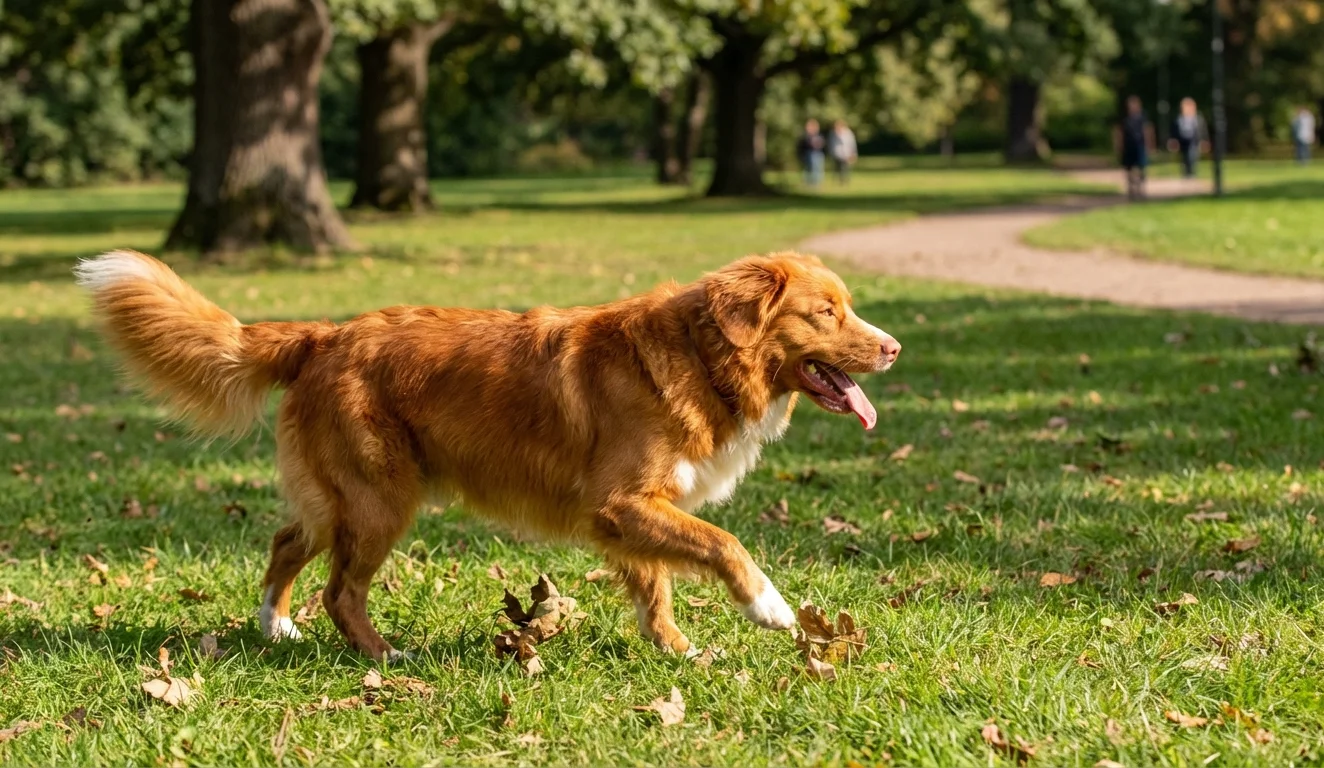
The Nova Scotia Duck Tolling Retriever, mercifully shortened to “Toller” by everyone who’s ever had to say the full name twice, stands 17-21 inches tall, weighs 35-50 pounds, and lives 12-14 years. They look like a smaller, fox-red Golden Retriever, which leads to constant misidentification at dog parks. But Tollers aren’t Goldens in a smaller package. They’re a completely different dog: more intense, more reserved with strangers, and built around one of the weirdest hunting strategies in the dog world.
In Short: 35–50 lbs, 12–14 years. High energy. Moderate shedding with seasonal blowouts. Watch for Hip Dysplasia and Addison’s Disease. Best for active owners who want a smart, athletic retriever that isn’t a Golden or a Lab.
Here’s the hunting strategy that gave this breed its name: the Toller plays along the shoreline, running, jumping, fetching sticks, visible to waterfowl sitting out on the water. Ducks are naturally curious, and this playful display (called “tolling”) draws them closer to shore to investigate. Once the ducks are within shooting range, the hunter takes the shot, and the Toller switches from performer to retriever, swimming out to bring back the bird. It sounds made up. It’s not. It actually works, and it’s been documented since at least the 17th century.
Nova Scotia Duck Tolling Retriever at a Glance
| Trait | Details |
|---|---|
| Breed Group | Sporting (AKC) |
| Height | Males: 18-21 in / Females: 17-20 in |
| Weight | Males: 35-50 lbs / Females: 35-44 lbs |
| Life Expectancy | 12-14 years |
| Coat | Medium-length, dense double coat with water-repellent outer layer |
| Colors | Various shades of red and orange, with white markings |
| Temperament | Intelligent, Outgoing, Adaptable, Alert |
| Shedding | Moderate (heavy seasonal blowouts) |
| Energy Level | High |
| Good With Kids | Yes |
| Apartment Friendly | Not ideal |
History
The Toller was developed in the early 19th century in Yarmouth County, Nova Scotia, Canada. The breed’s creation story is rooted in observing a natural phenomenon: indigenous Mi’kmaq people and early European settlers noticed that foxes would play along riverbanks, their frolicking drawing curious ducks toward shore. Hunters decided to replicate this with dogs.
The specific breeds that went into creating the Toller aren’t precisely documented, but historians believe the mix included small spaniels, setters, retrievers, and possibly a farm collie or two. The result was a medium-sized, fox-colored dog with an irresistible drive to play and fetch, the perfect tolling machine. The breed was refined in the Little River district of Yarmouth County, and for a while they were called “Little River Duck Dogs.”
Canada’s Kennel Club recognized the breed in 1945, and it became the official provincial dog of Nova Scotia in 1995. AKC recognition came much later, in 2003, making the Toller one of the newer breeds in the AKC registry. The breed remains relatively rare, you won’t see them at every dog park, but awareness has grown significantly in the last decade, particularly among active, outdoorsy dog owners looking for something different from the Lab-Golden-Chessie trifecta.
Size and Appearance
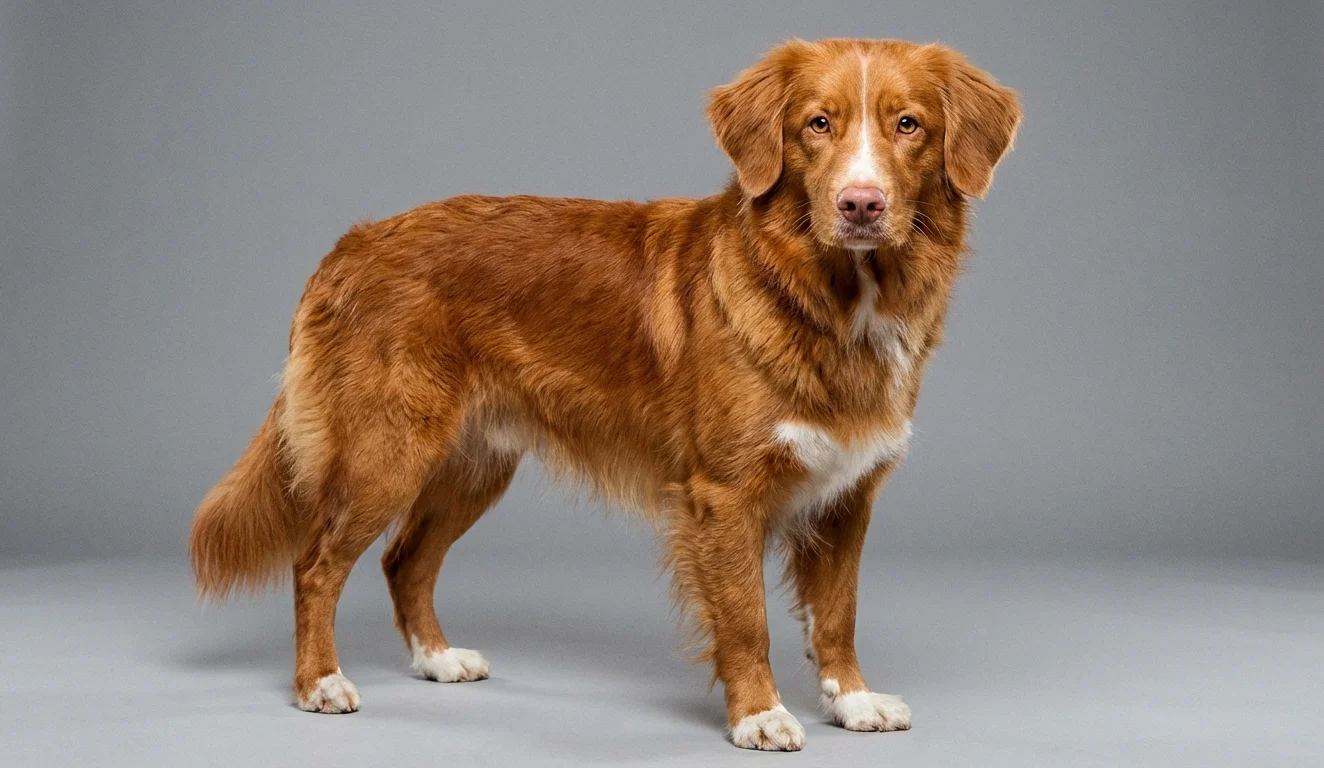
Tollers are the smallest of the retriever breeds, and their size is intentional. A dog that’s tolling along a shoreline needs to look vaguely fox-like from a distance, so the breed standard calls for a compact, medium-sized body. Males stand 18-21 inches and weigh 35-50 pounds. Females are 17-20 inches and 35-44 pounds.
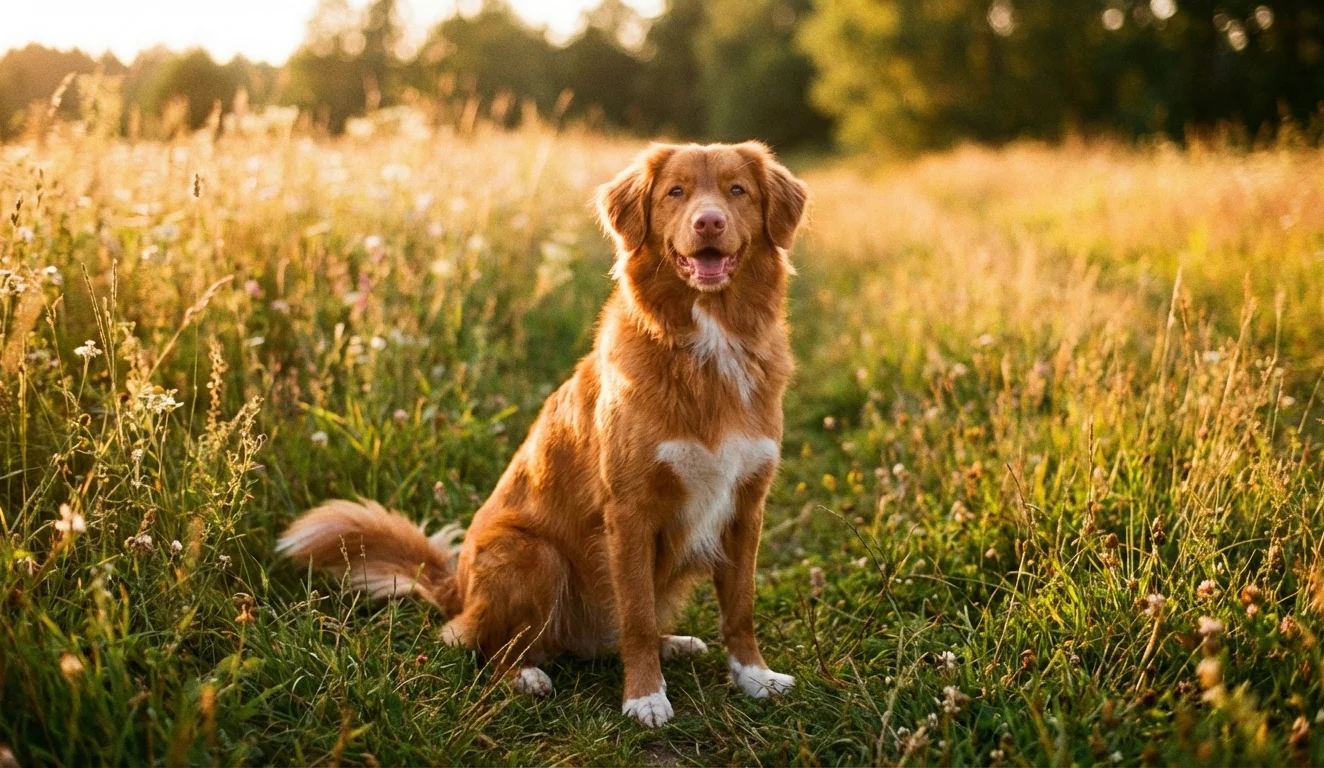
The coat is the first thing people notice. Tollers are strikingly beautiful dogs, their medium-length, dense double coat comes in shades ranging from golden red to dark coppery red, always with white markings on the tail tip, feet, chest, and often a blaze on the face. The white tail tip is particularly important: it acts as a visual lure when the dog is playing and tolling, flashing back and forth to catch the attention of distant waterfowl.
The build is athletic and compact, more agile than a Labrador, sturdier than a setter. They have wedge-shaped heads with medium-length muzzles, and their expression is intelligent and alert. The tail is heavily feathered and carried high when the dog is excited, which is most of the time.
One thing that surprises people: Tollers have a distinctive scream. Not a bark, a high-pitched, excited vocalization that they produce when they’re really amped up. The “Toller scream” is legendary among owners and can be alarming if you’re not expecting it.
Nova Scotia Duck Tolling Retriever Temperament
Tollers are not Golden Retrievers. This is the most important thing to understand if you’re considering the breed. Where Goldens love everyone instantly and unconditionally, Tollers are more discerning. They bond deeply with their family but can be aloof or reserved with strangers. It’s not unfriendliness, it’s selectivity.
What living with a Toller’s temperament actually looks like:
- They’re intense about play. Tollers don’t just enjoy fetch, they’re obsessive about it. A Toller will retrieve until it physically can’t anymore. This isn’t hyperbole. You’ll be the one who quits first, every single time.
- They’re smart in a problem-solving way. Tollers don’t just learn commands. They figure out how things work. Cabinet latches, gate mechanisms, puzzle toys, they approach the world like engineers. This intelligence is great when you’re training. It’s less great when they’re disassembling your kitchen.
- They have an “off switch” that other retrievers lack. Unlike Labs and Goldens, a well-exercised Toller can actually settle in the house. They have two modes: intense work mode and genuine relaxation. This is one of the breed’s most appealing qualities.
- The Toller scream is real. When excited, usually in anticipation of fetch, swimming, or food, Tollers produce a distinctive high-pitched scream that’s unlike any other dog vocalization. Some people find it endearing. Some find it piercing. You should hear it before you commit.
Tollers are good with children, particularly kids old enough to play fetch and join in outdoor activities. They’re generally good with other dogs, though some can be selective about their canine friends.
Exercise Needs
Tollers need 60-90 minutes of vigorous exercise per day. “Vigorous” is the key word, a leisurely neighborhood walk isn’t going to cut it. This is a sporting breed that was developed for long days of tolling and retrieving, and that athletic foundation hasn’t gone anywhere.
What works for Toller exercise:
- Retrieving. It’s their purpose, and they’ll do it with a focus that borders on mania. A ball launcher and a field or lake is the Toller exercise gold standard.
- Swimming. Tollers are strong, confident swimmers with water-repellent coats. Most will happily spend hours at a lake.
- Agility and flyball. The breed’s combination of speed, intelligence, and drive makes them agility superstars. Tollers regularly rank among the top-performing breeds in competitive agility.
- Hiking off-leash. Tollers have good natural recall and love trail running.
- Dock diving. The breed’s enthusiasm for water plus their athletic jumping ability makes this a natural fit.
The good news about Toller exercise: once they’ve been properly worked, they settle beautifully in the house. This is a breed that can go hard for 90 minutes and then nap on the couch for hours. That on/off switch is one of the Toller’s best features.
The bad news: if you skip the exercise, the on switch stays on. Under-exercised Tollers become restless, vocal, and destructive.
Grooming
The Toller’s double coat requires consistent maintenance but isn’t as demanding as you might expect from a retriever with feathering.
Grooming schedule:
- Brush 2-3 times per week with a slicker brush or undercoat rake
- Daily brushing during spring and fall blowouts (these are significant, expect about 3 weeks of heavy shedding each time)
- Bath every 6-8 weeks: the coat’s natural water-repellent oils mean you shouldn’t over-bathe
- Trim feathering on the ears, feet, and hocks as needed for tidiness
- Nail trim every 2-3 weeks
- Ear check weekly: especially important after swimming
Important note: never shave a Toller’s coat. The double coat provides insulation in both hot and cold weather, and shaving it disrupts the natural regrowth pattern. It can take 1-2 years for a shaved double coat to return to normal.
The Toller coat does a decent job of repelling dirt and water, so they stay cleaner than you’d expect. After a swim, a quick towel-dry is usually sufficient. The coat air-dries relatively quickly thanks to those natural oils.
Nova Scotia Duck Tolling Retriever Health Issues
Tollers are generally a healthy breed, but the relatively small gene pool (all modern Tollers trace back to a limited number of foundation dogs in Nova Scotia) concentrates some genetic conditions.
Hip Dysplasia
The OFA reports moderate prevalence of hip dysplasia in Tollers. Responsible breeders screen through OFA or PennHIP evaluations. Treatment ranges from conservative management to total hip replacement at $1,500-$6,000.
Addison’s Disease (Hypoadrenocorticism)
This is the breed’s hallmark health concern. Addison’s disease occurs when the adrenal glands don’t produce enough hormones, particularly cortisol and aldosterone. Tollers have one of the highest breed-specific rates of Addison’s in the dog world. Symptoms include lethargy, vomiting, muscle weakness, and in severe cases, an adrenal crisis that can be fatal. Once diagnosed, Addison’s is manageable with lifelong hormone replacement medication. Diagnosis costs $500-$1,500, and ongoing monthly medication runs $50-$150. The good news is that well-managed Addison’s dogs can live normal lifespans.
Progressive Retinal Atrophy (PRA)
PRA causes progressive vision loss and eventual blindness. A DNA test (prcd-PRA) exists for the form most common in Tollers, and all responsible breeders should be testing for it. Dogs can be clear, carrier, or affected. Carriers bred to clear dogs won’t produce affected puppies. There’s no treatment for PRA itself, but affected dogs adapt well to vision loss in familiar environments.
Immune-Mediated Rheumatic Disease (IMRD)
Tollers are predisposed to an autoimmune condition that causes joint inflammation, stiffness, and pain. It typically appears in young adults (1-3 years). Treatment involves immunosuppressive medication at $500-$2,000 annually. The condition can be managed but requires ongoing veterinary monitoring.
Degenerative Encephalopathy
A neurological condition documented in Tollers that causes progressive brain deterioration. Symptoms include behavioral changes and loss of coordination. It’s rare but serious, and research into genetic markers is ongoing.
Training
Tollers are highly trainable but require a different approach than the classic “eager to please” retrievers. They’re smart, really smart, and they’ll question the point of repetitive drills. A Toller that’s asked to sit-stay for the fifteenth time in a row will give you a look that clearly communicates, “We’ve covered this.”
Training approach for Tollers:
- Positive reinforcement with high-value rewards. Tollers are food-motivated and toy-motivated (especially anything they can retrieve).
- Variety is non-negotiable. Change up exercises, locations, and reward types frequently. Bored Tollers check out.
- Use their retriever instincts as a training motivator. “You can go get the bumper after you hold this stay” is an incredibly powerful motivator.
- Start socialization early and make it ongoing. The Toller’s natural reserve with strangers can tip into shyness if they’re not exposed to varied situations during the critical 8-16 week period.
- Work on the “Toller scream” management early if you need to, teach them that excitement doesn’t require full vocal expression.
Tollers excel at competitive obedience, agility, flyball, dock diving, and of course hunt tests. They’re also excellent scent detection dogs. Mental stimulation is just as important as physical exercise for this breed, puzzle toys, training games, and nose work keep that busy brain satisfied.
Cost
Purchase Price
A Nova Scotia Duck Tolling Retriever puppy from a reputable breeder costs $2,000-$3,500. The breed’s rarity means fewer breeders, longer wait lists, and higher prices. Many Toller breeders have wait lists of 1-2 years for puppies from health-tested parents.
Toller rescue is extremely limited due to the breed’s rarity. When dogs do become available through the Nova Scotia Duck Tolling Retriever Club (USA) rescue network, adoption fees are typically $300-$500.
Monthly Costs
| Expense | Monthly Estimate |
|---|---|
| Food (high-quality kibble) | $30-$50 |
| Preventive vet care (averaged) | $15-$30 |
| Pet insurance | $30-$50 |
| Treats and chews | $10-$20 |
| Miscellaneous (toys, supplies) | $10-$25 |
| Total | $95-$175 |
First-Year Costs
Budget $3,500-$5,500 for the first year, including purchase price, initial vet care, vaccinations, spay/neuter, supplies, and training. Given the breed’s predisposition to Addison’s disease, pet insurance is a wise investment, monthly medication costs add up to $600-$1,800 per year if your Toller is diagnosed.
Is a Nova Scotia Duck Tolling Retriever Right for You?
A Toller is a great fit if you:
- Want a retriever that’s a bit different from the Lab/Golden mainstream
- Are athletic and can commit to 60-90 minutes of vigorous daily exercise
- Enjoy water activities, swimming, dock diving, lake trips
- Want a dog that can go hard outdoors and then actually relax at home
- Appreciate intelligence and don’t mind a dog that occasionally questions your training choices
- Are interested in competitive dog sports
A Toller is probably NOT right if you:
- Want a dog that loves every stranger it meets, Tollers are friendly but selective
- Can’t handle the “Toller scream” (look it up on YouTube before you decide)
- Live in an apartment without easy access to outdoor space
- Want a low-energy companion dog
- Aren’t prepared for wait lists and limited breeder availability
- Expect Golden Retriever-level eagerness to please
The Toller is a breed for people who do their research. If you’re reading this, you’re probably the right type of owner, someone who wants to understand a breed fully before committing. Tollers reward that diligence with a partnership that’s smart, athletic, and genuinely unique. You’ll spend the rest of your dog’s life explaining what breed it is, and you’ll never mind doing it.
Related Breeds
If you’re considering this breed, you might also want to look at:
FAQ
What does “tolling” mean?
Tolling is a hunting technique where a dog plays along a shoreline to attract waterfowl. The dog’s playful movements, running, jumping, fetching, trigger the natural curiosity of ducks, drawing them closer to shore and into shooting range. The word “toll” comes from Middle English “tollen,” meaning to entice or lure. It’s the same root as “toll” in the sense of ringing a bell to draw attention. Tollers were specifically bred to perform this behavior, and most will do it instinctively even without training.
Are Nova Scotia Duck Tolling Retrievers good apartment dogs?
Not really. Tollers can theoretically adapt to apartment living if their exercise needs are fully met, but it’s not the ideal setup. They need significant daily exercise, access to swimming when possible, and space to play fetch. The Toller scream can also be a noise issue in multi-unit buildings. If you’re set on a Toller and live in an apartment, you’ll need to be near parks, trails, or water and be absolutely committed to daily exercise outings.
Do Tollers get along with other dogs?
Generally, yes. Tollers are usually friendly with other dogs, especially if socialized early. Some Tollers can be selective about their canine friends, they may have preferred playmates and be indifferent to others. Dog-aggression is not a breed trait, but individual temperament varies. Early socialization with a variety of dogs during puppyhood helps ensure your Toller grows up to be socially well-adjusted.
How rare are Nova Scotia Duck Tolling Retrievers?
Fairly rare. The AKC ranked the Toller 77th out of 200 breeds in popularity as of recent data, and they’re still relatively unknown compared to Labs, Goldens, and other retrievers. Expect to wait 6-24 months for a puppy from a reputable breeder. The breed’s scarcity actually works in its favor, Toller breeders tend to be experienced and committed to health testing, which means you’re more likely to get a well-bred puppy than with more popular breeds where backyard breeding is common.
What’s the Toller scream?
The Toller scream is a distinctive high-pitched vocalization, somewhere between a bark, a scream, and a shriek, that Tollers produce when they’re very excited. It typically happens in anticipation of something the dog loves: seeing a ball, approaching water, or greeting their favorite person. Not all Tollers scream at the same volume or frequency, but it’s a breed trait. It’s not trainable out of them entirely. Some owners find it endearing and hilarious. Others find it ear-splitting. We strongly recommend watching Toller scream videos online before committing to the breed.