English Springer Spaniel Breed Guide: The Bird Dog That Wants a Desk Job Too (2026)
English Springer Spaniels are 40-55 pound bundles of enthusiasm with long ears and zero concept of personal space. Here's what that life looks like.
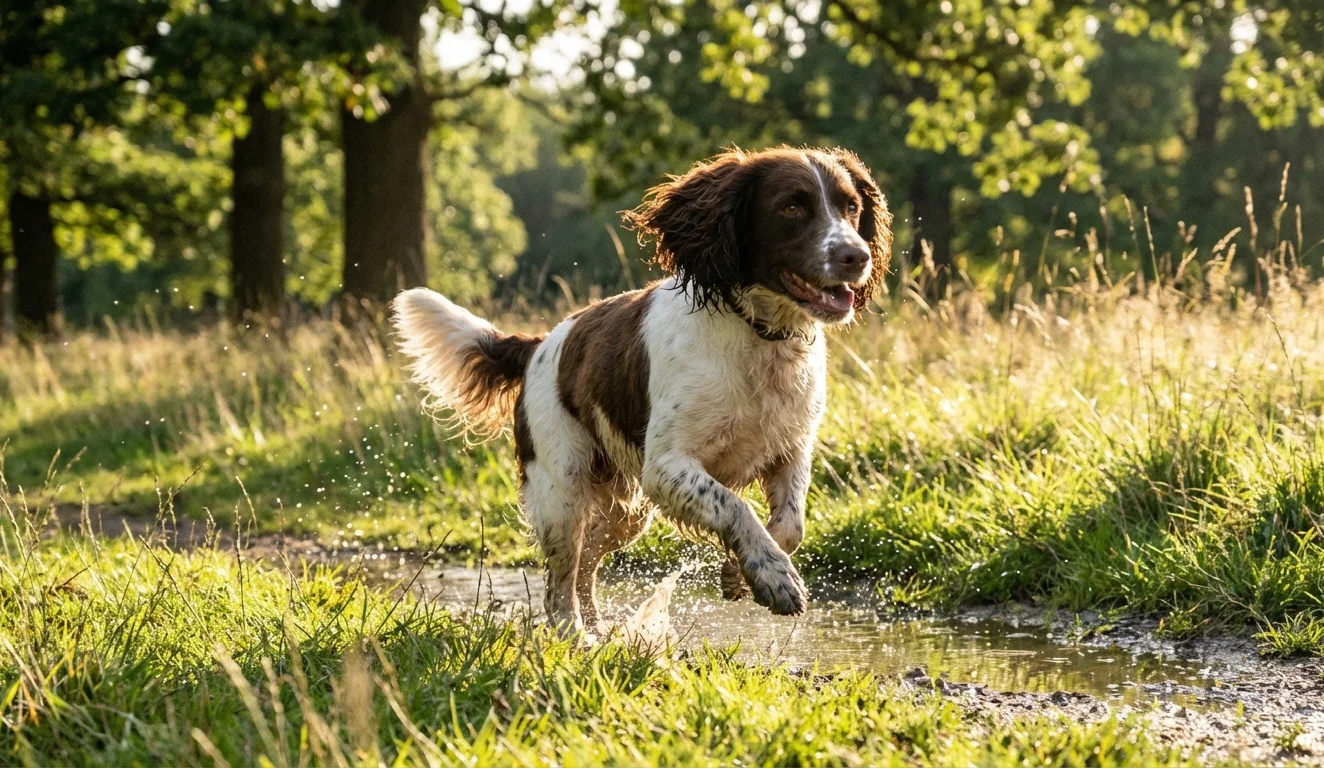
The English Springer Spaniel weighs 40-55 pounds, stands 18-21 inches tall, and lives 12-14 years. They were bred to flush, or “spring”, game birds from cover, and that original purpose tells you almost everything about this dog’s energy level. They’re fast, they’re tireless, and they approach every day like it’s the best day that’s ever happened to anyone.
In Short: 40–55 lbs, 12–14 years. High energy. Moderate shedding. Watch for Ear Infections. Great for families and first-time owners.
We think the English Springer Spaniel is one of the most overlooked family sporting dogs in America. Everyone knows about Labs and Goldens, but Springers are right there in the same category, trainable, great with kids, happy to work or just hang out, and they bring a level of athleticism that’s honestly kind of beautiful to watch in the field. The trade-off is those ears. We’ll get to the ears.
English Springer Spaniel at a Glance
| Trait | Details |
|---|---|
| Breed Group | Sporting (AKC) |
| Height | Males: 19-21 in / Females: 18-20 in |
| Weight | Males: 50-55 lbs / Females: 40-45 lbs |
| Life Expectancy | 12-14 years |
| Coat | Medium-length double coat with feathering |
| Colors | Black & White, Liver & White, Blue Roan, Liver Roan, Tricolor |
| Temperament | Friendly, Playful, Obedient |
| Shedding | Moderate |
| Energy Level | High |
| Good With Kids | Yes |
| Apartment Friendly | No |
| Trainability | Very High |
History
The English Springer Spaniel is one of the oldest sporting breeds, with roots stretching back to the 1500s or earlier. Before specialized breeds existed, “spaniels” were a catch-all group of dogs used for flushing game. Larger spaniels “sprang” at birds to flush them from the brush for hunters with nets or falcons. Smaller ones crouched or “cocked” to indicate woodcock, those became Cocker Spaniels. Same litters, different sizes, different jobs.
The formal split between Springer Spaniels and Cocker Spaniels didn’t happen until 1902, when the Kennel Club of England recognized them as separate breeds. The AKC followed in 1910. Before that, a single litter of spaniels could produce both “springers” and “cockers” based on nothing more than the size they grew to.
English Springer Spaniels became popular in America as dual-purpose dogs, they could hunt all day Saturday and sleep at your feet Sunday morning. The breed hit its stride in the mid-20th century and has maintained steady popularity since. A Springer named James won Best in Show at the 2007 Westminster Kennel Club Dog Show, which gave the breed a nice bump in public awareness.
Size and Appearance
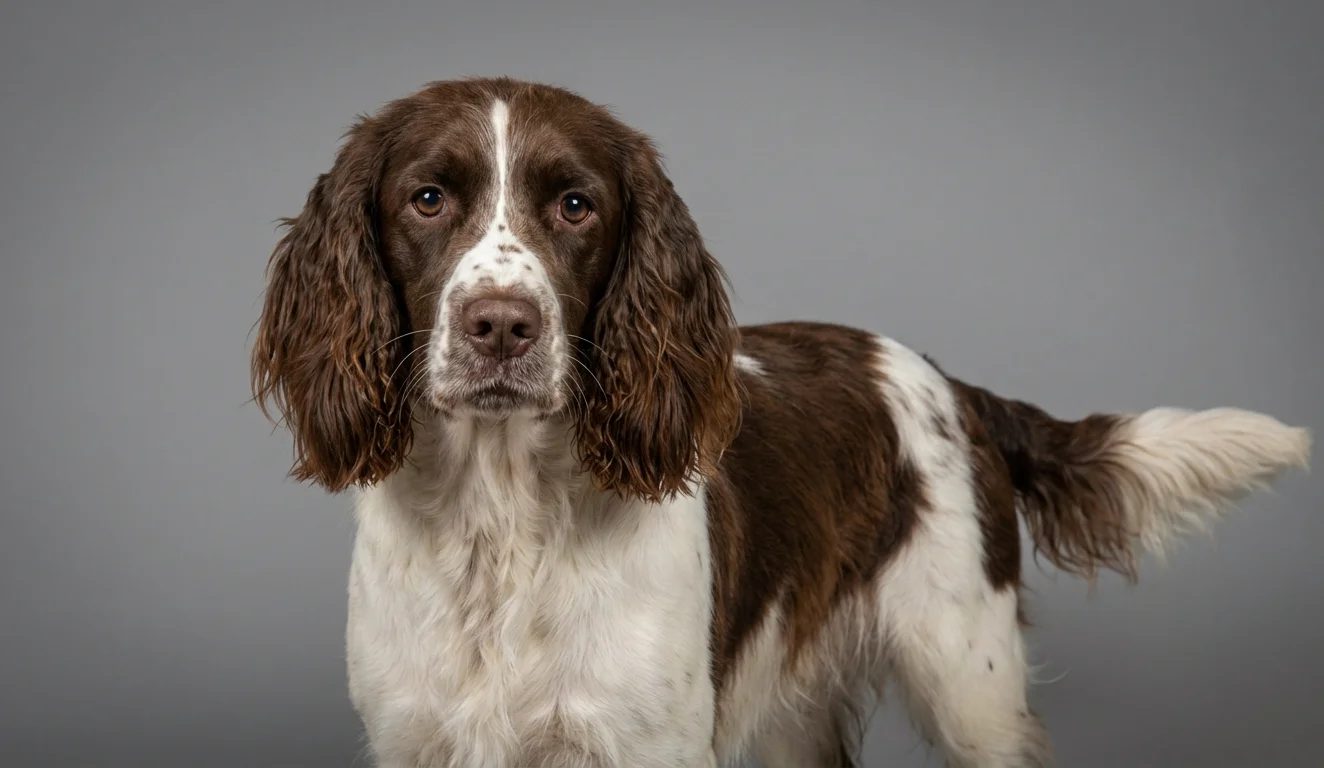
English Springer Spaniels are medium-sized, well-proportioned sporting dogs. Males stand 19-21 inches and weigh 50-55 pounds. Females are 18-20 inches and 40-45 pounds. They’re built for endurance in the field, not too heavy, not too light, with strong legs and a deep chest.
Show Type vs. Field Type
Like many sporting breeds, the Springer has diverged into two very different types over the past several decades.
- Show-type Springers have a heavier build, longer ears, more coat, and a calmer disposition. They look like what most people picture when they think “Springer Spaniel.”
- Field-type Springers are leaner, shorter-eared, with less coat and significantly more energy and drive. They’re built to hunt all day and they look the part, more athletic, less glamorous.
The difference between these two types is dramatic. A field-bred Springer and a show-bred Springer barely look like the same breed. If you want a family companion, we’d generally steer you toward show lines. If you hunt or do competitive field work, field lines are where the action is.
Coat and Color
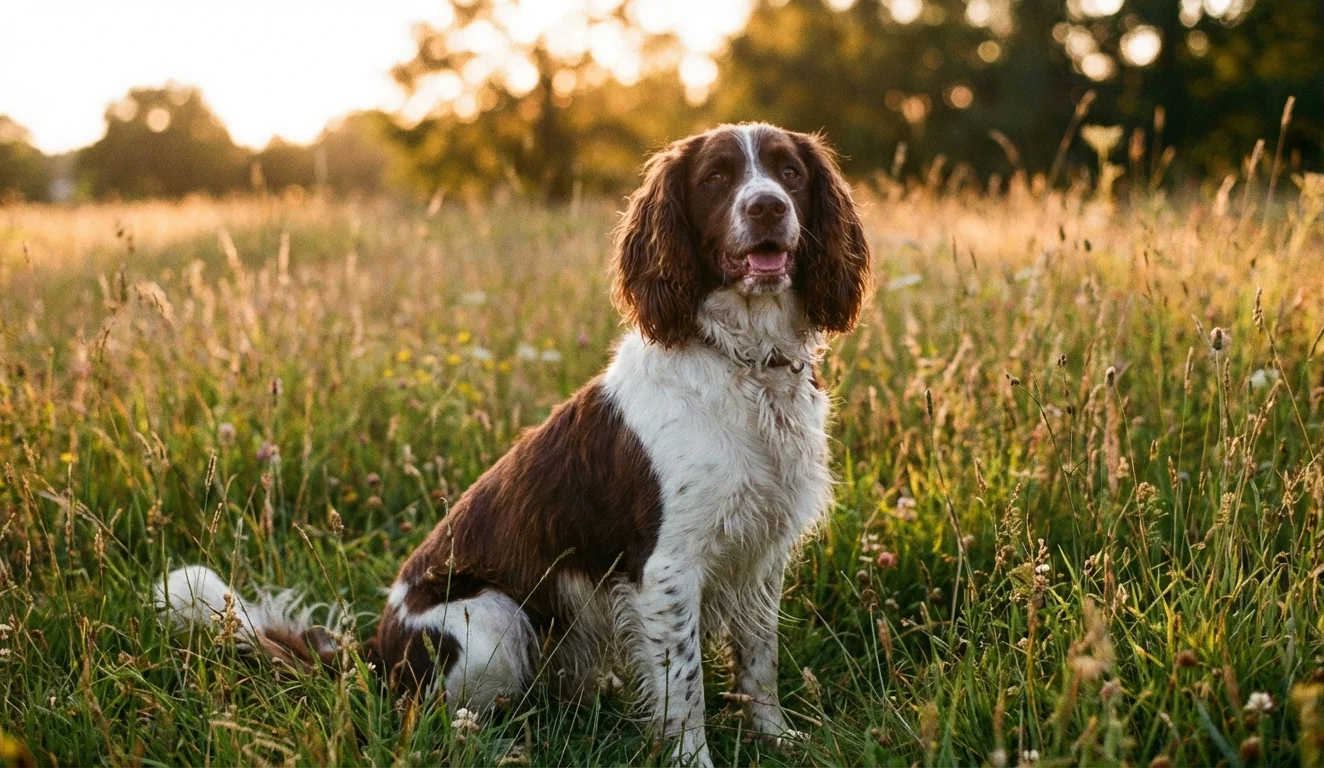
The coat is medium-length with feathering on the ears, chest, legs, and belly. It’s a double coat, a denser undercoat beneath a flatter, water-resistant outer coat. Common colors include black and white and liver and white, with or without ticking (small flecks of color in the white areas). Blue roan, liver roan, and tricolor are also recognized.
English Springer Spaniel Temperament
Springers are the middle ground between a hunting dog’s intensity and a companion dog’s warmth. They want to work and they want to be with you. Most of the time, those two desires align perfectly.
What Springer Spaniels are actually like to live with:
- Exuberantly friendly. Springers greet everyone like a long-lost friend. Tail going, body wiggling, entire back end swaying. They have no concept of playing it cool. This makes them terrible guard dogs but incredible family dogs.
- Eternally enthusiastic. A Springer doesn’t do anything at half-speed. Walks, meals, fetch, greeting you at the door, everything is approached with maximum excitement. This is charming for the first few years and occasionally exhausting after that.
- Birdy. Even Springers that have never hunted will point at pigeons, chase sparrows, and freeze when they catch a scent on the wind. The instinct is deeply embedded. If you have pet birds, think carefully.
- Emotionally tuned in. Springers are sensitive dogs that pick up on their owner’s mood. If you’re stressed, your Springer will be stressed. They do best in calm, stable households.
One important note: a small subset of English Springer Spaniels carry genes associated with a condition called “Springer Rage”, episodes of sudden, unprovoked aggression. This is rare, poorly understood, and may be linked to a form of epilepsy. It’s been largely bred out of reputable lines but is worth researching, particularly if you’re buying from an unfamiliar breeder. Ask about temperament history in the pedigree.
Exercise Needs
English Springer Spaniels need 60+ minutes of exercise per day, and that’s a minimum for adults. Field-type Springers may need even more. This is an athletic working breed, and if you don’t provide outlets for their energy, they’ll find their own, usually by rearranging your furniture.
Best activities for Springers:
- Long hikes or trail walks, this is a dog built for covering ground through brush and field
- Fetch (a ball launcher is your best friend with this breed)
- Swimming, most Springers are natural water dogs
- Hunting or hunt training, if you’re into that
- Agility, rally, or obedience competitions
- Nose work and scent tracking games
Springers that don’t get enough exercise become restless, mouthy, and destructive. A bored Springer will chew through things you didn’t think a dog could chew through. We’ve heard stories about baseboards, drywall, and an entire couch cushion.
The energy does mellow with age. Puppies and young adults (up to about 3 years) are high-octane. By age 5-6, most Springers settle into a more manageable rhythm where they’re happy with a solid hour of activity and some couch time.
Grooming
Springers require more grooming than a short-coated breed but less than something like a Poodle or an Old English Sheepdog.
Regular grooming routine:
- Brush 2-3 times per week to prevent matting, particularly in the feathered areas
- Professional grooming every 6-8 weeks for trimming and tidying ($50-$80 per session)
- Bathe as needed, typically every 4-6 weeks
- Ear care is non-negotiable. Those long, pendulous ears trap moisture and debris, creating a perfect breeding ground for infections. Check and clean ears weekly, more often after swimming.
- Trim nails every 2-3 weeks
- Brush teeth 2-3 times per week
Show-type Springers with heavier coats need more grooming than field types. Many owners keep their Springers in a “sporting clip” that shortens the body coat while keeping some feathering, it’s a practical middle ground that reduces matting without losing the breed’s look.
English Springer Spaniel Health Issues
English Springer Spaniels are generally healthy dogs with a 12-14 year lifespan. But there are a few conditions to watch for.
Hip Dysplasia
Moderate rates in the breed. The OFA evaluates English Springer Spaniels for hip dysplasia, and it occurs at roughly average rates for a medium-sized breed. Both parents should have OFA hip clearances before breeding. Surgery ranges from $1,500-$6,000 depending on severity and the type of procedure.
Progressive Retinal Atrophy (PRA)
PRA causes gradual vision loss leading to blindness. It’s caused by degeneration of the photoreceptor cells in the retina. DNA testing can identify carriers of the cord1-PRA mutation that’s specific to Springer Spaniels. There’s no cure, but the condition is painless and dogs adapt well to vision loss in familiar environments. Testing both parents before breeding is the only way to eliminate it from lines. Genetic testing costs approximately $2,000-$3,000 including the veterinary ophthalmology evaluations.
Retinal Dysplasia
A separate eye condition from PRA that involves malformation of the retina. It ranges from mild (small retinal folds with no vision impact) to severe (retinal detachment and blindness). Screening exams by a veterinary ophthalmologist can detect it. Treatment runs $500-$2,000 depending on severity.
Ear Infections
This is the most common day-to-day health issue for Springers. Those beautiful long ears are basically infection factories. Moisture gets trapped, bacteria grows, and suddenly your Springer is shaking their head and scratching their ears nonstop. Regular cleaning helps prevent infections, but most Springer owners will deal with at least a few ear infections over the dog’s lifetime. Treatment runs $100-$500 per episode depending on severity.
Phosphofructokinase (PFK) Deficiency
A rare metabolic disorder where the dog lacks an enzyme needed for energy production in red blood cells. It causes episodes of anemia, fever, and dark-colored urine after exercise or excitement. A DNA test can identify carriers. It’s rare but breed-specific, so reputable breeders test for it. Treatment costs $500-$2,000 for management.
Training
English Springer Spaniels rank among the most trainable breeds. They’re eager to please, quick to learn, and they thrive on having a job to do. If you want a dog that will actually enjoy training sessions, a Springer is an excellent choice.
Training tips:
- Start early and keep it consistent. Springer puppies are smart but can develop bad habits quickly if boundaries aren’t clear.
- Use their nose. Springers are scent-driven dogs, so incorporating nose work and scent-based games into training keeps them mentally engaged in a way that sits and stays alone can’t match.
- Manage the excitement. The biggest training challenge with Springers isn’t disobedience, it’s overexcitement. They get so amped up that they can’t focus. Practice impulse control exercises: wait at doors, stay before eating, settle on command.
- Recall is critical. Springers have strong prey drive for birds. Off-leash training requires a rock-solid recall, and even then, a bird flushing right in front of them can override months of training. Be realistic about this.
- Socialize extensively between 8-16 weeks. Expose your Springer puppy to different environments, surfaces, sounds, and people. Well-socialized Springers are confident, stable adults.
Cost
Purchase Price
An English Springer Spaniel puppy from a reputable breeder runs $800-$2,000. Field-bred puppies from proven hunting lines can push into the $2,000-$3,000 range. Show-bred puppies from champion lines sit at the upper end of that range too.
Rescue is a solid option. English Springer Spaniel rescue organizations operate nationally, and because the breed isn’t as trendy as some, you can often find them in shelters or through breed-specific rescue groups for $200-$500.
Monthly Costs
| Expense | Monthly Estimate |
|---|---|
| Food (high-quality, medium breed) | $40-$65 |
| Preventive vet care (averaged) | $15-$30 |
| Pet insurance | $30-$55 |
| Professional grooming (averaged) | $10-$20 |
| Treats and chews | $10-$20 |
| Miscellaneous (toys, supplies) | $10-$20 |
| Total | $90-$175 |
First-Year Costs
Expect $2,500-$4,500 in the first year, including the purchase price. Factor in ear care supplies as a recurring cost, a good ear cleaning solution and cotton balls should become permanent residents in your bathroom cabinet.
Is an English Springer Spaniel Right for You?
An English Springer Spaniel is a great fit if you:
- Are an active person or family with time for daily exercise
- Want a dog that’s both a working partner and a family companion
- Have a yard or live near parks, trails, or open spaces
- Hunt upland birds or are interested in starting
- Enjoy training and want a dog that actively participates
- Have kids, Springers are patient and playful with children
An English Springer Spaniel might NOT be right if you:
- Live in a small apartment with limited outdoor access
- Work long hours and can’t provide adequate exercise
- Don’t want to deal with ear maintenance (it’s genuinely a commitment)
- Have pet birds, that prey drive is real
- Want a low-energy companion dog
- Aren’t prepared for the first two years of Springer-level enthusiasm
The English Springer Spaniel is a dog that gives back exactly what you put in. Give them exercise, training, and companionship, and you get a loyal, fun-loving family dog that can also spend a Saturday in the field without missing a beat. Neglect those needs and you’ll have a frustrated, destructive animal that makes both of your lives miserable. They’re not hard dogs. But they’re honest ones, they’ll let you know real quick if you’re not holding up your end of the deal.
Related Breeds
If you’re considering this breed, you might also want to look at:
Frequently Asked Questions
Are English Springer Spaniels good family dogs?
English Springer Spaniels are excellent family dogs. They’re gentle with children, patient, and sturdy enough for rough-and-tumble play. The breed’s natural friendliness extends to visitors and strangers too, which makes them great in social households. The main consideration is exercise, a family with young kids who are already exhausted by bedtime needs to honestly evaluate whether they can provide 60+ minutes of daily activity for the dog as well.
Do English Springer Spaniels shed a lot?
Springers are moderate shedders with heavier shedding twice a year during seasonal coat changes. Weekly brushing manages day-to-day shedding. During blowout season, you’ll want to brush every other day. The feathered areas on the ears, legs, and belly collect debris and can mat if ignored. It’s not as bad as a Golden Retriever or a Husky, but you’ll still find hair on your couch.
What is “Springer Rage”?
Springer Rage (also called Rage Syndrome) is a rare condition involving episodes of sudden, unprovoked aggression that the dog appears to have no awareness of or control over. It’s been linked to a possible form of epilepsy affecting the brain’s temporal lobe. The condition has been largely bred out of well-bred lines through careful temperament selection over decades. When researching breeders, ask specifically about temperament history in the pedigree. Reputable breeders take this seriously and will have records going back multiple generations.
How much exercise does an English Springer Spaniel need?
Adults need a minimum of 60 minutes per day, and many field-type Springers need more than that. Puppies need less sustained exercise but more frequent play sessions throughout the day. A good rule for puppies is 5 minutes of structured exercise per month of age, twice a day, supplemented by free play. Senior Springers (8+ years) may slow down to 30-45 minutes of moderate activity, depending on joint health.
Are English Springer Spaniels easy to train?
Very much so. They’re ranked among the top 15 most intelligent dog breeds, and their eagerness to please makes them responsive to training. The main challenge isn’t intelligence, it’s managing their excitement level during training sessions. Keep sessions short (10-15 minutes), use high-value treats, and practice in low-distraction environments before adding difficulty. A well-trained Springer is an absolute joy. An untrained one is a whirlwind of energy with no off switch.