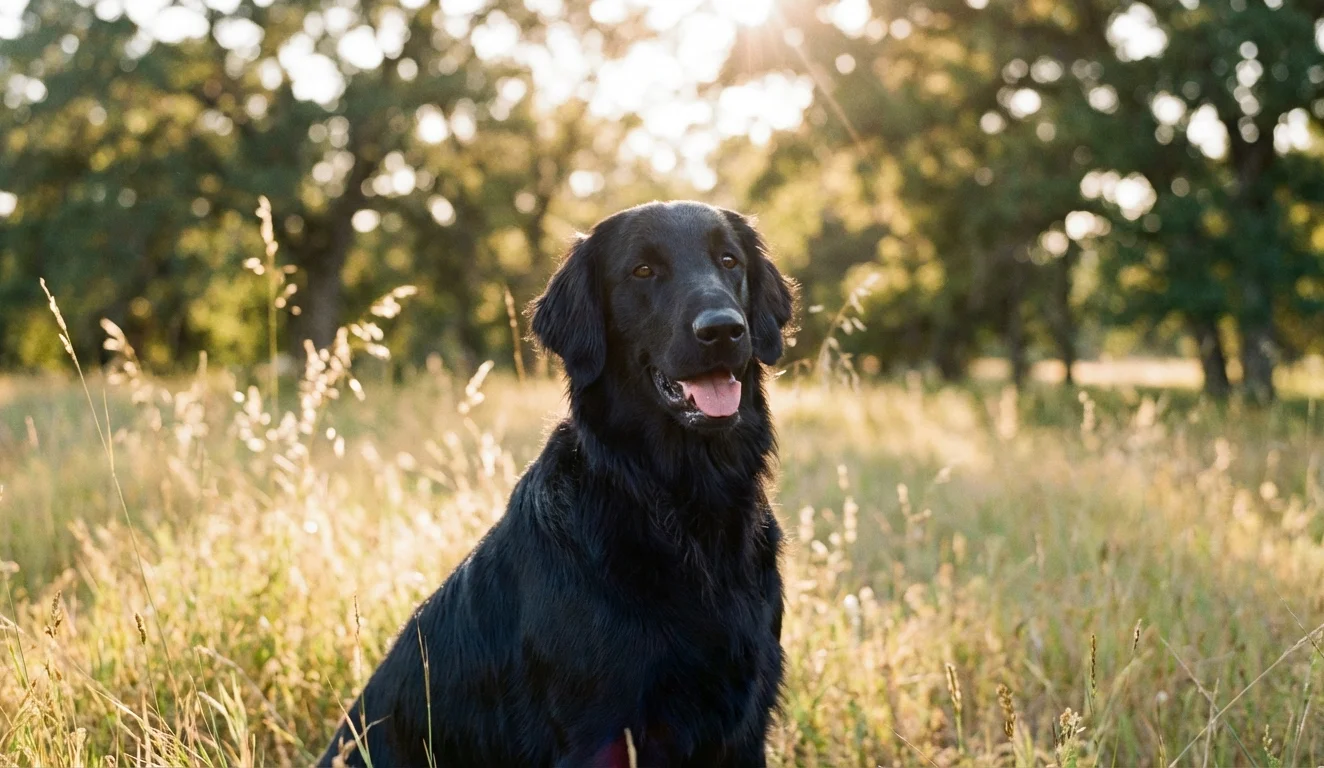
Flat-Coated Retriever Breed Guide: The Peter Pan of Dogs (2026)
The Flat-Coated Retriever never grows up, which is charming until you realize your 70-pound dog still acts like a puppy at age 5. Here's the full story.
The Flat-Coated Retriever stands 22-24.5 inches tall, weighs 60-70 pounds, and lives 8-10 years. That lifespan is the number that’ll stop you, it’s short, shorter than most retrievers, and there’s a reason for it we’ll get into. But first, let’s talk about what makes this breed worth knowing about anyway: the Flat-Coat is one of the most joyful, exuberant dogs you’ll ever meet. People who love this breed describe them as “perpetual puppies,” and they mean it literally. A five-year-old Flat-Coat will greet you with the same bouncing, tail-wagging, toy-in-mouth enthusiasm as a five-month-old.
In Short: 60–70 lbs, 8–10 years. High energy. Moderate shedding with seasonal increase. Watch for Cancer (especially histiocytic sarcoma) and Hip Dysplasia. Best for active families who want a goofy, affectionate sporting dog.
Any devoted Flat-Coat fan will tell you the same thing: this breed gives you the best years of your life, but not enough of them. The cancer rates in Flat-Coated Retrievers are heartbreakingly high, some studies suggest that over 50% of Flat-Coats will die of cancer. We don’t say this to scare you off. We say it because anyone considering this breed deserves to go in with their eyes open. The Flat-Coat will love you with its whole heart for as long as it has, and that makes the time you get count even more.
Flat-Coated Retriever at a Glance
| Trait | Details |
|---|---|
| Breed Group | Sporting (AKC) |
| Height | Males: 23-24.5 in / Females: 22-23.5 in |
| Weight | Males: 60-70 lbs / Females: 55-65 lbs |
| Life Expectancy | 8-10 years |
| Coat | Medium-length, flat-lying, dense |
| Colors | Solid Black, Solid Liver |
| Temperament | Optimistic, Playful, Exuberant |
| Shedding | Moderate (seasonal increase) |
| Energy Level | High |
| Good With Kids | Yes |
| Apartment Friendly | No |
History
The Flat-Coated Retriever was developed in England in the mid-1800s as a dual-purpose retriever, capable of working both on land and in water. The breed’s foundation stock likely included the St. John’s Water Dog (the same ancestor that produced the Labrador), setters, sheepdogs, and water spaniels. A gamekeeper named S.E. Shirley is credited with stabilizing the breed type in the 1860s and 1870s, and the Flat-Coat quickly became the most popular retriever in Britain.
For decades, the Flat-Coat was the retriever of choice for British gamekeepers. Then the Labrador and Golden Retriever happened. By the early 20th century, those two breeds eclipsed the Flat-Coat in popularity, and the breed nearly went extinct after both World Wars. By the 1960s, dedicated breeders in Britain had rebuilt the population, but the breed has never regained mainstream popularity. The AKC recognized it in 1915.
That relative obscurity may actually be a good thing. Flat-Coat breeders tend to be passionate and knowledgeable, and the breed hasn’t suffered the extreme over-breeding that’s plagued more popular retrievers. The downside of a small gene pool, though, is that health problems (particularly cancer) have been difficult to breed out.
Size and Appearance
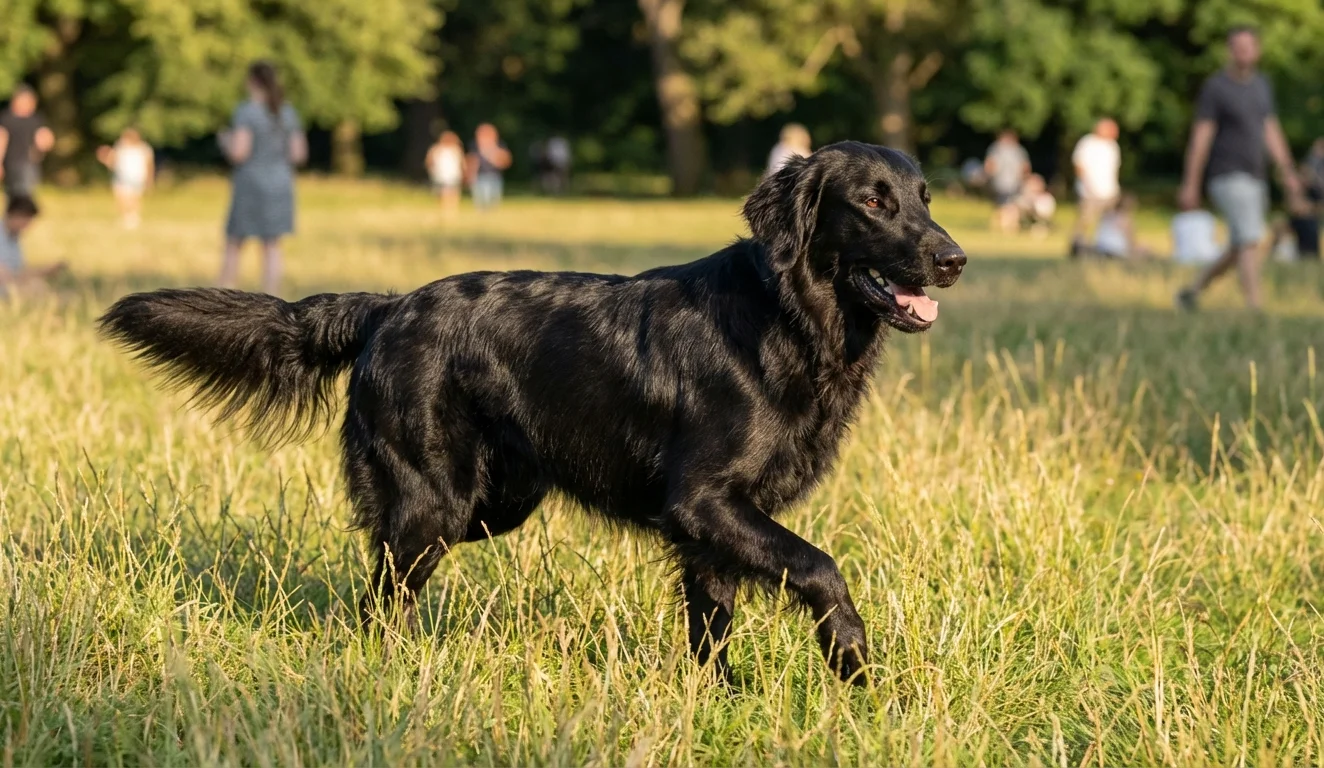
Flat-Coated Retrievers are elegant, athletic dogs with a distinctive silhouette. Males stand 23-24.5 inches and weigh 60-70 pounds. Females are 22-23.5 inches and 55-65 pounds. They’re leaner and more streamlined than Goldens or Labs, think “running back” rather than “linebacker.”
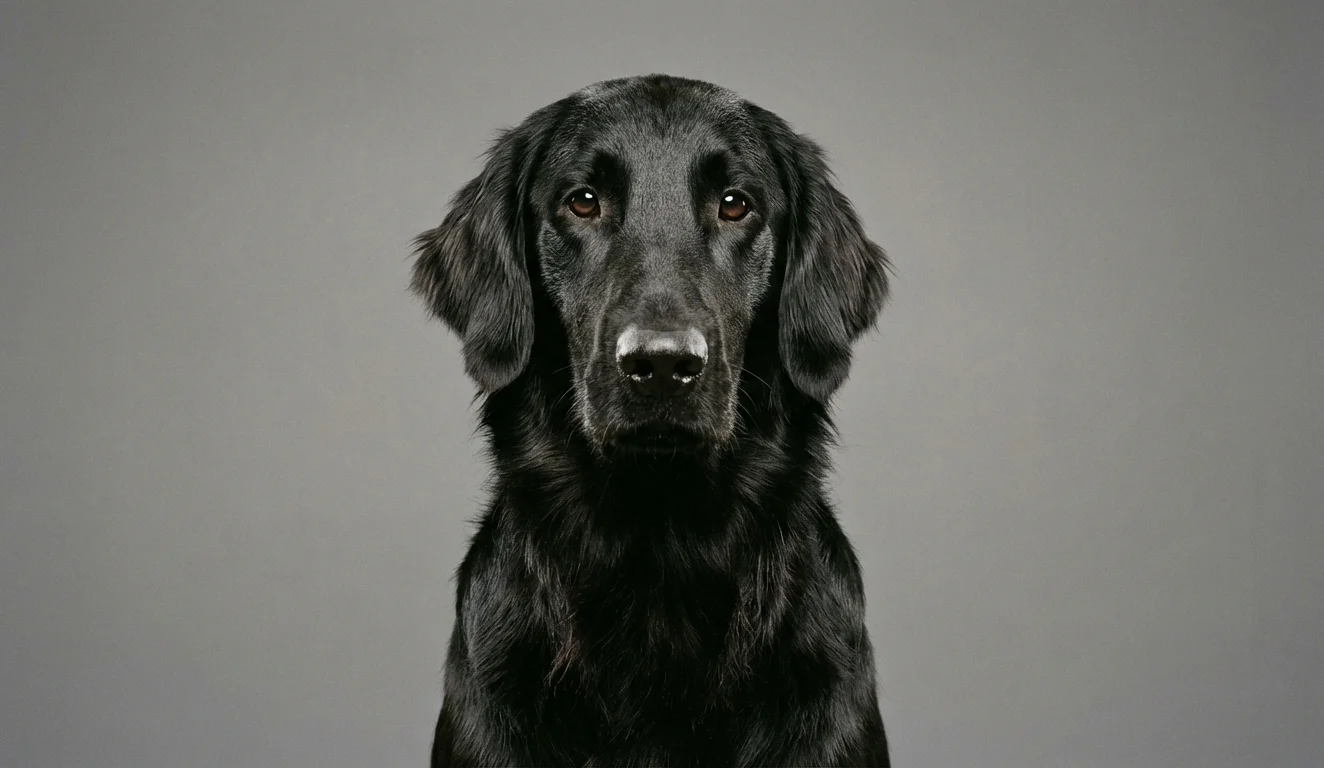
The head is the Flat-Coat’s defining feature: a unique, long, one-piece head with a minimal stop (the transition between skull and muzzle). The expression should look intelligent and kindly. The muzzle is about as long as the skull, giving the head an elegant, clean-lined appearance that’s distinctly different from the broader skulls of Labs and Goldens.
The coat is medium-length, dense, and lies flat against the body (hence the name). Flat-Coats come in only two colors: solid black and solid liver (a rich, dark brown). Black is more common. The coat has moderate feathering on the legs, chest, and tail, giving the dog a polished look without being overly fluffy.
Flat-Coated Retriever Temperament
If Golden Retrievers are the friendly neighbor who waves at everyone, Flat-Coats are the neighbor who waves, then jogs over to tell you a joke, then brings you cookies, then invites you to play frisbee. They’re Golden Retriever energy dialed up a notch, with even less of a “settle down” button.
What living with a Flat-Coat actually looks like:
- They stay puppy-like for years. Most retrievers mellow by age 3-4. Flat-Coats often maintain puppy energy and playfulness until age 5 or beyond. This is charming when they bring you a toy. It’s less charming when your 70-pound dog is counter-surfing with adolescent enthusiasm at age 4.
- They’re social butterflies. Flat-Coats love everyone, family, strangers, other dogs, the mail carrier. They’re terrible guard dogs. A burglar would get a wagging tail and a presented toy.
- They carry things. It’s a retriever thing, but Flat-Coats take it to another level. They need something in their mouth, a toy, a shoe, a sock, a stick. Many Flat-Coat owners keep a basket of “greeting toys” by the door so the dog has something to grab when visitors arrive.
- They’re sensitive under the silliness. Flat-Coats are more emotionally attuned than their clownish exterior suggests. They pick up on household stress and can become anxious in tense environments. Harsh training methods are counterproductive.
Flat-Coats are outstanding with children. Their playful, patient nature makes them natural family dogs. They’re also typically good with other dogs and even cats (though the retriever prey drive means small animals like rabbits should be supervised).
Exercise Needs
Flat-Coated Retrievers need 90 minutes of exercise per day, with a good portion being off-leash running or swimming. These are sporting dogs built for long days in the field, and they still have that stamina.
Best exercise for Flat-Coats:
- Swimming, Flat-Coats are natural water dogs and many will swim until you make them stop
- Retrieving games in a field or at a lake
- Long hikes with off-leash opportunities (assuming solid recall)
- Hunt training, even non-hunting owners find that retriever drills light up their dog in a way nothing else does
- Agility and rally obedience
Under-exercised Flat-Coats become inventive about entertaining themselves, which usually involves chewing, digging, or rearranging your home. They don’t get anxious the way some breeds do when bored, they get creative. That’s worse.
A fenced yard is strongly recommended. Flat-Coats aren’t as escape-prone as terriers, but they will wander if something interesting catches their attention.
Grooming
The Flat-Coat’s medium-length coat is lower-maintenance than it looks. It doesn’t mat easily thanks to the flat, straight texture (unlike the wavy, tangle-prone coats of Goldens).
Grooming schedule:
- Brush 2-3 times per week with a slicker brush or pin brush
- Daily brushing during seasonal blowouts (spring and fall, about 2-3 weeks each)
- Bath every 6-8 weeks or as needed, the flat coat actually sheds dirt pretty well
- Trim feathering on ears, legs, feet, and tail every 4-6 weeks to keep things tidy
- Nail trim every 2-3 weeks
- Ear check weekly: the pendulous ears can trap moisture, especially after swimming
Professional grooming isn’t strictly necessary, but many owners find a biannual professional groom helpful for tidying up the feathering and doing a thorough deshed. Expect $50-$80 per session.
Flat-Coated Retriever Health Issues
This is the section where we need to be direct. Flat-Coated Retrievers have a serious cancer problem, and it significantly impacts the breed’s lifespan. The average life expectancy is 8-10 years, roughly 2-4 years shorter than other retrievers.
Histiocytic Sarcoma
This is the cancer that haunts the Flat-Coat community. Histiocytic sarcoma is an aggressive cancer of the immune system that affects Flat-Coats at a dramatically higher rate than any other breed. A 2006 study published in the Journal of Veterinary Internal Medicine found that histiocytic sarcoma accounted for roughly 50% of cancer deaths in the breed. The cancer is often diagnosed at an advanced stage because early symptoms are vague, lethargy, loss of appetite, weight loss. Treatment (chemotherapy and sometimes surgery) costs $5,000-$15,000, and prognosis is generally poor. Median survival times after diagnosis are measured in months, not years. Research into genetic markers is ongoing, but as of 2026, there’s no reliable screening test for it.
Hemangiosarcoma
Another aggressive cancer that occurs at elevated rates in Flat-Coats. Hemangiosarcoma typically affects the spleen, liver, or heart and often ruptures before it’s detected, causing sudden internal bleeding. Treatment costs $3,000-$10,000, and outcomes are similar to histiocytic sarcoma, the cancer is difficult to treat effectively.
Hip Dysplasia
The OFA reports moderate prevalence of hip dysplasia in Flat-Coated Retrievers. Responsible breeders screen breeding stock through OFA or PennHIP evaluations. Treatment ranges from $1,500-$6,000 depending on severity.
Patellar Luxation
Documented in the breed at moderate rates. The kneecap slides out of position, causing intermittent lameness. Surgical correction costs $1,500-$3,000 per knee if needed.
Gastric Dilatation-Volvulus (Bloat)
As a deep-chested breed, Flat-Coats are at risk for bloat, where the stomach fills with gas and potentially twists on itself. This is a life-threatening emergency requiring immediate surgery ($2,000-$5,000). Many Flat-Coat owners opt for prophylactic gastropexy (stomach tacking) at the time of spay/neuter, which reduces the risk significantly.
Training
Flat-Coated Retrievers are eager learners with a desire to please, which makes them very trainable, in theory. In practice, you’re training a dog that thinks everything is a game, has the attention span of a caffeinated squirrel until about age 3, and would rather bring you a sock than sit still.
Training tips for Flat-Coats:
- Positive reinforcement works beautifully. They’re food-motivated and praise-motivated. Corrections cause them to shut down.
- Keep sessions playful and varied. The second a Flat-Coat gets bored, they’ll find a way to entertain themselves (and you won’t like it).
- Teach a solid “settle” command early. The breed’s extended puppyhood means you’ll be working on impulse control for longer than with other retrievers.
- Retriever-specific skills (hold, deliver to hand, steady) are excellent for channeling their natural instincts and building focus.
- Socialization is easy with this breed, they love everyone, but it’s still important to expose them to varied situations during the 8-16 week window.
Flat-Coats do well in formal obedience, agility, and especially hunt tests and field trials. Giving them a structured outlet for their retriever instincts is one of the best things you can do for their behavior at home.
Cost
Purchase Price
A Flat-Coated Retriever puppy from a reputable breeder costs $1,500-$3,000. The breed’s relative rarity means fewer breeders and sometimes longer wait lists. Show-quality puppies can exceed $3,500.
Flat-Coat rescue exists but placement is uncommon, the breed is rare enough that rescues are few and far between. When available, adoption fees run $300-$500 through the Flat-Coated Retriever Society of America rescue network.
Monthly Costs
| Expense | Monthly Estimate |
|---|---|
| Food (high-quality kibble) | $40-$65 |
| Preventive vet care (averaged) | $20-$35 |
| Pet insurance | $35-$60 |
| Treats and chews | $10-$20 |
| Miscellaneous (toys, supplies) | $10-$25 |
| Total | $115-$205 |
First-Year Costs
Budget $3,500-$5,500 for the first year, including purchase price, puppy veterinary care, spay/neuter, supplies, and training. Pet insurance is strongly recommended for this breed given the cancer risk, a single cancer diagnosis can cost $5,000-$15,000 in treatment. Get a policy before any diagnosis, because pre-existing conditions won’t be covered.
Is a Flat-Coated Retriever Right for You?
A Flat-Coat is a great fit if you:
- Want a retriever with even more exuberance and goofiness than a Lab or Golden
- Are active and can provide 90 minutes of daily exercise including swimming or retrieving
- Have a sense of humor about extended puppyhood, your dog will act like a teenager for years
- Want an exceptional family dog that’s great with kids
- Can accept a shorter-than-average lifespan and the emotional toll that comes with it
- Have or are willing to get solid pet insurance coverage
A Flat-Coat is probably NOT right if you:
- Want a calm house dog, Flat-Coats don’t really “calm down” until age 5+
- Aren’t prepared for the cancer risk that comes with this breed
- Live in an apartment without yard access
- Want a guard dog or a dog that’s reserved with strangers
- Are looking for a low-energy companion
The Flat-Coated Retriever is a breed of beautiful contradictions: tremendous joy paired with a heartbreaking health profile. People who own them say they wouldn’t trade a single day, even knowing the cost. That tells you something about what it’s like to live with one. They don’t give you a long time, but they give you a wonderful one.
Related Breeds
If you’re considering this breed, you might also want to look at:
FAQ
Why don’t more people own Flat-Coated Retrievers?
Flat-Coats never recovered from the popularity explosion of Labradors and Golden Retrievers in the early-to-mid 20th century. They’re also not as widely available, breeder numbers are much smaller, and wait lists can be long. The cancer issue is another factor. Many potential owners research the breed and decide the shortened lifespan is more heartbreak than they’re willing to sign up for. Those who do get Flat-Coats tend to be extremely devoted to the breed.
How are Flat-Coated Retrievers different from Golden Retrievers?
Flat-Coats are leaner, more athletic, and have a longer, narrower head than Goldens. They come only in black or liver, while Goldens are various shades of gold. Temperament-wise, Flat-Coats are goofier and maintain puppy-like energy longer, most Golden owners notice a distinct maturing around age 2-3, while Flat-Coat owners wait until 4-5 for that transition. The biggest difference, unfortunately, is lifespan: Flat-Coats average 8-10 years versus 10-12 for Goldens, largely due to cancer prevalence.
Do Flat-Coated Retrievers calm down?
Eventually. The breed’s nickname “the Peter Pan of dogs” exists for a reason, they mature more slowly than other retrievers. Most Flat-Coats start showing some settling behavior around age 4-5, but they’ll never be couch-potato dogs. A well-exercised adult Flat-Coat can be calm in the house, but “calm” is relative. They’ll still greet visitors with full-body enthusiasm and play like puppies when the mood strikes.
Are Flat-Coated Retrievers good for first-time owners?
They can be, but with a caveat. Flat-Coats are friendly, forgiving, and eager to please, all qualities that make life easier for new owners. But their extended puppyhood, high exercise needs, and resistance to settling down can frustrate inexperienced handlers. If you’re a first-time owner who’s committed to 90 minutes of daily exercise and patient with a dog that won’t mature as quickly as you’d like, a Flat-Coat can work. If you want a dog that’s easy from day one, a Lab or Golden is probably a safer bet.
How much exercise does a Flat-Coated Retriever really need?
At least 90 minutes per day, and that’s not just walking. Flat-Coats need running, swimming, or retrieving, activities that engage both their bodies and their retriever instincts. A 20-minute walk twice a day won’t cut it. The breed was developed for full days of field work, and while they don’t need that level of activity daily, they need substantially more than most people provide. Swimming is the gold standard for Flat-Coat exercise, it’s low-impact, high-intensity, and taps into their water-retriever heritage.