German Shorthaired Pointer Breed Guide: Built to Run and Will Prove It Daily (2026)
The German Shorthaired Pointer is an elite athlete that needs a job, a yard, and an owner who can keep up. Couch potato households need not apply.
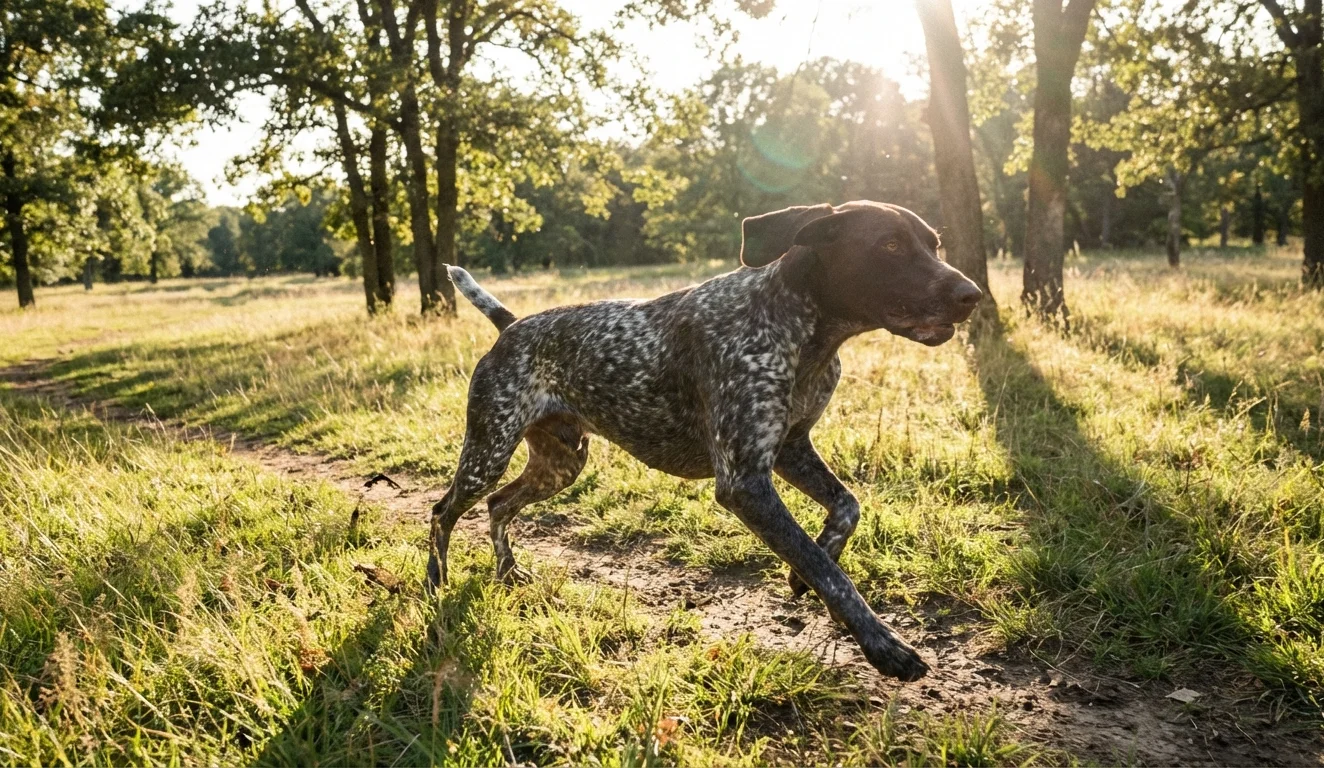
The German Shorthaired Pointer (GSP) weighs 45-70 pounds, stands 21-25 inches tall, and lives 12-14 years. Those are the numbers. The number that actually matters is 90, as in 90 minutes of exercise per day, minimum, or your house will pay the price. GSPs are the triathletes of the dog world. They point, they retrieve, they swim, they trail, they do it all at a pace that makes Border Collies look lazy on certain days. If you’re an active person looking for a dog that can genuinely keep up with your most ambitious outdoor plans, the GSP belongs on your short list.
In Short: 45–70 lbs, 12–14 years. Very high energy, needs serious daily exercise. Moderate shedding. Watch for Hip Dysplasia and Bloat (Gastric Dilatation-Volvulus). Good with kids, but better for experienced owners.
We’ll say it bluntly: the German Shorthaired Pointer is not a dog for most people. They’re the breed that shelters and rescues see most often from owners who “didn’t realize how much energy they had.” Which is wild, because the energy level is the first thing anyone mentions about this breed. But people hear “active” and think “likes walks.” GSPs don’t like walks. GSPs like running flat-out through open fields for an hour and then looking at you like “okay, what’s next?” If that sounds amazing to you, keep reading. If that sounds exhausting, we’d steer you toward a calmer breed.
German Shorthaired Pointer at a Glance
| Trait | Details |
|---|---|
| Breed Group | Sporting (AKC) |
| Height | Males: 23-25 in / Females: 21-23 in |
| Weight | Males: 55-70 lbs / Females: 45-60 lbs |
| Life Expectancy | 12-14 years |
| Coat | Short, dense, water-repellent |
| Colors | Liver, Liver & White, Liver Roan, Black, Black & White |
| Temperament | Intelligent, Bold, Boisterous, Affectionate |
| Shedding | Moderate |
| Energy Level | Very High |
| Good With Kids | Yes |
| First-Time Owner Friendly | No |
History of the German Shorthaired Pointer
The German Shorthaired Pointer was developed in Germany during the 19th century, though the breed’s foundation dogs go back further. German hunters wanted the “do-everything” gun dog, a single breed that could point upland birds, retrieve from water, trail wounded game, and work all day without quitting. They achieved this by crossing German Bird Dogs, early pointing breeds, with English Pointers for speed and refinement, and possibly with Bloodhounds for scenting ability. The result was a versatile hunting dog that could handle any task in the field.
Prince Albrecht zu Solms-Braunfels is credited with establishing the breeding program and studbook that standardized the GSP in the 1870s. The breed was refined with a single guiding principle: function over form. GSPs were judged on how they performed in the field, not how they looked in a show ring. This performance-first philosophy still defines the breed and is a big part of why GSPs are such capable athletes today.
GSPs arrived in the United States in the 1920s and gained AKC recognition in 1930. The breed’s popularity has grown steadily, and GSPs now rank in the AKC’s top 10 most popular breeds. Their surge in popularity among non-hunters, families and active individuals drawn to the breed’s athleticism, has been particularly notable in the last decade. The Westminster Kennel Club Dog Show named a GSP Best in Show in 2016, which only accelerated interest.
Size and Appearance
German Shorthaired Pointers are medium-to-large, lean, and athletic. Males stand 23-25 inches at the shoulder and weigh 55-70 pounds. Females are 21-23 inches and 45-60 pounds. There’s nothing bulky about a GSP, they’re built for speed and endurance, with a body that looks like it’s designed to cover ground.
Build
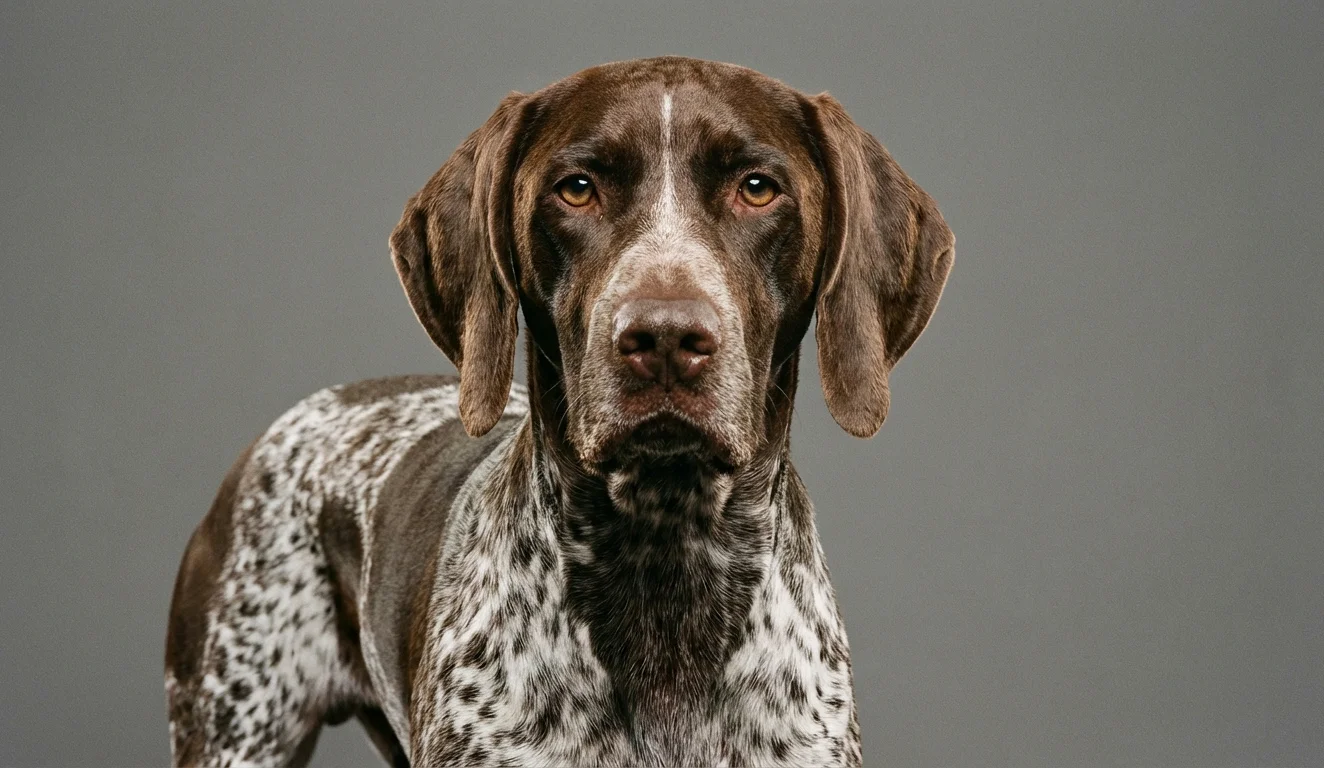
The GSP has a streamlined, balanced build. The chest is deep but not overly broad, the legs are long and muscular, and the overall impression is of a dog that can run all day and turn on a dime. The head is clean-cut with a moderately long muzzle, and the ears are set high and hang close to the head. The tail is traditionally docked to about 40% of its natural length in the US, though tail docking is banned in many European countries.
Coat and Color
The GSP coat is short, thick, and water-repellent, perfect for a dog that might be crashing through brush in the morning and swimming across a pond in the afternoon. The coat lies flat against the body and doesn’t require much maintenance.
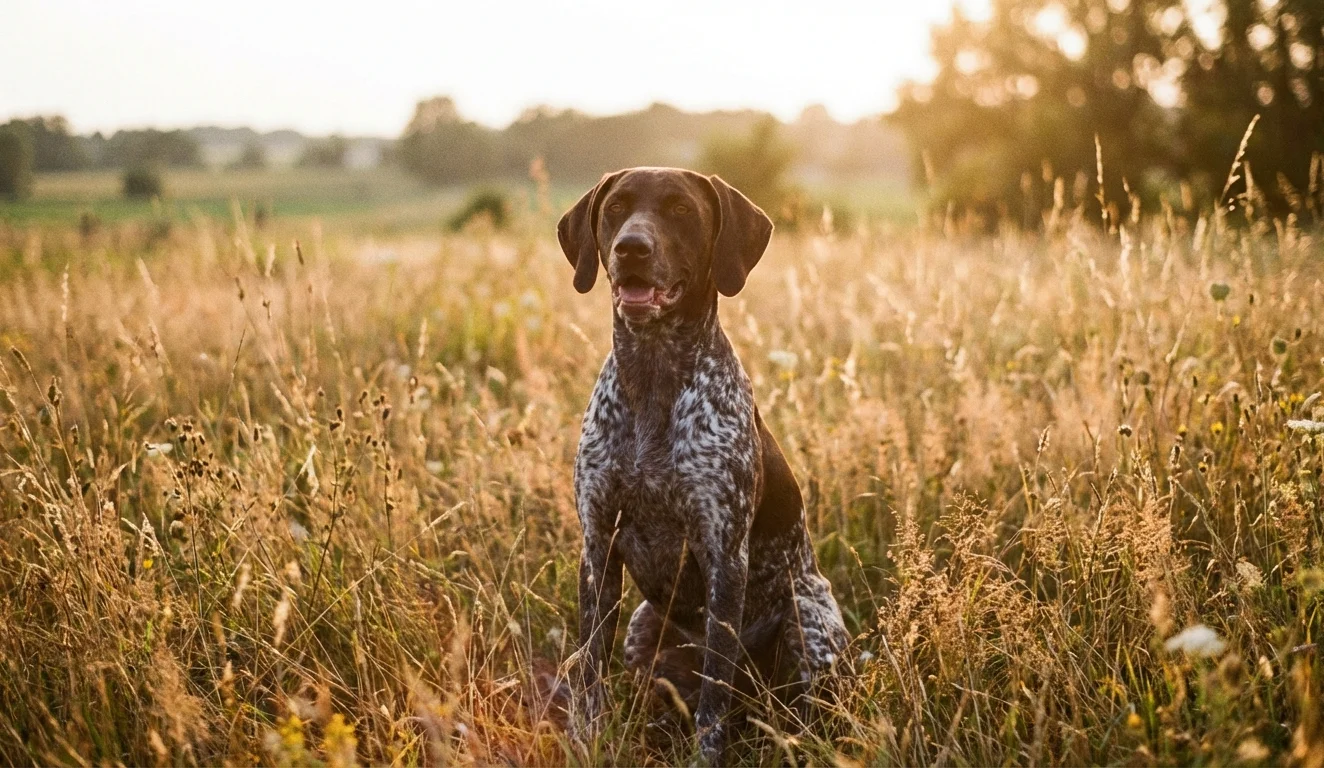
Colors are liver-based: liver (solid dark brown), liver and white (patched or ticked), and liver roan (an even mix of liver and white hairs creating a mottled appearance). Black and black-and-white GSPs exist and are accepted by the AKC, though liver coloring is more traditional. The liver roan pattern is probably the most iconic look for the breed, and it’s gorgeous in person, almost like the dog is wearing camouflage.
German Shorthaired Pointer Temperament
GSPs are high-energy, affectionate, and intensely bonded to their families. They’re not the type of dog that exists independently in the same house as you, they want to be involved in whatever you’re doing, and they want to be involved right now.
What living with a GSP is really like:
- The energy is not an exaggeration. A young GSP (under 3 years) with insufficient exercise is one of the most destructive forces in the domestic dog world. We’re talking drywall damage, furniture disassembly, counter destruction. These behaviors aren’t spite, they’re a desperate physical need being expressed in the only way available. Proper exercise prevents all of this.
- Velcro dogs. GSPs are sometimes called “velcro dogs” because they attach themselves to their owner and don’t detach. They’ll follow you to the bathroom, lean against you on the couch, and position themselves wherever you are in the house. It’s endearing until you trip over 60 pounds of dog for the third time in an hour.
- Good with kids, but rambunctious. GSPs love children and are playful family dogs. The caveat is that a young GSP’s enthusiasm can be overwhelming for small kids. They’re bouncy, they jump, and they don’t always understand their own momentum. Supervision with toddlers is important.
- Prey drive is strong. GSPs were bred to hunt, and that instinct is alive and well. Cats, rabbits, squirrels, and birds will trigger the chase response. Some GSPs can learn to coexist with cats (especially when raised together), but many cannot. This is something to evaluate honestly before bringing a GSP into a home with small animals.
The thing about GSPs that catches people off guard isn’t the energy during exercise, it’s the energy when they’re supposed to be relaxing. A well-exercised GSP will settle. But “well-exercised” for this breed means something different than for most dogs. If you can’t provide the outlet, the dog won’t adjust to your schedule. You’ll have to adjust to theirs.
Exercise Needs
GSPs need 90 minutes of exercise per day at minimum. And we don’t mean a leisurely stroll. We mean the kind of exercise that actually tires out an elite canine athlete.
What actually works for GSPs:
- Running. If you’re a runner, a GSP is the perfect partner. They can handle trail runs, road runs, and long-distance work. Many GSP owners take up running specifically because of their dog.
- Off-leash field time. If you have access to safe, enclosed land, letting a GSP run freely is the most efficient way to burn energy. They’ll cover five miles in the time you walk one.
- Hunting. This is what they were built for. If you hunt upland birds or waterfowl, a GSP will be the best field partner you’ve ever had. The breed’s versatility, pointing, flushing, and retrieving, is genuinely unmatched.
- Swimming. GSPs are strong, enthusiastic swimmers. Their water-repellent coat and webbed feet make them naturals. Dock diving is a popular GSP sport.
- Agility and competitive sports. GSPs have the speed, intelligence, and handler focus for nearly any canine sport.
What doesn’t work:
- A walk around the block and a few tosses of the ball. That’s a warm-up for a GSP, not exercise.
- Relying on a yard. A GSP alone in a yard won’t exercise itself, it’ll pace the fence line or dig holes.
Exercise needs decrease somewhat with age. A GSP over 5-6 years old may be content with 60 minutes, and seniors (10+) can often manage with 30-45 minutes. But young GSPs, roughly under age 3, are genuinely tireless.
Grooming
GSPs are low-maintenance in the grooming department. That short, dense coat is practically self-cleaning.
Grooming basics:
- Weekly brushing with a rubber curry brush or bristle brush. This removes loose hair and keeps the coat looking clean.
- Bathing every 6-8 weeks, or after particularly muddy adventures (which will be frequent).
- Nail trims every 2-3 weeks. Active GSPs that run on hard surfaces may wear their nails down naturally.
- Ear cleaning weekly. The pendant ears can trap debris and moisture after swimming or field work.
- Teeth brushing two to three times per week.
Shedding is moderate, you’ll find short liver-colored hairs on clothes and furniture, but it’s nothing compared to heavy shedders like Labs or German Shepherds. No professional grooming is needed.
The GSP’s coat does have a slight “self-cleaning” quality, dried mud tends to flake off on its own. It’s a field dog coat, designed to handle the elements and not require fussing over afterward.
German Shorthaired Pointer Health Issues
GSPs are a generally healthy breed with a good lifespan of 12-14 years. Their function-first breeding history has kept them more structurally sound than many popular breeds. Still, there are conditions to be aware of.
Hip Dysplasia
The OFA database shows a moderate prevalence of hip dysplasia in GSPs, not as high as breeds like German Shepherds or Rottweilers, but still present. Active, high-impact lifestyles can exacerbate the condition. Responsible breeders screen both parents with OFA hip evaluations. Treatment ranges from conservative management to total hip replacement at $1,500-$6,000.
Bloat (Gastric Dilatation-Volvulus)
As a deep-chested breed, GSPs are at moderate risk for bloat. This is a life-threatening emergency where the stomach fills with gas and can twist on itself. Classic symptoms: a distended, tight abdomen, unproductive retching, restlessness, and excessive drooling. Get to an emergency vet immediately, minutes matter. Treatment costs $2,000-$7,500. Some owners opt for prophylactic gastropexy during spay/neuter to reduce risk.
To minimize risk: feed two to three smaller meals instead of one large meal, avoid heavy exercise within an hour of feeding, and use a slow-feeder bowl if your GSP inhales food.
Von Willebrand Disease
A bleeding disorder caused by a deficiency in von Willebrand factor, a protein needed for blood clotting. It’s moderately prevalent in GSPs. Most affected dogs have the mild Type 1 form, which may not cause problems until surgery or injury, when excessive bleeding becomes apparent. A DNA test can identify carriers. Treatment costs $500-$3,000 depending on whether the condition causes an emergency. Always inform your vet if your GSP tests positive, and request a pre-surgical bleeding panel.
Entropion
A condition where the eyelid rolls inward, causing the eyelashes to rub against the cornea. It’s painful and can lead to corneal ulcers if untreated. Moderately common in GSPs. Surgical correction is effective and costs $500-$1,500.
Cone Degeneration
A rare but breed-specific condition where the cone cells in the retina degenerate, causing “day blindness”, the dog sees normally in dim light but struggles in bright conditions. It’s inherited as an autosomal recessive trait, and a DNA test is available. Most affected dogs adapt well with management. Treatment costs are minimal ($300-$1,000 for diagnosis), since there’s no cure, the focus is on environmental management.
Training a German Shorthaired Pointer
GSPs are among the most trainable breeds. Stanley Coren ranks them in the top tier for working intelligence, and their desire to partner with a handler makes them responsive students. Training a GSP is genuinely fun if you know what you’re doing.
Why GSPs train well:
- They’re eager to work and form a partnership with their handler
- They’re food-motivated and toy-motivated, you have multiple reward options
- They have excellent focus once they learn to channel their energy
- They retain training well and generalize learned behaviors to new contexts
Training priorities for GSP owners:
- Recall is non-negotiable. Invest serious time in building a reliable recall from puppyhood. A GSP with strong prey drive that doesn’t come when called is a liability. Use a long line during training, practice in increasingly distracting environments, and make coming back to you the best thing that happens all day.
- Impulse control. “Leave it,” “wait,” and “stay” are critical for a breed with strong chase instincts. Start these exercises early and reinforce them consistently.
- Off-switch training. Teaching a GSP to settle, to lie on a mat calmly when exercise time is over, is one of the most valuable things you can teach the breed. They won’t figure this out on their own.
- Channel the energy into structured activities. A GSP in a beginner obedience class will fidget and look around. A GSP in advanced obedience, agility, or field training will focus with laser intensity. They need challenge and purpose.
Common mistakes:
- Starting off-leash too early. Just because your GSP has a great recall in the backyard doesn’t mean it’ll hold when a pheasant flushes from the brush. Build off-leash reliability gradually across contexts.
- Not providing enough mental work. Physical exercise alone isn’t enough. Training sessions, puzzle toys, and scent games are essential supplements.
German Shorthaired Pointer Cost
Purchase Price
A GSP puppy from a reputable breeder typically costs $800-$2,000. Dogs from proven hunting lines, especially those with field trial titles in the pedigree, can cost $2,500-$4,000. The price reflects health testing (OFA hips, cardiac, and eye clearances plus DNA panels for breed-specific conditions) and breeding quality.
Rescue GSPs are available for $200-$500 through breed-specific organizations like the GSP Rescue Network. Adolescents and young adults are the most common age group in rescue, often surrendered because the original owner underestimated the breed’s exercise needs.
Monthly Costs
| Expense | Monthly Estimate |
|---|---|
| Food (high-quality, active formula) | $40-$65 |
| Preventive vet care (averaged) | $15-$30 |
| Pet insurance | $30-$50 |
| Treats and chews | $10-$20 |
| Miscellaneous (toys, supplies) | $15-$25 |
| Total | $100-$200 |
GSPs are moderate to maintain cost-wise. Their grooming needs are minimal, and their overall health is good. The main variable expense is food, active GSPs burn a lot of calories and may need a performance or sport formula, which costs more than standard adult kibble. Some GSP owners spend noticeably more on activities like hunt test entry fees, training sessions, or travel for field events.
First-year costs including purchase, supplies, initial vet visits, training, and spay/neuter typically run $3,000-$5,500.
Is a German Shorthaired Pointer Right for You?
A GSP is a great fit if you:
- Are genuinely active, running, hiking, hunting, or cycling regularly
- Have a house with a fenced yard (not optional for this breed)
- Want a dog that’s a true partner for outdoor adventures
- Can commit to 90+ minutes of daily exercise for the dog’s first several years
- Are experienced enough with dogs to handle a high-energy breed with prey drive
- Want a smart, affectionate dog that’s deeply bonded to you
A GSP might NOT be right if you:
- Work long hours and the dog would be alone most of the day
- Live in an apartment (possible only if you’re an extreme athlete who exercises the dog twice daily)
- Have cats or small pets, the prey drive is strong
- Define “active” as a 30-minute daily walk
- Are a first-time dog owner (the learning curve is steep)
- Travel frequently and need to kennel the dog, GSPs are prone to separation stress
The German Shorthaired Pointer is one of the most rewarding breeds in the world for the right owner. That’s not a generic compliment, it’s a conditional one. The “right owner” part matters enormously. A GSP matched with an active, outdoorsy person who wants a four-legged adventure partner will be one of the happiest dogs alive. The same dog in a sedentary household will be miserable, destructive, and eventually surrendered. Be honest with yourself about your lifestyle before committing. If you’re the right match, a GSP will give you the kind of partnership with a dog that most people only see in hunting magazines.
Related Breeds
If you’re considering this breed, you might also want to look at:
Frequently Asked Questions
How much exercise does a German Shorthaired Pointer need?
Adult GSPs need a minimum of 90 minutes of vigorous exercise per day. This isn’t a suggestion, it’s a requirement for the dog’s physical and mental health. “Vigorous” means running, swimming, field work, or active sports, not a leisurely walk. Young GSPs (under 3) often need even more. Exercise needs decrease with age, a senior GSP (10+) may be content with 30-45 minutes of moderate activity. If you can’t commit to this level of daily exercise, a GSP is not the breed for you.
Are German Shorthaired Pointers good family dogs?
GSPs can be excellent family dogs for active families. They’re affectionate, loyal, and playful with children. The main consideration is their energy and size, a young GSP’s exuberance can overwhelm toddlers, so supervision is important with very small children. GSPs also need their exercise needs met regardless of family obligations, which can be challenging for families with packed schedules. The ideal GSP family involves the dog in activities, hikes, camping trips, weekend adventures, rather than expecting the dog to adapt to a sedentary family routine.
Can German Shorthaired Pointers live in apartments?
Technically possible. Practically difficult. A GSP in an apartment needs an owner who’s committed to getting the dog outside for substantial exercise multiple times per day, think running, not walking. The dog also needs mental stimulation inside the apartment to prevent boredom between outings. Most GSP breeders and rescues will be upfront that apartments aren’t ideal. A house with a fenced yard is strongly preferred. If you’re determined to make an apartment work, you’ll need to significantly increase your outdoor exercise commitment and consider doggy daycare on days when your schedule is tight.
Do German Shorthaired Pointers shed a lot?
GSPs are moderate shedders. They have a short, dense coat that drops hair year-round, with slightly more shedding during seasonal changes. It’s manageable, weekly brushing controls most of it. You’ll find short hairs on furniture and clothing, but nothing like the volume produced by heavy-shedding breeds. The trade-off for the easy-care coat is that GSPs don’t have much insulation, so they can get cold in winter weather. A dog jacket may be warranted for cold-climate outdoor activities.
Are German Shorthaired Pointers easy to train?
Yes, with a caveat. GSPs are highly intelligent, eager to work, and responsive to training, but they’re also high-energy and easily distracted by birds and other prey animals. A GSP that hasn’t been exercised before a training session will be a disaster. A GSP that’s had a good run first will focus beautifully. The breed excels in advanced training, field work, competitive obedience, and agility. They need a confident handler who can channel their energy productively. First-time owners often find the combination of intelligence and energy overwhelming, which is why we recommend previous dog experience.