Lhasa Apso Breed Guide: The Tiny Tibetan Who Thinks It's a Bouncer (2026)
The Lhasa Apso spent a thousand years guarding Tibetan monasteries and hasn't stopped alerting on suspicious activity since. Twelve pounds of pure confidence.
The Lhasa Apso stands 10-11 inches at the shoulder and weighs 12-18 pounds. They live 12-15 years (with many reaching 16-18, making them one of the longest-lived breeds). Don’t let the flowing coat and cute face fool you, the Lhasa Apso is not a lapdog. Or rather, it is a lapdog, but it’s a lapdog that thinks it’s running security for the Dalai Lama. For roughly a thousand years, that’s exactly what these dogs did: served as interior sentinels in Tibetan monasteries and palaces, alerting the monks and the massive Tibetan Mastiffs outside to any intruders. That sentinel mentality hasn’t faded. Your Lhasa will absolutely alert you to the mail carrier, the neighbor’s cat, a car door closing three houses away, and, occasionally, nothing at all.
In Short: 12–18 lbs, 12–15+ years. Moderate energy. Moderate shedding (heavy grooming needs). Watch for Dry Eye and Patellar Luxation. Best for adults or families with older kids who want a long-lived, confident, independent small dog that takes its watchdog duties seriously.
The Lhasa Apso is frequently confused with the Shih Tzu, and while the two breeds share Tibetan ancestry and a similar coat, they’re different dogs with different temperaments. Shih Tzus were bred to be companions, they want to be loved by everyone. Lhasas were bred to be sentinels, they want to assess everyone first and then decide who deserves their attention. This makes the Lhasa a more complex, more independent, and (some would say) more interesting companion, but also one that’s not the best match for someone expecting a cuddly, easygoing toy breed.
Lhasa Apso at a Glance
| Trait | Details |
|---|---|
| Breed Group | Non-Sporting (AKC) |
| Height | 10-11 in |
| Weight | 12-18 lbs |
| Life Expectancy | 12-15 years |
| Coat | Long, dense, straight double coat |
| Colors | All colors, gold, cream, honey, black, white, parti-color, grizzle, slate, smoke |
| Temperament | Confident, Alert, Comical |
| Shedding | Moderate (hair gets caught in the long coat rather than falling) |
| Energy Level | Moderate |
| Good With Kids | Best with older, respectful children |
| AKC Recognition | 1935 |
History
The Lhasa Apso originates from Tibet, where it was bred for roughly 1,000 years as an interior guard dog in monasteries and the homes of Tibetan nobility. The name comes from “Lhasa” (the capital of Tibet) and “Apso” (which may derive from the Tibetan word for “bearded” or may be a corruption of “rapso,” meaning “goat-like,” referring to the coat’s texture). In Tibet, the breed was called Abso Seng Kye, “Bark Lion Sentinel Dog.”
The Lhasa’s role was specific: they patrolled the interiors of monasteries and palaces, alerting the larger Tibetan Mastiffs stationed outside if anyone approached. They were considered sacred and believed to house the souls of the Dalai Lamas who had not yet been reincarnated as humans. Because of this spiritual significance, Lhasas were never sold, they could only be given as gifts, particularly by the Dalai Lama himself.
The first Lhasas arrived in the United States in 1933 as gifts from the 13th Dalai Lama to C. Suydam Cutting, a naturalist and traveler. These dogs formed the foundation of the American breeding program. The AKC recognized the breed in 1935, originally placing it in the Terrier Group before moving it to Non-Sporting in 1959. The breed has maintained a steady following in the US, not wildly popular, but devotedly supported by owners who appreciate its unique combination of beauty and brass.
Size and Appearance
Lhasa Apsos are small but solidly built dogs. They’re longer than they are tall, with a level topline and a well-ribbed body that’s sturdier than it looks under all that coat. Males stand about 10-11 inches at the shoulder. Females may be slightly smaller. Weight ranges from 12-18 pounds, though some males push past that.
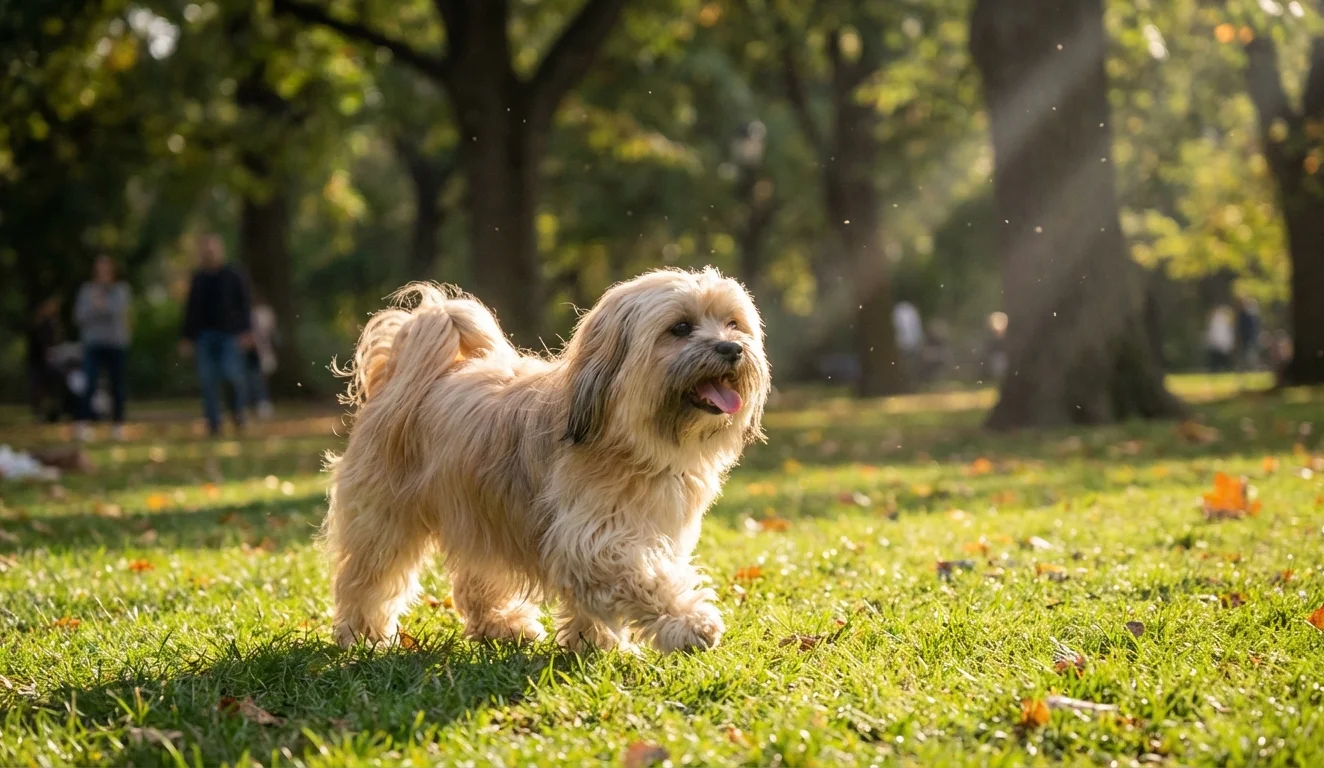
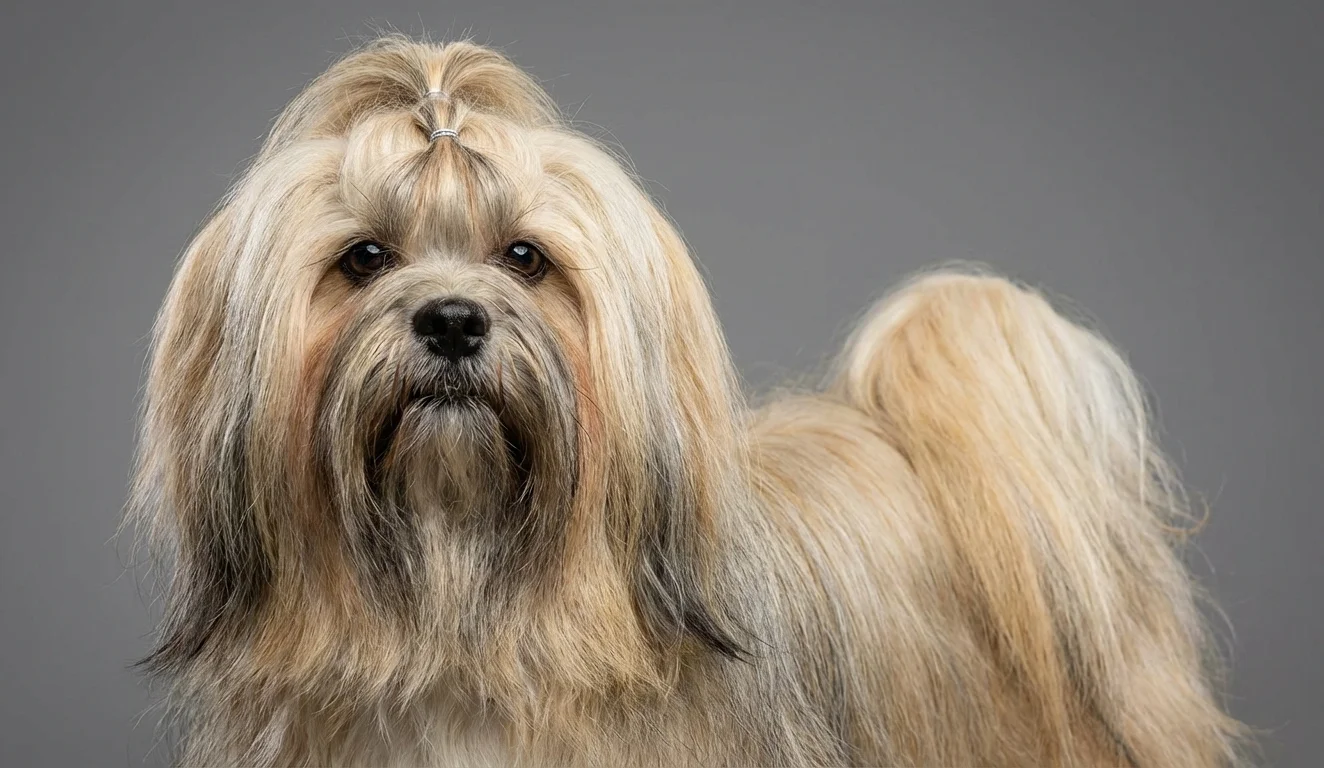
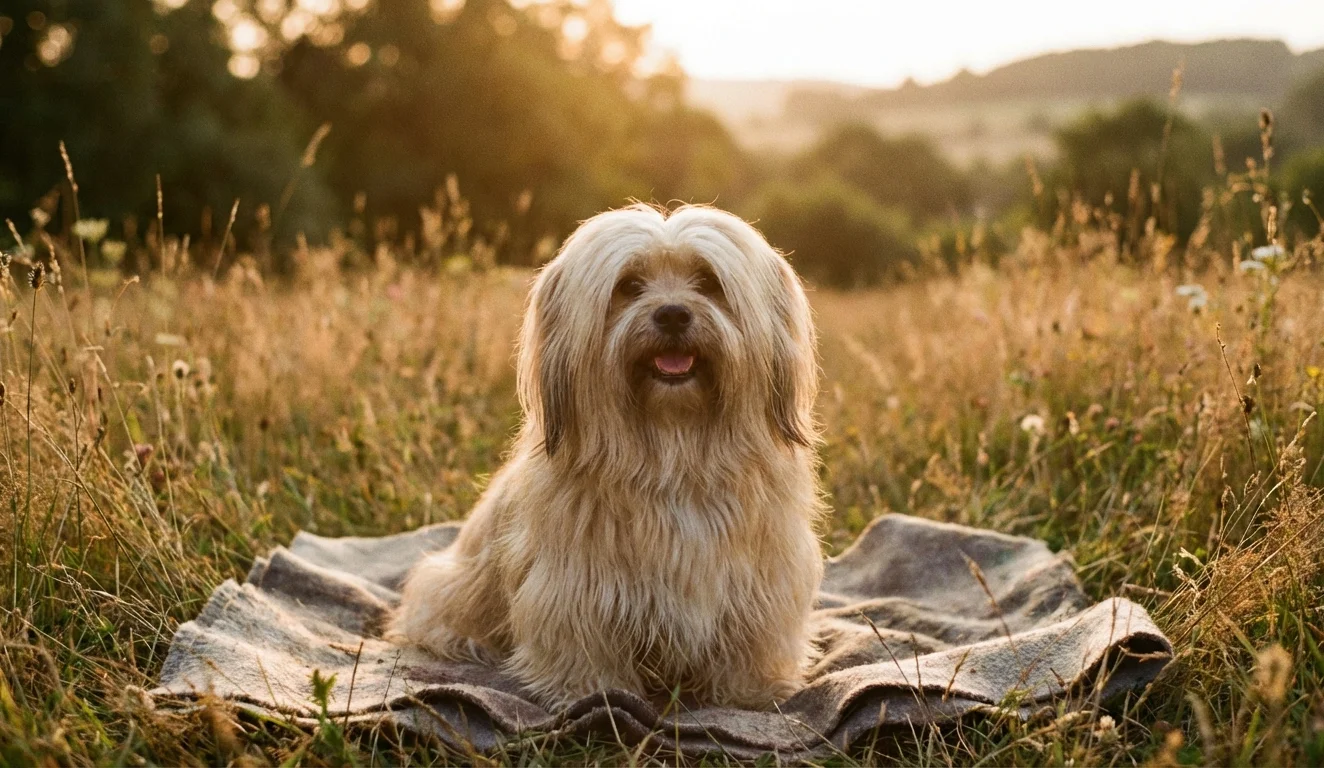
The coat is the Lhasa’s most dramatic feature. In full show coat, the hair parts down the center of the back and falls straight to the floor on both sides, covering the legs entirely. The head hair falls over the eyes, though they can see through it just fine — the hair acts as a natural sun visor in the high-altitude Tibetan environment. The coat is heavy, dense, and straight, not silky like a Yorkie’s and not cottony like a Bichon’s. It’s closer in texture to human hair, which means it grows continuously and doesn’t shed in the traditional sense. Loose hairs get caught in the coat rather than falling onto your furniture (but they do mat if you don’t brush regularly).
The face features dark, oval eyes, a medium-length muzzle (Lhasas are not brachycephalic, their muzzle is longer than a Shih Tzu’s), and heavily feathered pendant ears. The tail is carried over the back in a high curl, with a heavy plume of hair. In a pet clip (which most non-show Lhasas wear), they look like alert, shaggy little dogs with expressive faces and an unmistakable air of self-importance.
Lhasa Apso Temperament
The Lhasa Apso is what happens when you give a big dog’s personality to a small dog’s body and add a thousand years of sentinel breeding. They’re confident, independent, surprisingly tough, and possessed of an alertness that misses nothing.
What living with a Lhasa Apso is actually like:
- They’re alert machines. The Lhasa Apso has been alerting to potential threats for a millennium, and they haven’t received the memo that the threat level has been downgraded. Doorbells, footsteps, new smells, squirrels, they’ll announce it all. Training can moderate the volume and duration, but you’re not going to turn a Lhasa into a silent dog. It’s in the firmware.
- They’re loyal to their family but choosy with strangers. Lhasas bond tightly with their people and can be genuinely affectionate and playful at home. With strangers, they range from reserved to suspicious. Some warm up after an evaluation period. Others maintain a polite distance indefinitely.
- They’re stubborn. This is the breed’s defining training characteristic. Lhasas know what you want. They’ve heard the command. They’re considering whether to comply. They often decide against it. This isn’t aggression or defiance, it’s independence bred into them over centuries.
- They’re surprisingly hardy. Despite their small size, Lhasas are not fragile dogs. They were developed in one of the harshest environments on earth (the Tibetan Plateau, elevation 11,000+ feet) and have the constitution to show for it. They’re not the type of small dog that gets injured easily or trembles in cold weather.
- They have a silly side. Underneath the sentinel exterior, Lhasas can be genuine clowns with their family. They’ll do “Lhasa zoomies” around the house, play-wrestle with toys, and adopt positions of peak ridiculousness when sleeping. The serious face is for company. The goofy face is just for you.
Exercise Needs
Lhasa Apsos need about 30-40 minutes of exercise per day. Two short-to-moderate walks plus some indoor play usually satisfies them. They’re not sedentary dogs, they do enjoy their walks and will explore with enthusiasm, but they’re not endurance athletes. A Lhasa that gets its daily walks and some play time is a content Lhasa.
Mental stimulation matters as much as physical exercise for this breed. Puzzle toys, training sessions (even short, frustrating ones), nose work, and interactive games keep their alert minds engaged. A bored Lhasa isn’t destructive in the way a bored Husky is destructive, but it may become excessively barky, nippy, or attention-seeking.
One benefit: Lhasas don’t require a yard. They do well in apartments and condos. Their moderate exercise needs can be met entirely with leash walks and indoor play. Just be mindful of the barking, apartment-appropriate volume requires training.
Grooming
Here’s where the Lhasa demands your time. The long coat is gorgeous and high-maintenance. You have two options: maintain the long coat or keep the dog in a shorter “puppy clip.” Either way, grooming is not optional.
For a full-length coat:
- Daily brushing: and we mean daily. Use a pin brush and metal comb, working through the coat in layers to prevent mats. This takes 20-30 minutes
- Weekly bath and blow-dry: the coat stays cleaner and mats less when washed regularly. A good conditioner is mandatory
- Professional grooming every 4-6 weeks for trimming, face cleanup, and sanitary areas
For a puppy clip (most pet owners’ choice):
- Brushing 2-3 times per week: even short coats mat, especially behind the ears and in the armpits
- Professional grooming every 6-8 weeks: budget $50-$90 per session
- Regular face cleaning: tear staining is common in the breed. Wipe under the eyes daily with a damp cloth
Regardless of coat length:
- Nail trims every 2-3 weeks
- Dental care 4-5 times per week: small breeds are prone to dental disease, and Lhasas are no exception
- Ear cleaning weekly: the heavy ear leather and ear hair can trap moisture
The continuous-growth coat means Lhasas don’t shed in the usual sense, dead hair stays in the coat rather than falling on your furniture. This makes them better tolerated by some allergy sufferers, though they’re not hypoallergenic. The trade-off is that the trapped dead hair creates mats if not brushed out regularly.
Lhasa Apso Health Issues
Lhasa Apsos are among the longest-lived breeds. Lifespans of 14-16 years are common, and some reach 18-20 years. The AKC parent club (the American Lhasa Apso Club) reports an average lifespan of 12-15 years, but many breeders and owners cite even longer ranges. Still, the breed has some specific health predispositions to watch for.
Keratoconjunctivitis Sicca (Dry Eye)
Lhasas have one of the highest incidences of dry eye (KCS) among all breeds. The condition occurs when the tear glands don’t produce enough moisture to keep the cornea lubricated. Symptoms include thick, stringy eye discharge, redness, and squinting. Left untreated, it leads to corneal ulceration, scarring, and potentially blindness. Treatment is lifelong, immunosuppressive eye drops (cyclosporine or tacrolimus) cost $40-$80/month. The drops work well in most cases, but they’re a permanent commitment.
Patellar Luxation
Patellar luxation (kneecap displacement) affects approximately 7-8% of Lhasa Apsos according to OFA data. In mild cases (Grade 1-2), the kneecap slips out of position occasionally and pops back on its own. In severe cases (Grade 3-4), surgery is needed ($1,500-$3,000 per knee). Mild cases can often be managed with weight control and joint supplements. Ask breeders for patella evaluation results on both parents.
Progressive Retinal Atrophy (PRA)
PRA is a genetic eye disease that causes gradual vision loss and eventual blindness. It’s been identified in the Lhasa gene pool, and the American Lhasa Apso Club recommends CAER (Companion Animal Eye Registry) evaluations for breeding stock. Genetic testing can identify carriers. There’s no treatment, but dogs with PRA adapt well to vision loss in familiar environments and can live full lives.
Renal Dysplasia
This is a developmental kidney condition where the kidneys fail to mature properly. It can range from mild (detected only on biopsy) to severe (kidney failure in young dogs). Severe cases may present with excessive thirst, frequent urination, poor growth, and weight loss. The American Lhasa Apso Club has been working to reduce incidence through screening. Treatment for advanced cases involves supportive care ($200-$500/month for kidney-supportive diet, medications, and fluid therapy).
Intervertebral Disc Disease (IVDD)
The Lhasa’s long-backed conformation puts it at moderate risk for IVDD, where spinal discs deteriorate or rupture, pressing on the spinal cord. Symptoms range from back pain to complete paralysis. Conservative treatment (cage rest and anti-inflammatories, $500-$2,000) works for mild cases. Surgical decompression for severe cases costs $3,000-$8,000.
Training
Training a Lhasa Apso requires the patience of a monk, which is fitting, given the breed’s monastic origins. Lhasas are intelligent and learn quickly. The issue is compliance. They understand what you want. They just don’t always agree that it’s a reasonable request.
Positive reinforcement with high-value treats works best. Keep sessions short (5-10 minutes) and engaging. Repetitive drilling bores Lhasas quickly, and a bored Lhasa simply walks away. Vary the exercises, keep the energy upbeat, and accept that perfection isn’t the goal, “good enough to live with” is a realistic training standard for this breed.
Socialization is important from day one. Lhasas that aren’t exposed to various people, sounds, and situations during puppyhood can become overly suspicious and bark-reactive as adults. Puppy classes, positive exposure to visitors, and regular outings to different environments help develop a well-rounded temperament.
Housetraining is generally straightforward with Lhasas, they’re clean dogs that prefer not to soil their living space. Consistent scheduling and crate training produce good results within a few weeks for most puppies. Bell training (teaching the dog to ring a bell at the door when it needs to go out) works particularly well with this breed, since they’re already inclined to alert you to things.
Cost
Purchase Price
A Lhasa Apso puppy from a reputable breeder costs $1,200-$2,500. Show-quality puppies from champion lines can reach $3,500+. The breed’s long lifespan means you’re committing to 12-18 years, buying from a breeder who tests for eye conditions, patella, and kidney function is a worthwhile investment in those years.
Rescue Lhasas are available through the American Lhasa Apso Club’s rescue network and general small-breed rescues for $200-$500. Adult rescue dogs are often past the demanding puppy coat phase and already housetrained.
Monthly Costs
| Expense | Monthly Estimate |
|---|---|
| Food (small breed, high-quality) | $25-$45 |
| Preventive vet care (averaged) | $15-$35 |
| Pet insurance | $25-$45 |
| Professional grooming | $25-$50 |
| Grooming supplies | $10-$15 |
| Treats and chews | $10-$15 |
| Miscellaneous | $10-$15 |
| Total | $120-$220 |
First-Year Costs
Beyond the purchase price, first-year costs run $1,800-$3,000. This includes vaccinations, spay/neuter, a crate, grooming tools (pin brush, metal comb, conditioner), professional grooming sessions, initial vet exams, microchipping, and dental care supplies. If you’re maintaining a full coat, expect grooming costs to be at the higher end. A good quality pin brush and metal comb ($30-$50 total) are investments that last years.
Is a Lhasa Apso Right for You?
A Lhasa Apso could be a great fit if you:
- Want a long-lived, small companion with real personality
- Appreciate an independent dog that’s loyal but not needy
- Are willing to commit to regular grooming (or regular grooming appointments)
- Live in an apartment or small home
- Want a natural watchdog in a small package
- Have older children who respect a dog’s space
- Enjoy a dog with a sense of humor and a stubborn streak
A Lhasa Apso is probably not right if you:
- Have toddlers or very young children (Lhasas don’t tolerate rough handling)
- Want a dog that loves everyone it meets
- Expect instant, eager obedience to every command
- Don’t want to deal with grooming or pay for regular professional grooming
- Are looking for a quiet dog (Lhasas bark, it’s their calling)
- Want an off-leash dog that comes when called every single time
- Need a high-energy exercise partner
The Lhasa Apso is a small dog with an ancient job and the personality to match. They’re not for people who want a simple, easygoing pet, they’re for people who want a genuine character. A companion with opinions, a sense of humor, and a thousand-year-old conviction that watching the door is the most important job in the house. If you can appreciate that combination of independence, loyalty, and barely suppressed ridiculousness, the Lhasa Apso will reward you with a decade and a half (or more) of the most entertaining companionship you’ve ever had.
Related Breeds
If you’re considering this breed, you might also want to look at:
Frequently Asked Questions
What’s the difference between a Lhasa Apso and a Shih Tzu?
The two breeds share Tibetan ancestry (the Shih Tzu was developed in China from Lhasa Apso stock mixed with Pekingese), but they’re distinct in both appearance and temperament. Lhasas are slightly larger (12-18 lbs vs. 9-16 lbs), have a longer muzzle, and a narrower skull. Temperament-wise, Lhasas are more independent, more reserved with strangers, and more alert. Shih Tzus are more outgoing, affectionate, and people-oriented. If you want a dog that loves everyone, get a Shih Tzu. If you want a dog that evaluates everyone, get a Lhasa.
Do Lhasa Apsos bark a lot?
Yes. This is a breed that was literally selected over a thousand years for its alerting ability. They bark at doorbells, strangers, unusual sounds, animals outside, and things that humans can’t detect. Training can reduce unnecessary barking and teach a “quiet” command, but you’ll never fully eliminate alerting behavior. If barking is a dealbreaker, this breed isn’t for you.
How long do Lhasa Apsos live?
Lhasa Apsos are one of the longest-lived breeds. The typical lifespan is 12-15 years, but many live to 16-18 years, and a few documented cases have reached 20+. The oldest verified Lhasa Apso lived to 29 years (though this is extremely unusual). Their longevity means a Lhasa Apso is a long-term commitment, you should be prepared for 15+ years of ownership.
Are Lhasa Apsos hypoallergenic?
No dog is truly hypoallergenic. Lhasas do have a hair-type coat that grows continuously and sheds less than fur-type coats, which means less dander floating in the air. Many allergy sufferers find Lhasas more tolerable than heavy-shedding breeds. But individual reactions vary, and the only way to know is to spend time with a Lhasa before committing.
Can Lhasa Apsos be left alone?
Better than many small breeds. Lhasas are independent dogs that don’t typically develop severe separation anxiety. Most adult Lhasas can handle 6-8 hours alone if properly crate-trained or given a safe space. Puppies need more frequent attention, but adults settle into a workday routine well. But no dog should be alone for 10+ hours daily, if that’s your schedule, a dog walker or midday visit from a pet sitter is recommended.