Doberman Pinscher Breed Guide: Misunderstood, Loyal, and Smarter Than You Think (2026)
Doberman Pinschers are elite athletes with a reputation that doesn't match reality. Here's what the breed is actually like behind the intimidation factor.
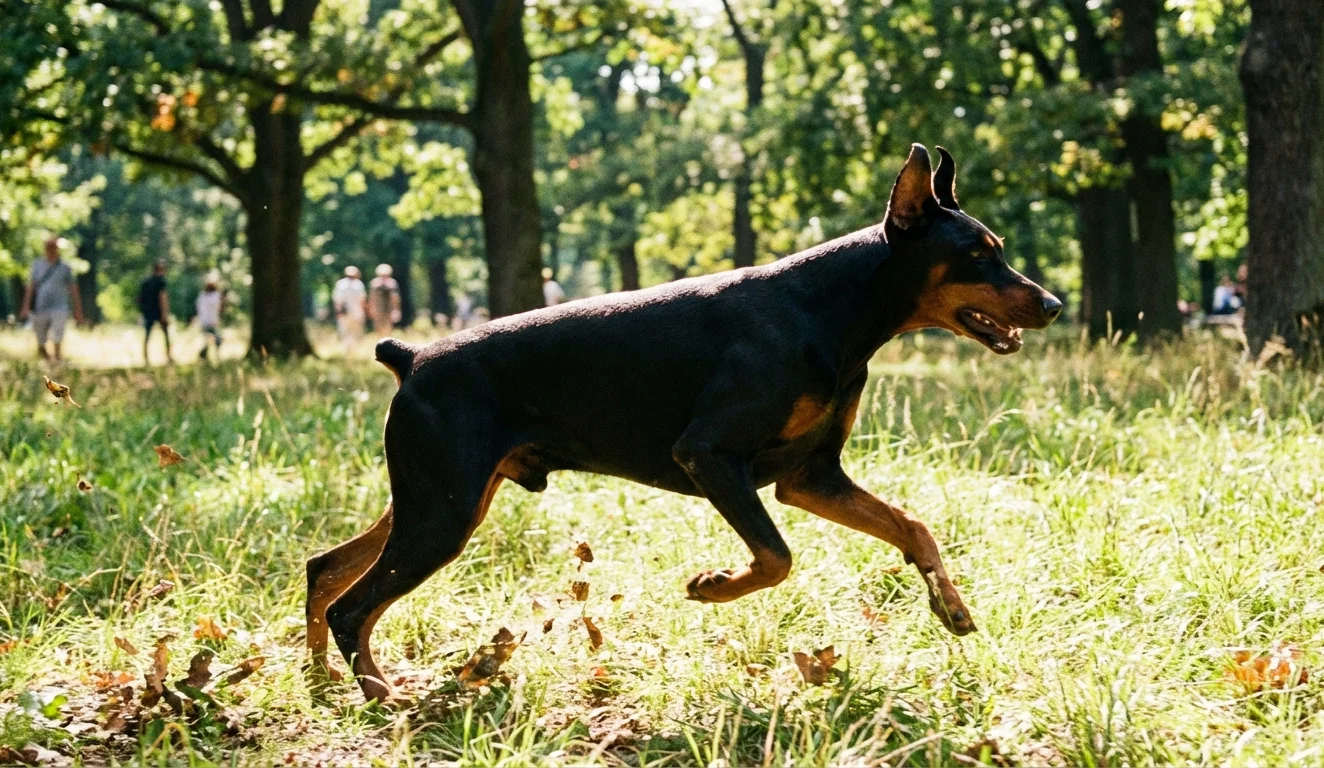
The Doberman Pinscher weighs 60-100 pounds, stands 24-28 inches tall, and lives 10-12 years. On paper, that describes a large working dog. In person, a Doberman looks like it was designed in a wind tunnel, everything about this breed is sleek, muscular, and purposeful. There’s no wasted mass on a Doberman. They’re among the most athletic dogs alive, and they know it.
In Short: 60–100 lbs, 10–12 years. High energy. Moderate shedding. Watch for Dilated Cardiomyopathy and Von Willebrand Disease. Good with kids, but better for experienced owners.
We think the Doberman is one of the most misunderstood breeds out there. The movies gave them a reputation as aggressive guard dogs, and that image stuck hard. In reality, most Dobermans are affectionate, sensitive dogs that want to lean against your leg on the couch and follow you to the bathroom. They’re protective, sure, that’s built into the breed. But “protective” and “aggressive” aren’t the same thing, and the average well-bred, well-socialized Doberman is far more likely to lick a stranger than bite one.
Doberman Pinscher at a Glance
| Trait | Details |
|---|---|
| Breed Group | Working (AKC) |
| Height | Males: 26-28 in / Females: 24-26 in |
| Weight | Males: 75-100 lbs / Females: 60-90 lbs |
| Life Expectancy | 10-12 years |
| Coat | Short, smooth, dense |
| Colors | Black & Rust, Red & Rust, Blue & Rust, Fawn & Rust |
| Temperament | Loyal, Fearless, Alert |
| Shedding | Moderate |
| Energy Level | High |
| Good With Kids | Yes (with socialization) |
| First-Time Owner Friendly | No |
History of the Doberman Pinscher
The Doberman Pinscher was created by one man with a very specific goal. Karl Friedrich Louis Dobermann was a tax collector in Apolda, Germany, in the late 1800s. He also ran the local dog pound. His job was dangerous, tax collectors weren’t exactly popular, so he set out to breed the ideal protection dog: intimidating enough to deter threats, loyal enough to be trusted completely, and intelligent enough to assess situations without constant direction.
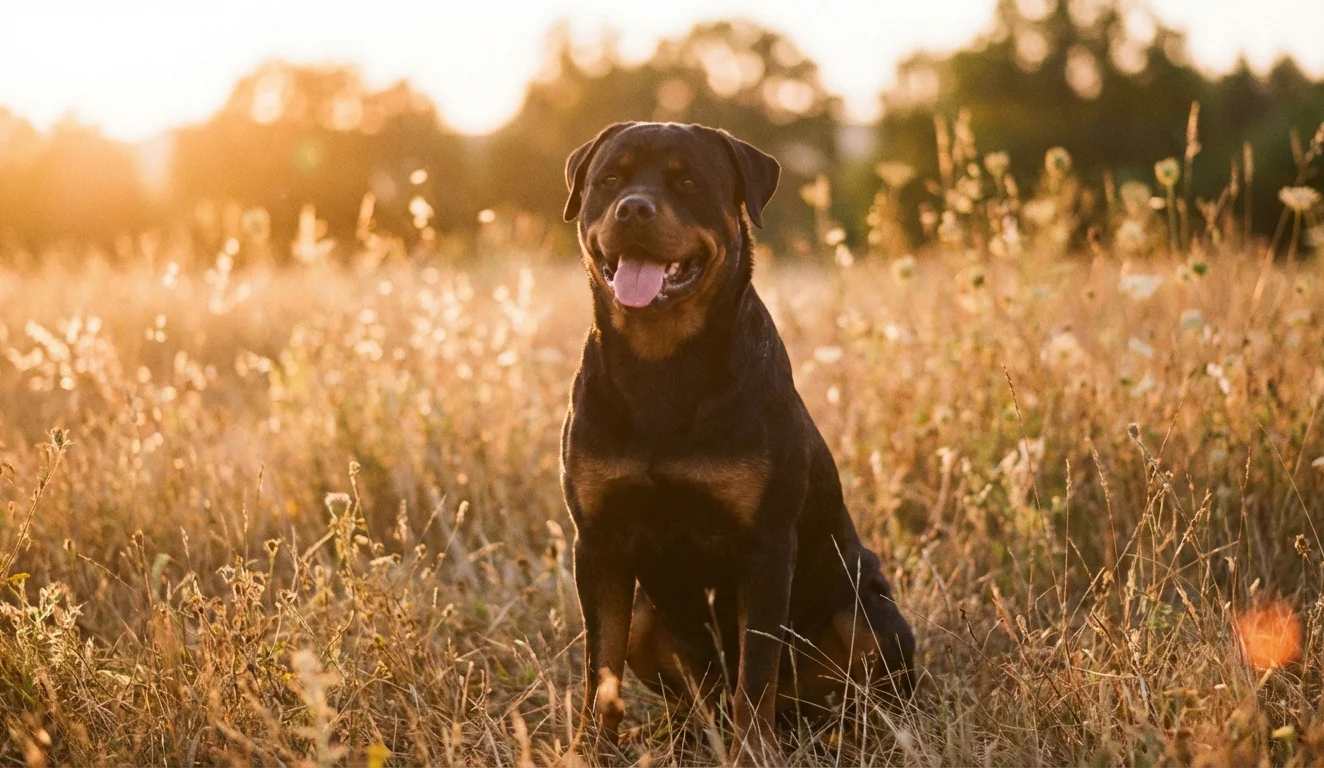
Dobermann crossed several breeds to get what he wanted, likely including the Rottweiler, German Pinscher, Weimaraner, and old German Shepherd. The exact recipe is debated, but the result speaks for itself. By the early 20th century, the Doberman had established itself as one of the premier working breeds in Europe.
The breed earned AKC recognition in 1908. Dobermans served extensively in both World Wars, particularly with the U.S. Marine Corps in the Pacific Theater during WWII, where they worked as sentries, scouts, and messengers. Twenty-five Dobermans died during the Battle of Guam, and a memorial on the island honors them. The breed’s military service cemented its reputation for courage and intelligence, though it also contributed to the “dangerous dog” stereotype that persists today.
Size and Appearance
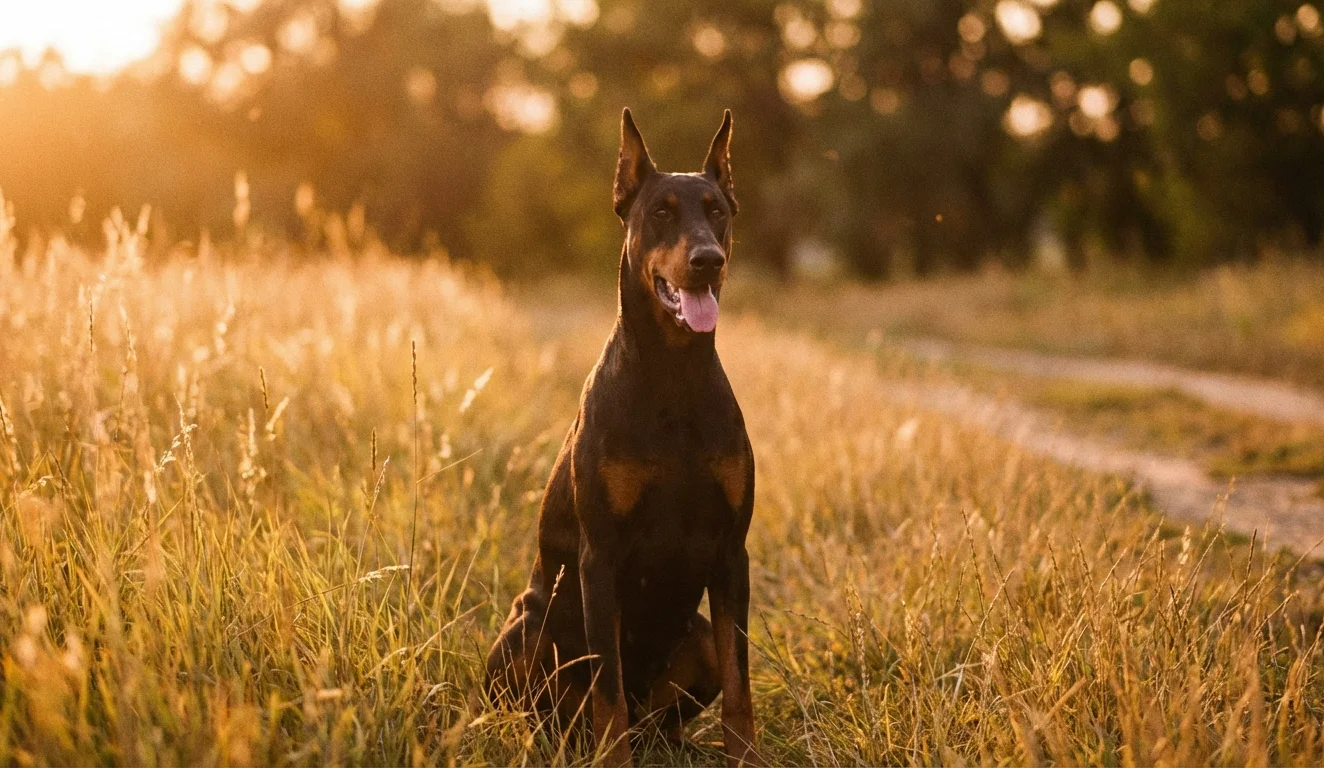
The Doberman Pinscher is a large, powerful dog with an unmistakable silhouette. Males stand 26-28 inches at the shoulder and weigh 75-100 pounds. Females are slightly smaller at 24-26 inches and 60-90 pounds, though some females are nearly as large as males.
Build
The Doberman’s build is all about efficiency. A square body profile (height roughly equal to length), deep chest, tucked abdomen, long neck, and powerful hindquarters give the breed its characteristic athletic look. Dobermans are fast, they can hit 30+ mph at a sprint, and their movement is smooth and ground-covering.
Ears and Tail
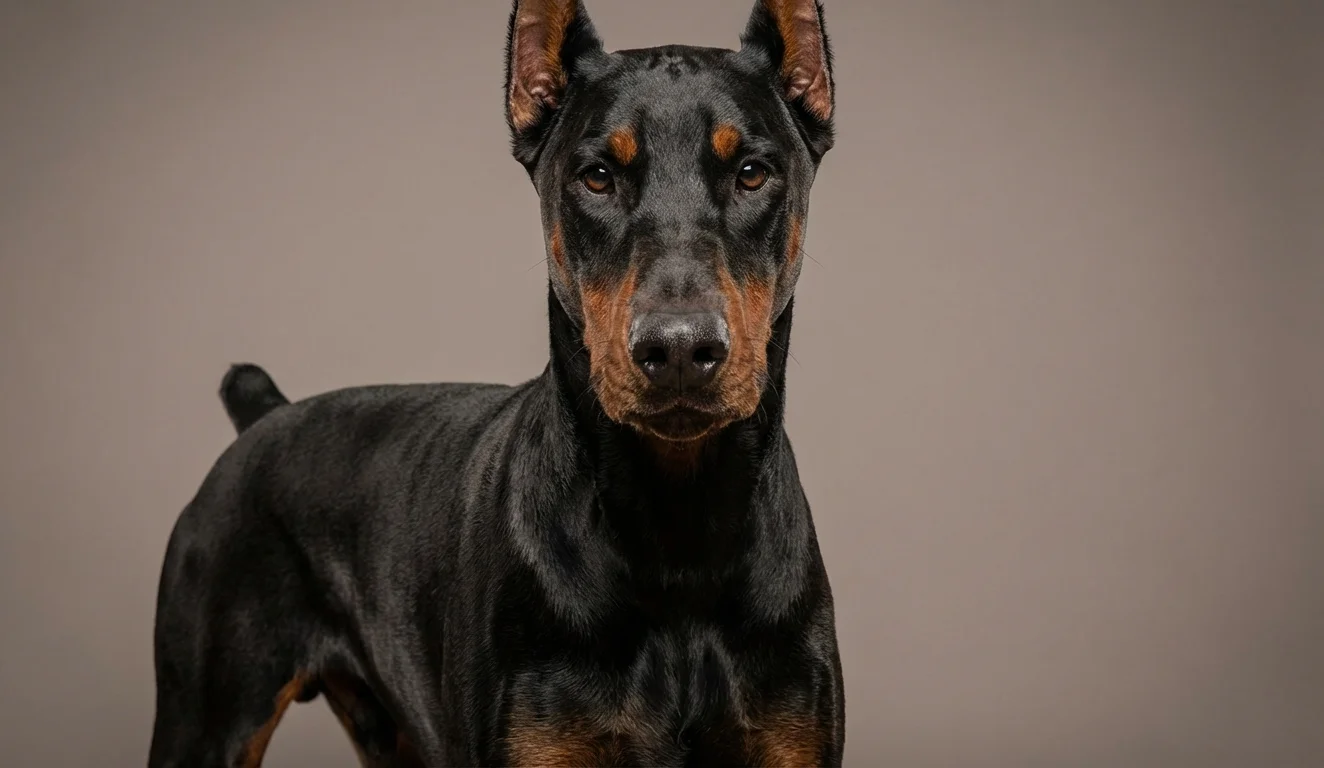
The cropped ears and docked tail that most Americans associate with the Doberman are actually surgical modifications, not natural features. Natural Doberman ears are medium-sized and fold forward. The natural tail is long and thin. Ear cropping and tail docking are increasingly controversial and are banned in many European countries, Australia, and parts of Canada. We won’t tell you what to decide on this, it’s a personal choice, but know that it’s a cosmetic procedure with no health benefit.
Coat and Colors
The Doberman coat is short, smooth, and lies close to the body. It’s a single-layer coat (no undercoat), which means Dobermans are not well-suited to cold climates without protection. Standard colors are black and rust (by far the most common), red and rust, blue and rust, and fawn (Isabella) and rust. The blue and fawn colors carry a dilution gene that’s associated with a skin condition called Color Dilution Alopecia (CDA), which can cause hair loss and skin issues. Something to be aware of if you’re drawn to the rarer colors.
Doberman Pinscher Temperament
The Doberman temperament is the single biggest gap between public perception and reality. People who have never owned one see a scary guard dog. People who have owned one see a 90-pound lapdog with boundary issues.
What Doberman ownership is really like:
- They’re clingy. Dobermans are nicknamed “velcro dogs” for good reason. They want physical contact with their people at all times. A Doberman will follow you from room to room, lean its full weight against your legs while you’re standing, and try to sleep on top of you at night. If you want a dog that keeps its distance, look elsewhere.
- They’re protective without being aggressive. A well-bred Doberman has excellent threat assessment. They’ll position themselves between you and a stranger, watch intently, and relax once they determine there’s no threat. This instinct requires proper socialization to develop correctly, an under-socialized Doberman can become fearful and reactive, which is dangerous in a dog this powerful.
- They’re emotionally sensitive. This surprises people. Dobermans are sensitive to household tension, raised voices, and their owner’s mood. They don’t respond well to harsh training methods, they shut down. If you yell at a Doberman, it won’t just sulk. It’ll remember.
- They don’t tolerate boredom. A Doberman with nothing to do becomes a problem. They’ll chew, dig, pace, and develop anxiety-driven behaviors faster than most breeds.
Dobermans are good with children in their own family, especially when raised together. They’re patient and protective with “their” kids. With unfamiliar children, supervision is always appropriate, not because the dog is aggressive, but because a Doberman’s size and protectiveness require management.
They are not generally recommended with other dogs or cats, though individual temperament and socialization matter enormously.
Exercise Needs
Dobermans need 60 minutes of vigorous exercise per day at minimum. These are high-energy athletes that were built to work, and they need an outlet for that physical capacity.
Effective exercise for Dobermans:
- Running alongside a bike or jogging, Dobermans are outstanding running partners with the speed and endurance to keep up with serious athletes
- Structured fetch with sprinting (Dobermans love to run full-out)
- Agility and obedience competition, the breed excels at both
- Schutzhund/IPO training, this is what the breed was designed for, combining tracking, obedience, and protection work
- Swimming, most Dobermans enjoy water, though they’re not natural swimmers like retrievers
What to avoid:
- Leaving a Doberman in a yard and expecting it to self-exercise. It won’t. It’ll stand at the door and wait for you.
- Long periods of confinement without activity. Crated or confined Dobermans that don’t get adequate exercise develop serious behavioral issues.
Exercise needs decrease moderately with age, but even senior Dobermans (8+) typically need 30-45 minutes of daily activity to stay physically and mentally healthy.
Grooming
Dobermans are one of the lowest-maintenance breeds when it comes to grooming. That short, smooth coat is a gift.
Grooming routine:
- Weekly brushing with a rubber curry brush or grooming mitt, this removes loose hair and distributes skin oils
- Bath every 6-8 weeks or as needed. Dobermans don’t have a strong doggy odor.
- Nail trims every 2-3 weeks: their dark nails make it hard to see the quick, so trim carefully or use a Dremel
- Ear cleaning weekly: especially if the ears are cropped, the open ear canal can collect debris
- Teeth brushing 2-3 times per week
Dobermans shed moderately year-round. The short hairs embed in fabrics and can be harder to remove than longer dog hair, but overall shedding is very manageable. No professional grooming is needed. Total annual grooming cost: minimal, maybe $50-$100 for supplies.
Doberman Pinscher Health Issues
This is the hard part of the Doberman conversation. The breed has some serious genetic health concerns, and being honest about them is more important than being optimistic.
Dilated Cardiomyopathy (DCM)
DCM is the leading cause of death in Doberman Pinschers, and the numbers are sobering. Studies estimate that 50-60% of Dobermans will develop DCM during their lifetime, according to research published in the Journal of Veterinary Internal Medicine. The disease causes the heart muscle to weaken and enlarge, leading to heart failure. It can appear as early as age 4, though it more commonly develops between ages 6-8.
Annual cardiac screening (echocardiogram and 24-hour Holter monitor) starting at age 2 is strongly recommended by the Doberman Pinscher Club of America. Early detection allows medication to slow progression. Treatment costs $3,000-$10,000 over the course of the disease.
This is the single biggest factor to weigh when considering a Doberman. We don’t say that to scare you, but a breed where more than half will develop a serious heart condition deserves honest framing.
Von Willebrand Disease (vWD)
A common blood clotting disorder in Dobermans. Type 1 vWD (the most common form in Dobies) causes mild to moderate bleeding tendencies, affected dogs may bleed more during surgery or from injuries. A DNA test can identify carriers. Reputable breeders test all breeding stock. Treatment costs range from $500-$3,000 depending on severity and circumstances.
Wobbler Syndrome (Cervical Vertebral Instability)
Wobbler Syndrome occurs when the cervical vertebrae compress the spinal cord, causing a characteristic wobbly gait in the hind legs. Dobermans are disproportionately affected compared to other breeds. Treatment ranges from conservative management (rest and medication) to spinal surgery costing $5,000-$10,000. Outcomes vary depending on severity.
Hip Dysplasia
Moderate prevalence in the breed. The OFA recommends hip evaluations for all Dobermans used in breeding programs. Treatment costs range from $1,500-$6,000 for surgical intervention.
Progressive Retinal Atrophy
PRA causes gradual vision loss. DNA testing can identify carriers, and responsible breeders screen for it.
Training a Doberman Pinscher
Dobermans are among the most trainable breeds in existence. Stanley Coren’s The Intelligence of Dogs ranks the Doberman as the 5th most intelligent breed, ahead of the Labrador Retriever. They learn new commands with remarkable speed and have an innate desire to work with their handler.
What makes Doberman training unique:
- They read body language better than almost any breed. Your posture, tone, and emotional state all register with a Doberman. Be aware of what you’re communicating beyond words.
- Positive reinforcement is non-negotiable. Dobermans are too sensitive and too smart for punishment-based training. They’ll either shut down or lose trust, and losing a Doberman’s trust is hard to repair.
- Socialization is the highest training priority. Between 8-16 weeks, a Doberman puppy needs extensive, positive exposure to different people (especially men in hats, uniforms, and sunglasses, common triggers), other dogs, varied environments, and novel situations.
- Teach an “off switch.” Dobermans can be intense, and they need to learn to settle on command. Structured relaxation training (look up Karen Overall’s relaxation protocol) is incredibly valuable for this breed.
Common training mistakes with Dobermans:
- Encouraging guarding behavior in puppies. A Doberman doesn’t need encouragement to be protective, that instinct will develop on its own. Encouraging it in a young dog creates a liability.
- Skipping socialization because the puppy seems fine. A 12-week-old Doberman that’s fearless at home may become reactive at 18 months if it wasn’t properly socialized during the critical window.
- Assuming intelligence equals compliance. Dobermans are smart enough to test boundaries regularly.
Doberman Pinscher Cost
Purchase Price
A Doberman Pinscher puppy from a reputable breeder with full health testing (cardiac, vWD, hips, eyes) costs $1,500-$2,500. Working-line Dobermans from European bloodlines or titled parents can cost $3,000-$5,000+.
Given the DCM prevalence in this breed, health testing in the breeder’s lines is not a nice-to-have, it’s a requirement. Ask for cardiac screening history going back at least two generations. Any breeder who doesn’t screen for DCM should be disqualified immediately.
Doberman rescue organizations place dogs regularly. Adoption fees run $200-$500.
Monthly Costs
| Expense | Monthly Estimate |
|---|---|
| Food (high-quality large-breed formula) | $60-$90 |
| Preventive vet care (averaged) | $15-$30 |
| Pet insurance | $35-$65 |
| Treats and chews | $10-$20 |
| Annual cardiac screening (averaged) | $15-$30 |
| Miscellaneous (toys, supplies) | $10-$20 |
| Total | $100-$225 |
Pet insurance is not optional for this breed, in our opinion. A single DCM treatment course can run $3,000-$10,000, Wobbler surgery $5,000-$10,000, and hip dysplasia surgery $1,500-$6,000. Get insurance early, before any conditions develop.
First-Year Costs
Budget $3,500-$6,000 for the first year, including purchase price, initial veterinary workup, supplies, training, and the beginning of annual cardiac screening. Obedience training ($200-$600 for a course) is strongly recommended, a 100-pound dog with protective instincts needs excellent manners.
Is a Doberman Pinscher Right for You?
A Doberman is a great fit if you:
- Want an intensely loyal, affectionate dog that bonds deeply to its family
- Are an experienced dog owner comfortable with a powerful, intelligent breed
- Can provide 60+ minutes of daily vigorous exercise
- Have time and patience for ongoing socialization and training
- Are financially prepared for potential health costs (DCM screening and treatment especially)
- Want a dog that will be glued to your side
A Doberman is probably NOT right if you:
- Are a first-time dog owner, the breed requires experienced handling
- Want a dog that’s happy left alone for long hours
- Aren’t willing to invest in serious socialization work
- Live in a community with breed-specific legislation that restricts Dobermans
- Are put off by the breed’s health concerns, particularly DCM
- Want a dog that’s friendly with everyone, Dobermans are reserved with strangers by nature
The Doberman is a breed that gives you everything it has. Its loyalty, its attention, its physical presence, it’s all yours. But it asks for a lot in return. Time, training, exercise, veterinary vigilance, and the emotional preparedness to manage a breed with significant health risks. If you can meet those demands, a Doberman will be one of the most remarkable dogs you’ll ever share your life with.
Related Breeds
If you’re considering this breed, you might also want to look at:
Frequently Asked Questions
Are Doberman Pinschers dangerous?
No more than any other large breed when properly bred, socialized, and trained. The “dangerous Doberman” stereotype comes from their use as guard dogs and their portrayal in movies, not from breed-wide aggression data. The American Temperament Test Society (ATTS) reports that Dobermans pass temperament testing at a rate of about 79%, which is comparable to or better than many popular breeds. Poorly bred, under-socialized, or mistreated Dobermans can be dangerous, but that’s true of any powerful breed. The key factors are responsible breeding, early socialization, and consistent training.
How serious is DCM in Dobermans?
Very serious. Studies suggest 50-60% of Dobermans will develop Dilated Cardiomyopathy during their lifetime. It’s the leading cause of death in the breed. Annual cardiac screening (echocardiogram plus 24-hour Holter monitor) starting at age 2 is the standard recommendation from the Doberman Pinscher Club of America. Early detection allows treatment that can extend quality of life, but there’s currently no cure. This is a reality every prospective Doberman owner needs to accept and plan for, financially, medically, and emotionally.
Should I crop my Doberman’s ears?
This is a personal decision with no medical benefit. Ear cropping is a cosmetic surgical procedure typically performed at 7-12 weeks of age, followed by months of ear posting and taping to train the ears to stand erect. It’s banned in many countries. Proponents argue it gives the breed its traditional look and may reduce ear infections (though evidence for this is weak). Opponents argue it’s unnecessary cosmetic surgery on a puppy. The AKC breed standard allows both cropped and natural ears. Many Doberman owners are increasingly choosing to leave ears natural.
Are Dobermans good with other dogs?
It depends on the individual and their socialization history. Dobermans are not naturally dog-friendly in the way a Labrador or Golden Retriever is, the breed database lists them as not good with other dogs. Same-sex aggression is relatively common, particularly between intact males. Still, many Dobermans live happily with other dogs, especially when raised together from puppyhood or introduced carefully. Early, consistent socialization with other dogs is critical. If you have other dogs at home, introduce them on neutral territory and supervise closely during the adjustment period.
How much exercise does a Doberman need?
A healthy adult Doberman needs at least 60 minutes of vigorous exercise per day. We’d emphasize “vigorous”, a leisurely neighborhood walk doesn’t cut it for this breed. Dobermans need to run, sprint, and use their bodies. Running alongside a bike, structured fetch sessions, agility, and swimming are all excellent outlets. Mental stimulation is equally important, training sessions, puzzle toys, and interactive games prevent the boredom-driven behaviors that Dobermans are famous for when under-stimulated.