Bull Terrier Breed Guide: The Egg-Headed Clown That Lives Life at Full Volume (2026)
The Bull Terrier is a muscular, egg-headed, endlessly entertaining comedian of the dog world that treats every day like a party it's personally hosting.
The Bull Terrier weighs 50-70 pounds, stands 21-22 inches at the shoulder, and lives 12-13 years. It’s the dog with the face you can’t mistake for anything else, that egg-shaped head, the triangular eyes, the Roman nose profile that looks like it was designed by a cartoonist on a deadline. The AKC recognized the Bull Terrier in 1885, and the breed has been polarizing opinions ever since. People either love them or don’t get them. There’s very little middle ground.
In Short: 50–70 lbs, 12–13 years. High energy, needs 60+ minutes of vigorous daily exercise. Low shedder, easy coat care. Watch for Deafness and Heart Disease. Best for experienced owners who want an intensely bonded, high-energy companion with a sense of humor.
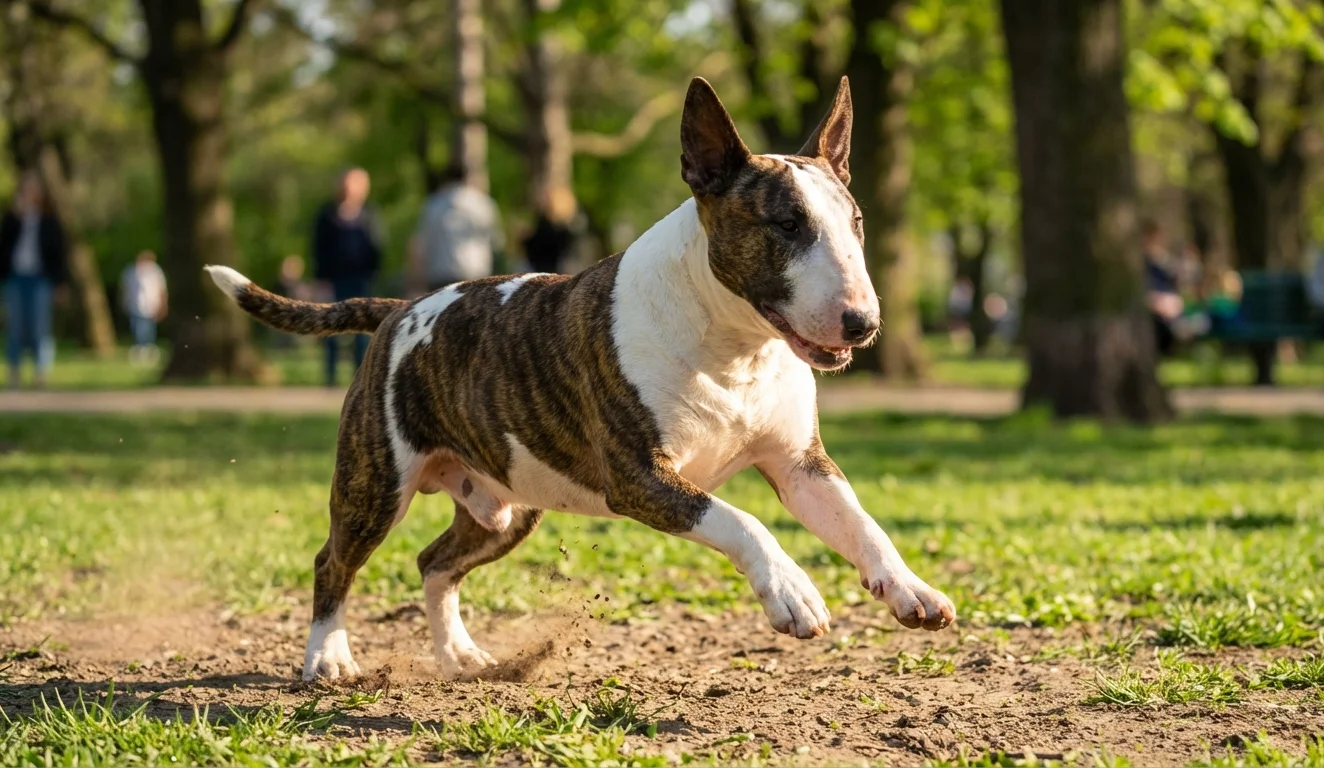
If you’ve ever watched a Bull Terrier play, you’ve seen something close to controlled chaos. They spin, they bounce, they grab toys and shake them violently, they sprint in circles for no apparent reason (this is called a “Bully run” and it’s as hilarious as it sounds), and they do all of this with a level of commitment and joy that’s impossible not to admire. The Bull Terrier approaches life the way a toddler approaches a ball pit: full speed, no hesitation, maximum enthusiasm.
Bull Terrier at a Glance
| Trait | Details |
|---|---|
| Breed Group | Terrier (AKC, 1885) |
| Height | 21-22 in |
| Weight | 50-70 lbs |
| Life Expectancy | 12-13 years |
| Coat | Short, flat, glossy |
| Colors | White, Brindle, Fawn, Red, Black, Tricolor |
| Temperament | Playful, Charming, Mischievous |
| Shedding | Low to Moderate |
| Energy Level | High |
| Good With Kids | Yes (older children, with supervision) |
| First-Time Owner Friendly | No |
History
The Bull Terrier was created in early 19th century England from a grim origin story. When blood sports were popular in Britain, breeders crossed Bulldogs with terriers to produce dogs for bull-baiting and dog fighting, combining the Bulldog’s jaw strength with the terrier’s agility and tenacity. These early “Bull and Terrier” dogs were the ancestors of several modern breeds, including the Bull Terrier, the Staffordshire Bull Terrier, and the American Pit Bull Terrier.
The man who transformed the breed was James Hinks of Birmingham, who in the 1860s began crossing the Bull and Terrier with the now-extinct English White Terrier and possibly Dalmatians and Pointers to create a more refined, all-white dog. Hinks wanted an elegant companion that still had the terrier’s courage but looked more like a gentleman’s dog and less like a fighting dog. His creation, the white Bull Terrier, was an immediate hit in the show ring. The distinctive egg-shaped head wasn’t part of the original design. It developed gradually through selective breeding in the late 1800s and early 1900s, becoming the breed’s most recognizable feature.
Colored Bull Terriers (non-white) were recognized as a separate AKC variety in 1936 after breeders argued that the all-white breeding focus was causing health problems (particularly deafness). Today, both white and colored Bull Terriers compete and are bred, though deafness remains more common in white dogs, a pattern seen across multiple white-coated breeds.
Size and Appearance
Bull Terriers are medium-sized, powerfully built dogs. They stand 21-22 inches tall and weigh 50-70 pounds, though the breed standard doesn’t set strict weight limits, the emphasis is on proportion and substance. A well-built Bull Terrier looks like a compact athlete: broad chest, muscular shoulders, strong hindquarters, and a short, level back.
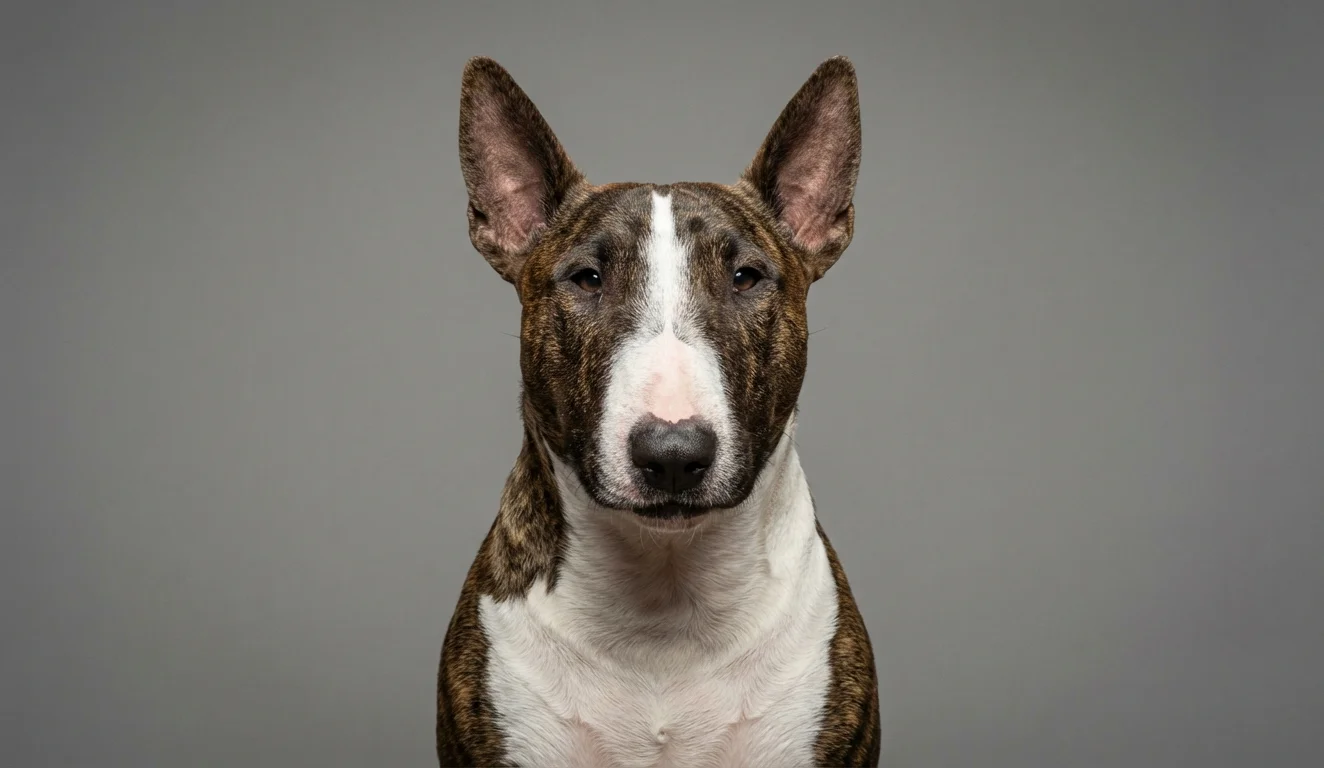
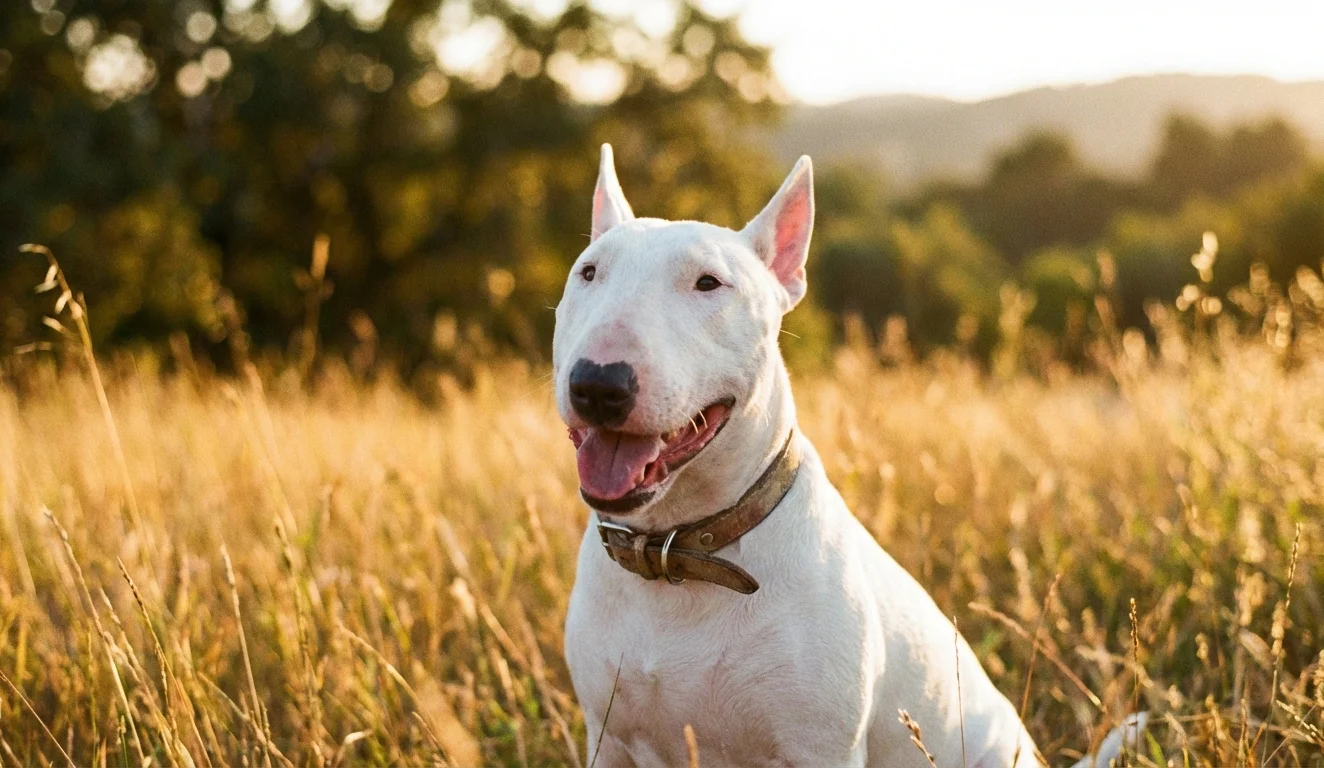
The head is the star. There’s nothing else in the dog world that looks like a Bull Terrier’s head. Viewed in profile, it curves downward from the top of the skull to the tip of the nose in a smooth, unbroken arc, the “egg shape” or “Roman nose.” The eyes are small, triangular, deep-set, and dark, positioned on the head in a way that gives the dog a uniquely mischievous expression. The ears are small, thin, and erect, sitting close together on top of the skull.
The body is round and muscular, with a distinctive barrel-shaped ribcage. Bull Terriers are solid, they feel heavier than they look when you pick one up (or when one jumps on you, which will happen frequently).
Coat and Color
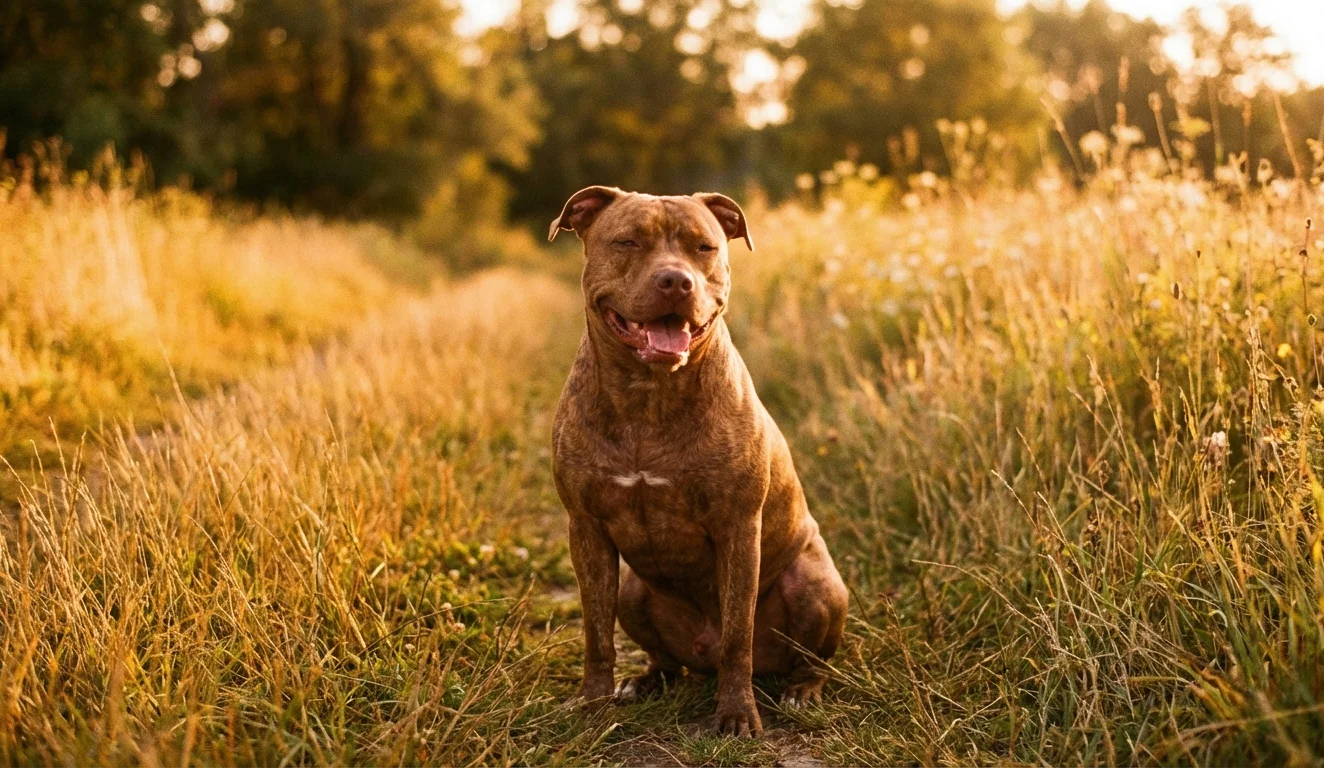
The coat is short, flat, glossy, and harsh to the touch. It’s one of the lowest-maintenance coats in the dog world. White Bull Terriers are solid white, sometimes with colored markings on the head only. Colored Bull Terriers come in brindle (the most common and often considered the most striking), fawn, red, black, and tricolor. Brindle is preferred in the show ring for colored dogs.
Bull Terrier Temperament
The Bull Terrier temperament is best described as “maximum personality in a medium-sized package.” They are, without exaggeration, one of the most entertaining breeds to live with. They’re also one of the most demanding.
What living with a Bull Terrier is actually like:
- Clowns with muscles. Bull Terriers are genuinely funny dogs. They play with a physical comedy that seems almost intentional, spinning, bouncing, making weird noises, carrying objects around the house, and performing “Bully runs” (sudden, explosive sprints in tight circles that look like the dog has temporarily lost its mind). This goofiness is the breed’s most endearing quality and continues well past puppyhood.
- Obsessively bonded to their people. Bull Terriers don’t just like their owners, they’re fixated on them. They follow you room to room, press against you on the couch, stare at you while you work, and become genuinely distressed when separated. This is a breed that does not do well left alone for long periods. Separation anxiety is common and can be severe.
- Mouthy. Bull Terriers use their mouths to explore, play, and communicate. Puppies are especially mouthy, and without consistent training, this can become a problem in adult dogs. They need to learn bite inhibition early, and they need durable toys to redirect the chewing instinct (which is powerful, Bull Terriers can destroy “indestructible” toys in minutes).
- Strong-willed and creative. Like all terriers, Bull Terriers have their own ideas about how things should go. They’ll test boundaries, find loopholes in your rules, and invent new forms of mischief you didn’t think to prevent. They’re smart enough to open doors, figure out latches, and problem-solve their way into trouble.
- Dog-selective. Many Bull Terriers do not get along well with other dogs, particularly dogs of the same sex. This is a breed with a fighting heritage, and while modern Bull Terriers are not fighting dogs, same-sex aggression and dog reactivity are real concerns. Early socialization helps but doesn’t guarantee dog-friendliness.
Exercise Needs
Bull Terriers need 60-90 minutes of vigorous exercise per day. This is a high-energy breed that needs to burn off physical and mental energy daily, or you’ll pay for it in destroyed furniture, landscaping, and household items.
Good exercise for Bull Terriers:
- High-intensity play sessions. Tug-of-war, fetch with balls or frisbees, and flirt pole games are excellent. Bull Terriers play hard and physical, they want activities that let them use their strength and speed.
- Structured walks at a brisk pace. A leisurely stroll doesn’t cut it. Bull Terriers want to move with purpose. Thirty to forty-five minutes of brisk walking, plus play sessions, covers the daily minimum.
- Running. Adult Bull Terriers (over 18 months) make decent short-to-medium distance running partners. They’re fast in bursts and can maintain a moderate pace for a few miles.
- Puzzle toys and mental enrichment. Kong toys, snuffle mats, food puzzles, and hide-and-seek games engage the brain. Bull Terriers that get only physical exercise without mental stimulation will still be restless.
The “Bully run” factor: Bull Terriers are famous for sudden explosive energy releases, sprinting in circles at full speed, bouncing off furniture, tearing through the house or yard like they’re being chased by something invisible. This usually lasts 30-60 seconds and is completely normal (and hilarious). It tends to happen in the evening. Just make sure there’s nothing fragile in the path.
What happens when a Bull Terrier doesn’t get enough exercise: obsessive behaviors (spinning, tail chasing, fixating on shadows or light reflections), destructive chewing, digging, and general hyperactivity. An under-exercised Bull Terrier is a problem Bull Terrier.
Grooming
Bull Terriers are as low-maintenance as grooming gets. The short, flat coat takes care of itself for the most part.
Grooming routine:
- Brush once a week with a soft bristle brush or rubber curry mitt to remove loose hair and distribute skin oils
- Bath every 6-8 weeks or when dirty, the coat doesn’t hold odor and dries quickly
- Nail trims every 2-3 weeks
- Ear cleaning weekly: particularly for white Bull Terriers, who can be prone to skin sensitivities
- Dental care. Bull Terriers have strong jaws and should have regular dental cleanings. Dental chews and brushing help prevent buildup.
Shedding is low to moderate. You’ll find some hair on your clothes and furniture, but nothing like a double-coated breed. During seasonal transitions (spring and fall), shedding picks up slightly. A rubber grooming mitt during these periods handles it quickly.
Bull Terrier Health Issues
Bull Terriers have some breed-specific health concerns that prospective owners need to understand. The breed’s unusual head structure and history of breeding for specific physical traits have contributed to some unique health challenges.
Deafness
Deafness is significantly more common in white Bull Terriers, with studies showing that up to 18% of white Bull Terriers are unilaterally deaf (one ear) and about 1-2% are bilaterally deaf (both ears). Colored Bull Terriers have much lower rates. The BAER (Brainstem Auditory Evoked Response) test can diagnose deafness in puppies as young as 5 weeks. The test costs $50-$100, and responsible breeders BAER test all puppies before placement. Deaf dogs can live full, happy lives with modified training (hand signals instead of verbal commands), but it requires an experienced owner.
Heart Disease
Bull Terriers are prone to mitral valve disease and aortic stenosis. The Bull Terrier Club of America recommends cardiac screening by a board-certified cardiologist for all breeding stock. Symptoms of heart disease include exercise intolerance, coughing, fainting, and labored breathing. Diagnosis involves echocardiography ($400-$600). Treatment depends on severity, mild cases may require monitoring only, while severe cases need medication ($500-$2,000 per year) or surgical intervention ($5,000-$15,000).
Patellar Luxation
The kneecap slipping out of its normal position is moderately common in Bull Terriers. Mild cases cause intermittent skipping or limping. Severe cases require surgical correction ($1,500-$3,000 per knee). The OFA evaluates patellas, and breeders should screen for this condition.
Kidney Disease (Hereditary Nephritis)
Bull Terriers can develop a breed-specific form of hereditary kidney disease. A urine protein-to-creatinine ratio (UPC) test can detect early signs. Annual UPC testing costs $50-$100 and should be part of routine health monitoring. If detected early, management through diet and medication can slow progression, costing $500-$1,500 per year depending on severity.
Skin Allergies
Both white and colored Bull Terriers are prone to skin issues, including contact dermatitis, food allergies, and environmental allergies. Symptoms include itching, redness, hot spots, and recurrent ear infections. Management costs $300-$2,500 per year depending on severity and treatment approach (antihistamines, Apoquel, Cytopoint injections, or immunotherapy).
Training
Training a Bull Terrier is an experience in character management. They’re intelligent and capable of learning anything, the variable is whether they feel like cooperating today. Consistency, patience, and a good sense of humor are mandatory.
What works with Bull Terrier training:
- High-energy, positive methods. Bull Terriers respond best to upbeat, reward-based training that matches their energy level. Treats, toys, and enthusiastic praise work. Monotone repetition doesn’t. If you’re bored during training, the Bull Terrier checked out five minutes ago.
- Bite inhibition from day one. Puppy mouthing is normal. A 60-pound adult with the jaw strength of a Bull Terrier mouthing is not. Redirect to toys immediately, interrupt play when teeth touch skin, and be consistent. This is non-negotiable training for the breed.
- Short sessions, high frequency. Five-minute training bursts multiple times a day beat a single 30-minute session. Bull Terriers have the attention span for concentrated effort, but they don’t have patience for grinding through repetitive drills.
- Socialization that accounts for dog selectivity. Controlled, positive exposure to other dogs during puppyhood is important, but be realistic. Some Bull Terriers will never be dog-park dogs, and forcing the issue creates more problems than it solves. Learning to read your specific dog’s threshold is more valuable than pursuing universal dog-friendliness.
- Manage the obsessive tendencies. Bull Terriers can develop compulsive behaviors, tail chasing, shadow fixation, light chasing, spinning. These behaviors are not funny (even though they can look it). Redirect immediately with toys or activities. If compulsive behavior develops, consult a veterinary behaviorist.
Cost
Purchase Price
A Bull Terrier puppy from a reputable breeder costs $1,200-$3,500. Show-quality dogs from health-tested parents may run $4,000+. BAER testing, cardiac screening, and kidney function testing should all be done by the breeder before sale, if a breeder doesn’t mention these tests, that’s a red flag. Rescue adoption through breed-specific organizations runs $300-$500.
Monthly Costs
| Expense | Monthly Estimate |
|---|---|
| Food (high-quality, active breed formula) | $40-$70 |
| Preventive vet care (averaged) | $15-$30 |
| Pet insurance | $30-$55 |
| Treats and chews (durable) | $15-$25 |
| Miscellaneous (tough toys, replacements, supplies) | $15-$30 |
| Total | $115-$210 |
First-Year Costs
First-year expenses beyond the purchase price run $2,500-$4,000. This includes vaccinations, spay/neuter, a heavy-duty crate (Bull Terriers can break out of flimsy ones), tough toys that survive the jaw pressure, training classes (strongly recommended for this breed), initial vet workup including UPC testing, and supplies. Budget extra for toy replacement, Bull Terriers destroy toys at a rate that will shock you.
Is a Bull Terrier Right for You?
A Bull Terrier could be a great fit if you:
- Have experience with strong-willed, high-energy terrier breeds
- Want a dog with maximum personality and entertainment value
- Can provide 60+ minutes of vigorous daily exercise
- Are home frequently or can arrange for someone to be (they don’t tolerate isolation well)
- Have a sense of humor about dog ownership
- Can commit to consistent training starting in puppyhood
- Want a deeply bonded, one-family kind of dog
- Don’t have other dogs (or can carefully manage multi-dog households)
A Bull Terrier is probably not right if you:
- Are a first-time dog owner
- Work long hours away from home and can’t provide companionship
- Have multiple dogs or frequent dog visitors
- Want a dog that’s reliably friendly with all other dogs
- Can’t handle a mouthy breed or one that plays rough
- Expect a calm, quiet, low-maintenance companion
- Are uncomfortable with a breed that has a fighting heritage (BSL restrictions exist in some areas, check local laws)
- Want a dog that responds to commands without negotiation
The Bull Terrier is the kind of dog that makes you pull out your phone to record at least once a day. They do things no other breed does, the Bully runs, the head tilts, the full-body wiggles, the creative destruction. They’re not for everyone. They’re not even for most people. But for the right owner, someone who’s active, present, patient, and appreciates a dog that refuses to be boring, a Bull Terrier is a 50-70 pound package of pure, unfiltered joy.
Related Breeds
If you’re considering this breed, you might also want to look at:
Frequently Asked Questions
Are Bull Terriers aggressive?
Bull Terriers are not inherently aggressive toward people. The breed was historically bred for dog fighting, but modern Bull Terriers have been selectively bred for stable temperament with humans. The Bull Terrier Club of America notes that human-directed aggression is a disqualifying fault in the breed standard. The more realistic concern is dog aggression, many Bull Terriers don’t get along with unfamiliar dogs, particularly same-sex dogs. This requires management: leash awareness, controlled introductions, and sometimes accepting that your Bull Terrier is a one-dog household dog.
Why does my Bull Terrier spin in circles?
The “Bully run” or spinning is normal breed behavior when it happens briefly during play or excitement. It becomes a concern when it’s compulsive, spinning for extended periods, unable to be interrupted, happening multiple times daily without a play trigger. Compulsive spinning is a recognized behavioral issue in Bull Terriers (possibly linked to the breed’s unique neurological wiring) and should be addressed with a veterinary behaviorist. Ensure adequate exercise, redirect with toys, and consult your vet if the behavior seems obsessive rather than playful.
Do Bull Terriers get along with cats?
Some do. Some very much don’t. Bull Terriers have a moderate to high prey drive, and a running cat can trigger the chase instinct. The best outcomes come from raising a Bull Terrier puppy with a confident adult cat, the puppy learns early that the cat is family, not prey. But there are no guarantees, and you should always have a plan for separation if the introduction doesn’t go well. Never leave a Bull Terrier unsupervised with a cat until you’ve observed months of calm interactions.
Are Bull Terriers banned anywhere?
Yes. Bull Terriers are subject to breed-specific legislation (BSL) in some jurisdictions. Several countries (including portions of Australia, Germany, and the UK under the Dangerous Dogs Act for the pit bull type, though Bull Terriers are often distinguished) have restrictions. Within the United States, some cities and counties have BSL that includes Bull Terriers. Check your local laws before purchasing. Also verify that your homeowner’s or renter’s insurance covers the breed, some insurance companies exclude Bull Terriers or charge higher premiums.
How much exercise does a Bull Terrier really need?
Sixty minutes minimum for an adult, and many individuals need closer to 90. This should be a mix of vigorous play (tug, fetch, flirt pole) and structured exercise (brisk walks or runs). Puppies need shorter, more frequent sessions, avoid high-impact exercise until growth plates close at 12-18 months. Mental stimulation (puzzle toys, training games, sniff work) also counts and helps tire the brain as well as the body. A Bull Terrier that seems “hyper” is almost always under-exercised or under-stimulated.