Gordon Setter Breed Guide: The Scottish Gentleman That Hunts Like a Machine (2026)
The Gordon Setter is the largest, most loyal, and least trendy of the setter breeds. It's also the one most serious bird hunters won't shut up about. Here's why.
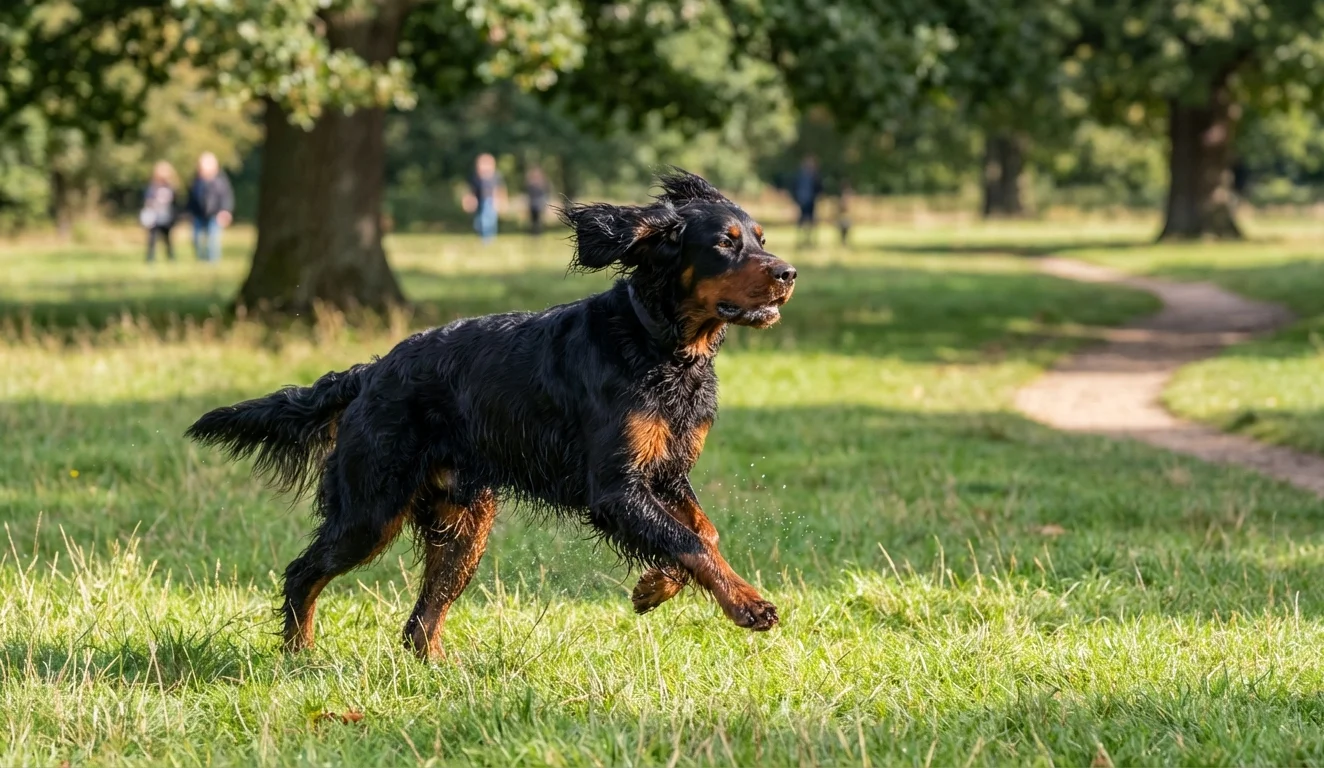
The Gordon Setter weighs 45-80 pounds, stands 23-27 inches tall, and lives 12-13 years. They’re the heaviest and most substantial of the three setter breeds (the others being Irish and English), and they’re the only one that’s black and tan, a coat combination that looks more Rottweiler than bird dog until you see them move in the field. The AKC recognized them way back in 1884, making them one of the original AKC breeds. Despite that pedigree, they’ve never been popular. They’ve hovered around #100 on the AKC’s popularity list for decades, consistently overshadowed by flashier sporting breeds. Gordon Setter owners are fine with this. More than fine, actually.
In Short: 45–80 lbs, 12–13 years. Moderate energy. Moderate shedding. Watch for Bloat (GDV). Best for active families who want a loyal, one-family sporting dog with the stamina for fieldwork and the temperament for the living room.
The Gordon Setter is the loyal introvert of the sporting group. Where Irish Setters befriend every person in the room and English Setters do their job with quiet efficiency, the Gordon bonds deeply to its family and is politely indifferent to everyone else. They’re not unfriendly, they’re just not interested in being everybody’s friend. If you’ve ever felt personally attacked by the phrase “this dog loves everyone,” the Gordon Setter might be your breed.
Gordon Setter at a Glance
| Trait | Details |
|---|---|
| Breed Group | Sporting (AKC) |
| Height | Males: 24-27 in / Females: 23-26 in |
| Weight | Males: 55-80 lbs / Females: 45-70 lbs |
| Life Expectancy | 12-13 years |
| Coat | Long, silky, with feathering on ears, chest, legs, belly, and tail |
| Colors | Black and tan (always) |
| Temperament | Loyal, Confident, Alert, Affectionate |
| Shedding | Moderate |
| Energy Level | Moderate (high in the field) |
| Good With Kids | Yes |
| Good With Other Dogs | Yes |
| Good With Cats | Yes (with early socialization) |
| AKC Recognition | 1884 |
History
The Gordon Setter was developed in Scotland, primarily at Gordon Castle, the estate of Alexander Gordon, 4th Duke of Gordon, in the late 18th and early 19th centuries. The Duke wanted a setter that could handle the harsh Scottish Highlands terrain while maintaining the stamina to hunt all day in cold, wet conditions. He selected for endurance over speed, resulting in a setter that was heavier, more muscular, and more methodical in its field work than the lighter Irish and English Setters.
The breed’s exact heritage isn’t fully documented, but the Duke’s setters likely incorporated Bloodhound and Collie bloodlines alongside existing setting spaniels. The Bloodhound influence added scenting power and endurance. The Collie influence may have contributed the breed’s notable loyalty and handler focus. The black-and-tan coloring, unique among setters, was stabilized during this period and became the breed’s signature.
Gordon Setters arrived in the United States in 1842, imported by Daniel Webster, the statesman, and George Blunt. The AKC recognized the breed in 1884 as one of the original breeds in the sporting group. Despite that early start, the Gordon never achieved the popularity of the Irish Setter (which had the advantage of being strikingly beautiful) or the English Setter (which was faster in field trials). The Gordon’s fans argue that speed isn’t everything, a Gordon finds every bird on the ground, just at its own pace. And they have a point.
Size and Appearance
Gordon Setters are the largest setter breed. Males stand 24-27 inches and weigh 55-80 pounds. Females are 23-26 inches and 45-70 pounds. They’re substantial dogs with heavy bone and solid musculature, built for endurance rather than the lean, racing build of Irish Setters.
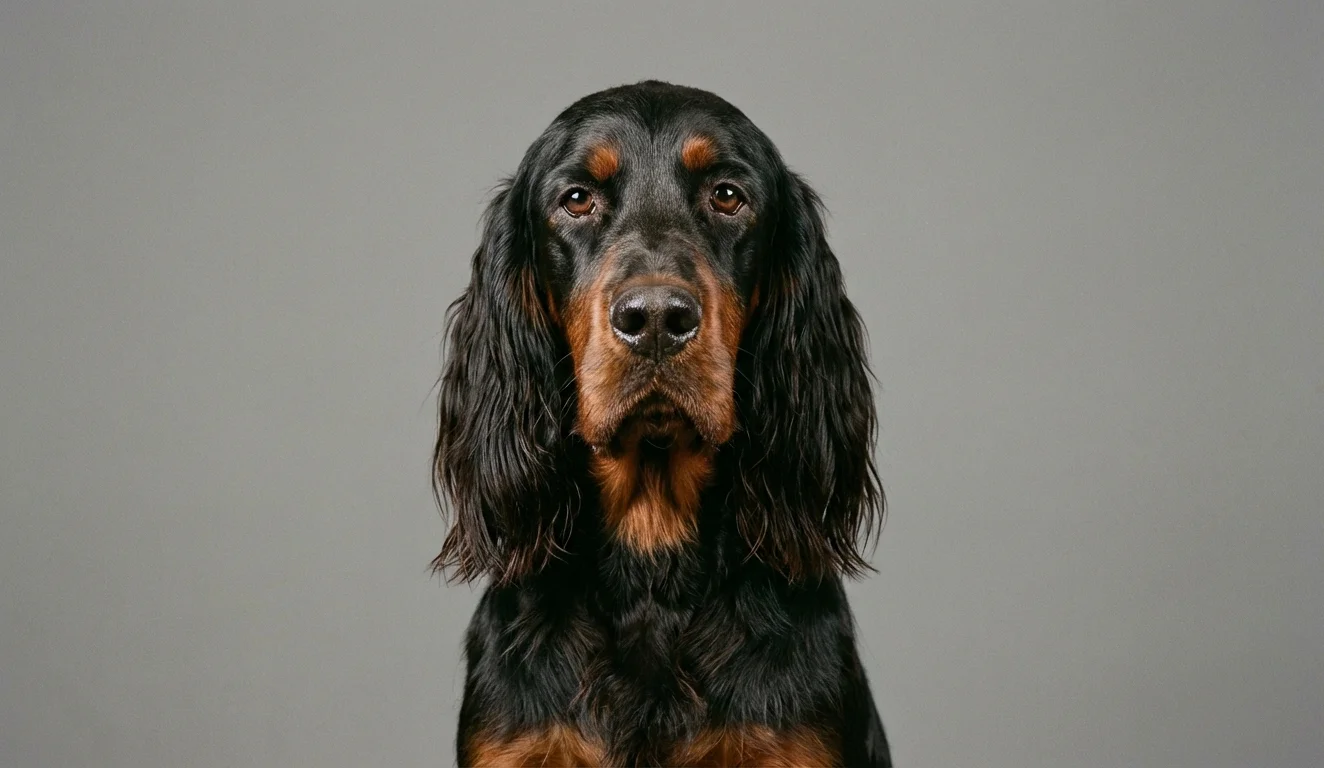
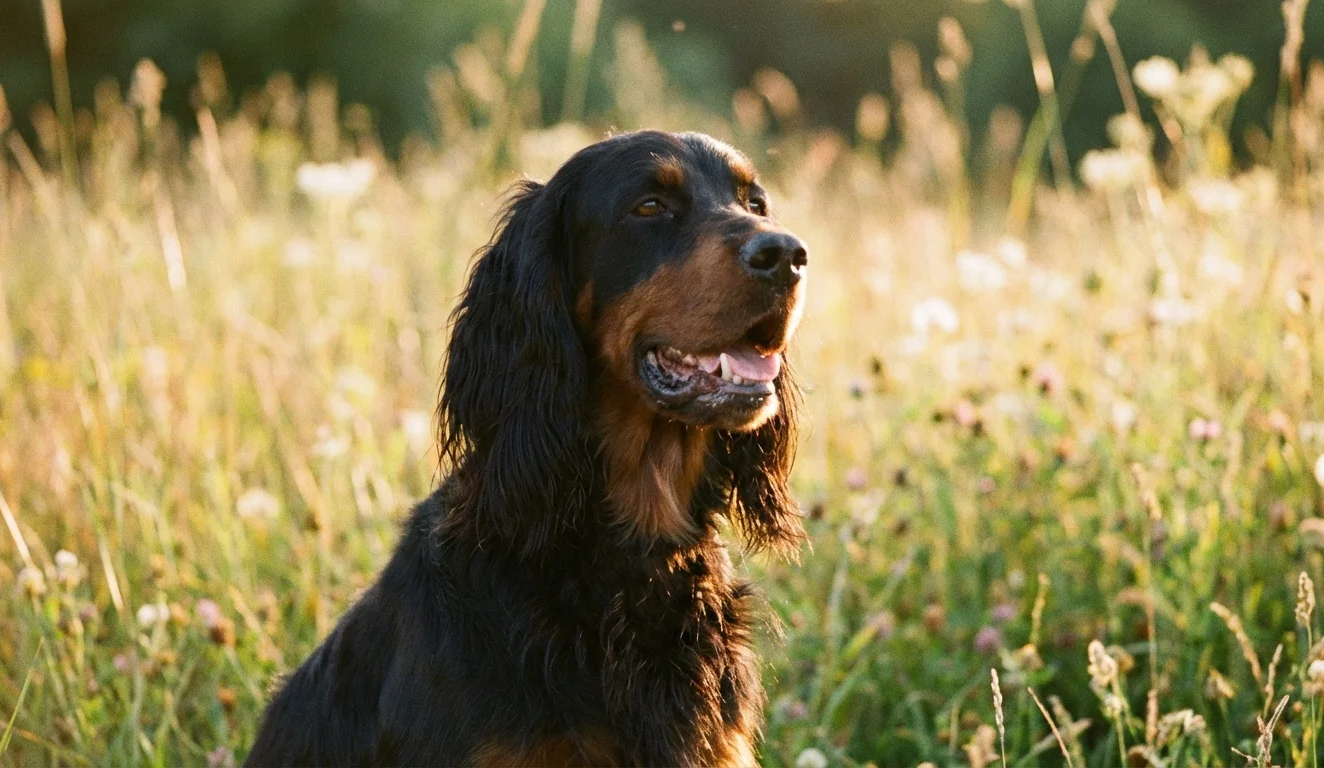
The coat is the breed’s visual highlight. It’s always black with rich tan markings, tan spots above the eyes, on the sides of the muzzle, on the throat, chest, inside the hind legs, and on the forelegs. The black is deep and glossy, almost liquid-looking in good light. The coat is long and silky on the body with significant feathering on the ears, chest, legs, belly, and tail. In full coat, a Gordon Setter in motion is a genuinely beautiful sight.
The head is deep and fairly broad, with long, low-set ears covered in silky hair. The expression is intelligent and dignified, a dog that looks like it’s thinking about something. The eyes are dark brown and carry the alert, confident look typical of dogs that were bred to scan landscapes for game. The tail is carried at or below the back line and has a flag-like feathering that moves gracefully when the dog is in motion.
There’s a noticeable difference between field-bred and show-bred Gordons. Field dogs tend to be leaner, with shorter coats and a more athletic build. Show dogs are heavier, with more coat and a more exaggerated silhouette. Both are beautiful, but if you plan to hunt, field lines are more practical.
Gordon Setter Temperament
The Gordon Setter’s temperament is what makes it stand out from other sporting breeds. Where most sporting dogs are everyone’s best friend, the Gordon is selectively devoted.
What you should actually expect from a Gordon Setter:
- One-family loyalty. Gordons bond deeply and specifically. They love their people with a quiet intensity that’s different from the indiscriminate enthusiasm of a Lab or a Golden. Your Gordon will be your shadow, attentive, protective, and always aware of where you are. Visitors will get a polite acknowledgment and maybe a tail wag, but the full affection is reserved for the inner circle.
- Excellent with kids. Gordon Setters are patient, gentle, and sturdy enough for family life. They tend to be particularly attentive to children in the household, keeping a watchful eye without being overbearing. Their tolerance for kid chaos is high, and they’re big enough not to be accidentally hurt by small children.
- More serious than other setters. Irish Setters are clowns. English Setters are gentle and sweet. Gordon Setters are… thinking. They have a seriousness about them that some people read as aloofness but is really just a more mature, measured approach to life. They have fun, they absolutely do, but they don’t have the goofy, attention-seeking energy of some sporting breeds.
- Alert and watchful. Gordons are better watchdogs than most sporting breeds. They’ll bark at strangers approaching the house and position themselves protectively. They’re not aggressive, just attentive. This is a trait that many sporting breed owners aren’t used to.
- They have a stubborn streak. “Slow to mature” is the polite way breeders describe it. Gordon Setters can take 2-3 years to fully grow up, and adolescent Gordons can be willful, goofy, and selectively deaf. The breed standard uses the word “fearless” to describe their temperament, and that confidence sometimes manifests as “I heard you, but I’m going to finish this first.”
Our opinion: the Gordon Setter is the sporting dog for people who want a genuine partnership rather than a fawning follower. If you want a dog that lives to please you without question, get a Lab. If you want a dog that respects you, works with you, and has its own personality while still being deeply loyal, that’s a Gordon.
Exercise Needs
Gordon Setters need 60-90 minutes of exercise daily. They’re listed as “moderate energy” because they’re calm indoors, but don’t let that fool you, in the field or outdoors, they have the stamina of a true sporting breed.
Exercise that works for Gordon Setters:
- Long walks and hikes. Gordons are natural walking companions, they’ll maintain a steady pace for hours on trails without flagging. Their heavier build means they’re not as fast as an Irish Setter, but they’ll outlast most humans on an all-day hike.
- Bird hunting is what they were built for. If you hunt upland game, a well-trained Gordon Setter is a methodical, thorough worker that finds every bird on the ground. They don’t have the range of a pointer or an English Setter, but they’re remarkably reliable and stay closer to the handler.
- Swimming. Most Gordons enjoy water and are strong swimmers. It’s a great low-impact exercise option, especially for older dogs or those with joint concerns.
- Fetch and retrieval games. Gordons have the retrieve instinct bred into them and most enjoy extended fetch sessions.
- Running at a moderate pace once the dog is physically mature (18+ months). They’re not sprinters, but they make solid jogging partners for 3-5 mile runs.
Two notes on exercise: First, Gordon Setter puppies should not be over-exercised. Their large frames take 18-24 months to mature, and excessive exercise during growth can damage developing joints. Moderate play and short walks are appropriate for puppies, with distance and intensity increasing gradually. Second, Gordons are prone to overheating in warm weather due to their black coat. Exercise during cooler parts of the day in summer.
Grooming
The Gordon Setter’s beautiful coat requires regular maintenance. It’s not as demanding as an Old English Sheepdog, but it’s not low-maintenance either.
Regular grooming schedule:
- Brush 3-4 times per week to prevent matting, especially in the feathered areas (behind the ears, under the legs, on the belly, and the tail plume). A pin brush and a steel comb are the tools you’ll use most.
- Pay special attention to the ears. Gordon Setters have long, heavily feathered ears that trap moisture, dirt, and debris. Check ears after every walk and clean weekly to prevent infections.
- Bathe every 3-4 weeks or as needed. Use a quality dog shampoo followed by a conditioner to keep the silky coat manageable and reduce tangles.
- Trim the hair between the paw pads every 2-3 weeks to prevent matting and improve traction.
- Trim nails every 2-3 weeks.
Every 6-8 weeks:
- A more thorough grooming session to neaten the feathering, trim foot hair, and tidy the ears. Many Gordon owners learn to do this themselves, but professional grooming runs $60-$100 per session for a setter.
Shedding is moderate. Gordons shed year-round with heavier shedding during spring and fall coat changes. The long hair is more noticeable on furniture and clothing than short-haired breeds. Regular brushing controls the loose hair, but you’ll still find black and tan hair on everything you own.
Field-bred Gordons with shorter, less abundant coats are easier to groom than show-bred dogs. If low-maintenance grooming matters to you, look for field lines.
Gordon Setter Health Issues
Gordon Setters are generally healthy for a large sporting breed, but there are breed-specific health concerns.
Bloat (Gastric Dilatation-Volvulus)
The most life-threatening risk for Gordon Setters. Their deep chest makes them a high-risk breed for bloat, a condition where the stomach fills with gas and potentially twists on itself. Without treatment, it’s fatal. Surgery costs $3,000-$8,000. Prevention: feed two to three smaller meals instead of one large meal, avoid vigorous exercise for 60 minutes after eating, use a slow-feeder bowl, and seriously consider a prophylactic gastropexy ($400-$800) during spay/neuter surgery. This procedure tacks the stomach in place and reduces bloat risk dramatically.
Hip Dysplasia
The OFA reports approximately 20% of Gordon Setters evaluated show some degree of hip dysplasia. That’s a significant number, and hip evaluations for breeding dogs are strongly recommended. Treatment ranges from conservative management (weight control, anti-inflammatories, physical therapy at $500-$1,200/year) to total hip replacement ($3,500-$7,000 per hip) for severe cases. Keeping your Gordon lean, you should be able to feel the ribs without pressing hard, is the most effective preventive measure.
Hypothyroidism
More common in Gordon Setters than the general population. Symptoms include weight gain, lethargy, skin problems, and coat changes. Diagnosis is straightforward via blood test ($100-$200), and treatment is daily thyroid medication ($20-$50/month). Most dogs return to normal with proper medication, and the condition is easily managed for life.
Progressive Retinal Atrophy (PRA)
A genetic eye disease that causes progressive vision loss leading to blindness. DNA testing is available for the rcd4 form of PRA, which is the most common type in Gordon Setters. Responsible breeders screen for it. There’s no treatment, but affected dogs adapt to gradual vision loss. Annual eye exams through the OFA/CERF program cost $200-$400.
Cerebellar Abiotrophy
A neurological condition specific to a few breeds, including Gordon Setters. It causes progressive loss of coordination, typically appearing in young adults. There’s no treatment, and the progression varies, some dogs maintain quality of life for years, while others decline more quickly. It’s relatively rare, but ask breeders about the condition in their lines.
Training
Gordon Setters are intelligent and capable of learning at a high level, but they mature slowly and can be stubborn during adolescence. Training a Gordon requires patience and a long-term perspective.
Training approach for Gordon Setters:
- Start early, but be realistic about timelines. Gordon Setters take 2-3 years to fully mature mentally. A two-year-old Gordon may still act like a teenager, goofy, distractible, and selectively deaf. This is normal for the breed. Stay consistent and don’t expect a finished product at 12 months.
- Positive reinforcement with food and play rewards. Gordons are sensitive dogs that shut down under harsh correction. They respond to fairness and consistency, not intimidation. If your Gordon isn’t responding to training, the approach is wrong, not the dog.
- Keep it interesting. Gordons are smart enough to get bored with repetitive drills. Vary your training exercises, change locations, and incorporate games and problem-solving into sessions.
- Socialization between 8-16 weeks is important but doesn’t need to be as intensive as with naturally reserved breeds. Gordons are naturally confident, socialization aims to broaden their comfort zone, not overcome fearfulness.
- Field training for hunting takes patience. Gordons develop their hunting instincts later than some sporting breeds. Some breeders recommend not starting serious field work until 12-18 months. The payoff is a methodical, reliable bird dog that gets better with age.
- Recall is trainable with this breed, more so than with hounds. Gordons are handler-focused enough that a solid recall is achievable, though distractions (birds, squirrels) will test it.
House training is straightforward with Gordons. They’re clean, dignified dogs that catch onto routines quickly. Most are reliable by 4-5 months with crate training.
Gordon Setter Cost
Purchase Price
A Gordon Setter puppy from a reputable breeder costs $1,500-$2,500. Field-bred puppies from proven hunting lines may cost more, especially from breeders with titled dogs. Show-quality puppies from champion bloodlines are at the upper end. The breed isn’t produced in high volume, so expect a waiting list from good breeders, 6-12 months is common. Insist on health clearances (hips, eyes, thyroid, and PRA DNA testing) from both parents. Rescue Gordon Setters are available through the Gordon Setter Club of America rescue program, typically for $250-$500.
Monthly Costs
| Expense | Monthly Estimate |
|---|---|
| Food (high-quality kibble, large breed) | $40-$65 |
| Preventive vet care (averaged) | $20-$30 |
| Pet insurance | $35-$55 |
| Grooming (supplies/occasional professional) | $15-$30 |
| Treats and chews | $10-$20 |
| Miscellaneous (toys, supplies) | $10-$15 |
| Total | $130-$215 |
First-Year Costs
Budget $3,500-$6,000 for the first year, including purchase price. The gastropexy surgery ($400-$800 if done during spay/neuter) should be treated as a standard first-year expense given the breed’s bloat risk. Quality pet insurance that covers bloat is also a smart investment, enroll early, before any issues develop.
Is a Gordon Setter Right for You?
A Gordon Setter is a great fit if you:
- Want a loyal, devoted family dog that bonds deeply to its people
- Lead an active lifestyle with daily time for walks, hikes, or field work
- Have a house with a fenced yard
- Can handle the grooming requirements of a long-coated breed
- Appreciate a dog with personality, confidence, and a bit of an independent streak
- Are patient enough to work through a slow adolescence (the adult dog is worth the wait)
A Gordon Setter is probably NOT right if you:
- Want a dog that’s instantly friendly with every person it meets
- Prefer a low-maintenance, short-coated breed
- Don’t have time for daily exercise that goes beyond a quick walk
- Live in a hot climate (that black coat absorbs heat)
- Want a dog that matures quickly and is easy to train in the first year
- Prefer a smaller dog, Gordons are big, especially males
The Gordon Setter is a dog for people who appreciate depth over breadth. They don’t love everyone, they love their family, deeply and completely. They’re not the fastest dogs in the field, but they find every bird. They’re not the easiest dogs to train, but they’re worth the investment. If you want a dog with substance, loyalty, and genuine character, the Gordon Setter has been quietly excelling at all three since the 1800s. It’s about time more people noticed.
Related Breeds
If you’re considering this breed, you might also want to look at:
Frequently Asked Questions
Are Gordon Setters good for first-time owners?
They can be, with some preparation. Gordons are forgiving of mistakes, patient, and not aggressive, all qualities that help first-time owners. The challenges are the slow maturation, the exercise needs, and the grooming commitment. If you’re a first-time owner who’s active, patient, and willing to learn, a Gordon is manageable. If you’re looking for a low-effort first dog, start with something less demanding.
How do Gordon Setters compare to Irish Setters?
Gordons are heavier, more reserved with strangers, and more focused in the field. Irish Setters are lighter, more outgoing, and faster. Temperament is the biggest difference, an Irish Setter will charm everyone at a party, while a Gordon Setter will sit with you in the corner and judge everyone at the party. Both are beautiful, athletic dogs. The Gordon tends to be a better choice for people who want a one-family dog, while the Irish suits people who want a social butterfly.
Do Gordon Setters need a lot of exercise?
Yes, 60-90 minutes daily. They’re calm indoors once their needs are met, but skipping exercise leads to restlessness and weight gain. They’re not as hyperactive as some sporting breeds, they won’t bounce off the walls, but they need consistent daily activity to stay healthy and happy. A long walk and some fetch or play time covers it for most Gordons.
Can Gordon Setters live in apartments?
It’s not ideal. They’re large dogs that benefit from a yard and space to move. Apartment living is technically possible if you’re extremely committed to daily exercise and the building allows large dogs, but a house with a fenced yard is a much better fit. The coat also drops hair throughout the day, which is more noticeable in a small space.
How long does it take for a Gordon Setter to mature?
Two to three years is typical. Gordons are considered “slow to mature” even by large-breed standards. Expect adolescent goofiness, occasional stubbornness, and selective deafness well past the first birthday. The good news: the adult Gordon Setter is a composed, dignified, reliable companion. The puppy years are the price of admission, and every Gordon owner will tell you it’s worth it.