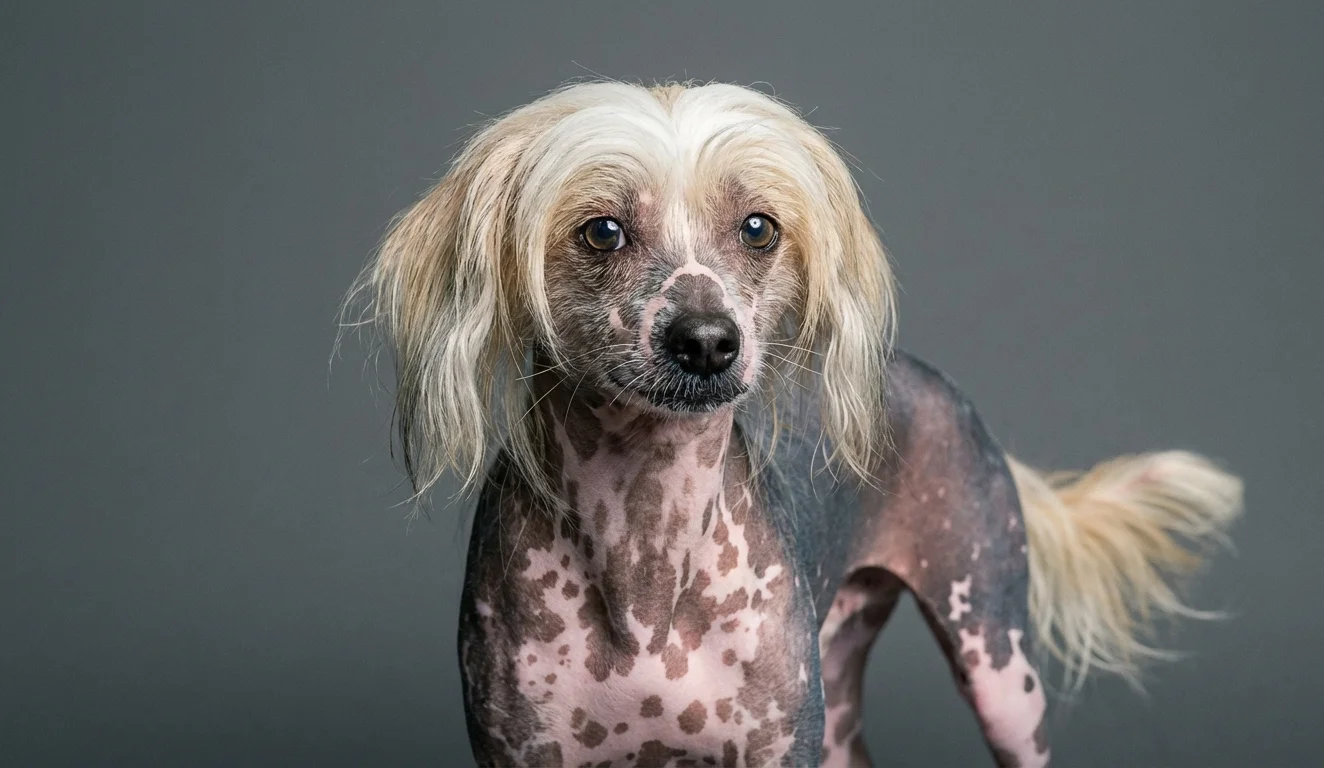

Chinese Crested Breed Guide: The Dog That Breaks Every Rule of What Dogs Look Like (2026)
The Chinese Crested is either the weirdest-looking dog you've ever seen or the most beautiful. There's no middle ground. Here's why both sides are right.
The Chinese Crested weighs 8-12 pounds, stands 11-13 inches tall, and lives an impressively long 13-18 years. They come in two varieties: the Hairless (mostly bare skin with tufts of hair on the head, feet, and tail) and the Powderpuff (fully coated with a soft, flowing coat). Both varieties can appear in the same litter. The Hairless version has won the World’s Ugliest Dog Contest so many times that the competition practically feels like a breed showcase. But ugly? We’d push back on that. Chinese Cresteds are striking, unusual, and oddly elegant. They look like they were designed by someone who’d never seen a dog before but had a very specific vision.
In Short: 8–12 lbs, 13–18 years. Moderate energy. No shedding (Hairless) / Low shedding (Powderpuff). Watch for Dental Issues. Best for apartment dwellers, allergy sufferers, and anyone who wants a velcro companion that will turn heads everywhere you go.
What the ugly dog contests don’t convey is that Chinese Cresteds are genuinely great companion dogs. They’re affectionate to the point of being clingy, they’re playful without being hyperactive, and they’re adaptable to just about any living situation. They’re also one of the longest-lived breeds, which means your Crested could be with you for nearly two decades. If you can get past the unusual appearance (or, like most Crested owners, fall completely in love with it), you might be looking at one of the best small companion breeds available.
Chinese Crested at a Glance
| Trait | Details |
|---|---|
| Breed Group | Toy (AKC) |
| Height | 11-13 in |
| Weight | 8-12 lbs |
| Life Expectancy | 13-18 years |
| Coat | Hairless: bare skin with hair on head (crest), feet (socks), tail (plume); Powderpuff: full double coat, soft and silky |
| Colors | Any color or combination |
| Temperament | Affectionate, Alert, Lively, Playful |
| Shedding | None (Hairless) / Low (Powderpuff) |
| Energy Level | Moderate |
| Good With Kids | Older kids (too fragile for young children) |
| Good With Other Dogs | Yes |
| Good With Cats | Yes |
| AKC Recognition | 1991 |
History
Despite the name, the Chinese Crested probably isn’t from China. The breed’s actual origins are murky, but the prevailing theory is that hairless dogs from Africa or Mexico were brought to China by traders, where they were selectively bred down in size. Chinese sailors kept small hairless dogs on ships as ratters and traded them at port cities throughout Asia, Africa, and the Americas. This is how the breed spread globally, as a ship dog, not a palace dog.
Hairlessness in dogs is caused by a specific genetic mutation (the FOXI3 gene), and it appeared independently in several breeds across different continents, the Chinese Crested, Mexican Hairless (Xoloitzcuintli), and Peruvian Inca Orchid all carry variations of this trait. The Chinese Crested’s particular contribution was combining that hairlessness with a small, elegant frame and an affectionate temperament that made them ideal companions.
The breed gained popularity in the U.S. through the efforts of burlesque dancer Gypsy Rose Lee, who was a passionate Chinese Crested breeder in the mid-20th century. Her breeding program helped establish the breed in America. The AKC recognized the Chinese Crested in 1991. Today they rank around #75 in AKC popularity, not mainstream, but far from obscure. They’ve carved a niche among people who appreciate unusual breeds and want a devoted companion that doesn’t shed.
Size and Appearance
Chinese Cresteds are fine-boned, graceful toy dogs. Both varieties stand 11-13 inches and weigh 8-12 pounds, though there’s a fair amount of variation. Some Cresteds are quite delicate at 6-7 pounds. Others are sturdier at 12-13 pounds.
The Hairless variety is the one most people recognize. The body is mostly bare skin, smooth, soft, and warm to the touch. Hair grows on the head (the “crest”), the lower legs and feet (the “socks”), and the tail (the “plume”). The amount of body hair varies, some Hairless dogs are genuinely bare, while others (called “hairy hairless”) have a moderate amount of body hair that needs to be groomed away for show but is perfectly fine to leave for a pet. The skin can be any color, spotted, solid, or mottled, and it darkens with sun exposure, much like a human tan.
The Powderpuff variety has a full double coat of soft, silky hair that flows over the entire body. They look like completely different dogs from the Hairless variety. Many people don’t realize that Powderpuffs are the same breed. Genetically, the Powderpuff has two copies of the “normal” coat gene, while the Hairless has one copy of the hairless gene and one normal copy. (Two copies of the hairless gene are lethal before birth, which is why both varieties always appear in litters.)
Both varieties have the same build: slender, elegant, and surprisingly athletic for a toy breed. The legs are long relative to the body, and the overall silhouette is more hare-like than the chunky proportions of other toy breeds.
Chinese Crested Temperament
Chinese Cresteds are the definition of a companion dog. They were bred to be with people, and they take that job seriously. Very seriously.
What sharing your life with a Chinese Crested actually involves:
- Extreme attachment. Chinese Cresteds bond intensely to their primary person. “Velcro dog” undersells it, they want physical contact as much as possible. On your lap, under the covers, tucked into your armpit on the couch. If you’re the type who likes personal space, a Crested will challenge that boundary daily.
- Separation anxiety is common. The flip side of that intense attachment is that Cresteds don’t handle being alone well. Long hours away from their person can result in destructive behavior, excessive barking, and genuine distress. This is a breed that does best with someone who’s home frequently or works from home.
- Playful and entertaining. Cresteds have a clownish side that surprises people who expect a delicate, fussy toy breed. They’ll play fetch, do tricks, and perform silly antics for your entertainment. They seem to enjoy making people laugh.
- Good with other pets. Cresteds are one of the less territorial toy breeds. They generally get along well with other dogs (especially other Cresteds, many owners end up with multiples) and are typically fine with cats.
- Alert but not aggressive. They’ll bark to let you know someone’s at the door, but they’re not the yappy, neurotic stereotype that people associate with toy breeds. Compared to a Chihuahua, the Crested is downright mellow.
Our honest take: the Chinese Crested is one of the most rewarding companion breeds if your lifestyle fits. They give you an almost embarrassing amount of devotion, and they’re endlessly entertaining. But the separation anxiety is real, and it limits who this breed is right for. A Crested left alone 9 hours a day is not a happy dog.
Exercise Needs
Chinese Cresteds need about 30-45 minutes of exercise daily. They’re moderate-energy dogs, they want some activity but they’re not going to pester you for a second hike.
What works for Chinese Crested exercise:
- Short walks (15-20 minutes) once or twice a day. They enjoy exploring but they’re not endurance athletes.
- Indoor play sessions. Fetch down a hallway, tug toys, and puzzle toys all work well for days when the weather doesn’t cooperate.
- Small dog agility. Cresteds are athletic for their size and many enjoy agility courses designed for toy breeds. They’re fast and nimble, and the mental challenge engages them.
- Free play with other small dogs. Cresteds are social and enjoy romping with dogs their own size.
Important considerations for Hairless Cresteds:
- Sun protection. Hairless Cresteds can get sunburned. Apply dog-safe sunscreen before extended outdoor time. SPF 30 or higher on exposed skin, avoiding the eyes and mouth.
- Cold weather protection. Without a coat, Hairless Cresteds get cold quickly. They need sweaters or coats in cool weather and shouldn’t be left outside in winter. Yes, you will be that person dressing their dog in a sweater. Embrace it.
- Paw protection. Their paws are more sensitive to hot pavement than coated breeds. If the ground is too hot for your hand, it’s too hot for your Crested’s feet.
Powderpuffs are less weather-sensitive but should still be protected from extreme temperatures. Both varieties are indoor dogs that need climate-controlled living.
Grooming
Grooming requirements vary dramatically between the two varieties.
Hairless Chinese Crested grooming:
- Skin care is the priority. Bathe every 1-2 weeks with a gentle, moisturizing shampoo. Follow with a light, non-comedogenic moisturizer to prevent dry skin. Think of it less like dog grooming and more like a skincare routine, because that’s what it is.
- Remove unwanted body hair by shaving or using a gentle epilator every 2-3 weeks. “Hairy hairless” dogs need more frequent maintenance.
- Watch for blackheads and acne, especially on the back and chest. These are common in Hairless Cresteds and can be managed with regular bathing and occasional exfoliation.
- Apply sunscreen before sun exposure.
- The crest, socks, and plume need regular brushing and occasional trimming to keep them tidy.
Powderpuff Chinese Crested grooming:
- Brush every other day to prevent matting. The soft, silky coat tangles easily, especially behind the ears and in the leg furnishings.
- Bathe every 2-3 weeks. The coat benefits from a conditioning treatment to keep it soft and manageable.
- Professional grooming every 6-8 weeks for a trim and tidy-up, running $40-$70 per session.
Both varieties:
- Dental care is non-negotiable with this breed (see Health Issues section). Brush teeth daily or at minimum several times a week.
- Trim nails every 2 weeks. Cresteds have “hare feet” with longer toes, and the nails grow quickly.
- Clean ears weekly.
The Hairless variety is sometimes marketed as “no grooming needed” because they don’t have a coat. This is misleading. They trade coat care for skin care, and the skin care is not trivial.
Chinese Crested Health Issues
Chinese Cresteds are long-lived dogs (13-18 years is a wide and encouraging range), but they have some breed-specific health concerns that need attention.
Dental Issues
This is the breed’s #1 health challenge. Hairless Chinese Cresteds have a genetic link between the hairless gene and dental abnormalities, many are born with missing teeth, misaligned teeth, or teeth that fall out prematurely. It’s not uncommon for a Hairless Crested to lose most of its teeth by middle age. This doesn’t usually affect their quality of life (they adapt to eating without teeth surprisingly well), but dental cleanings ($200-$500 each) and potential extractions ($100-$300 per tooth) are a predictable expense. Powderpuffs have normal dentition and fewer dental issues.
Patellar Luxation
Common in toy breeds, including Cresteds. The kneecap slips out of its groove, causing intermittent lameness. Grades 1-2 often need only monitoring. Grades 3-4 may require surgical correction at $1,500-$3,000 per knee. The OFA recommends patella evaluations for breeding Cresteds.
Progressive Retinal Atrophy (PRA)
A genetic eye disease causing progressive vision loss. DNA testing is available (specifically for the prcd-PRA form), and responsible breeders screen for it. There’s no treatment, but affected dogs adjust well if the decline is gradual. Annual eye exams cost $200-$400.
Legg-Calve-Perthes Disease
A condition where the head of the femur (thigh bone) degenerates due to reduced blood supply. It typically appears between 4-12 months of age and causes hind-leg lameness. Surgical removal of the femoral head ($1,500-$3,500) is the standard treatment, and most dogs recover well with physical therapy.
Skin Conditions (Hairless variety)
Hairless Cresteds are prone to acne, blackheads, sunburn, and dry skin. These are manageable with proper skin care but they’re an ongoing concern. Severe skin allergies or infections may require veterinary treatment at $100-$500 per episode. Good skin care habits prevent most problems before they start.
Training
Chinese Cresteds are intelligent and eager to please, which makes them more trainable than many toy breeds. They respond well to positive reinforcement and will learn tricks, obedience commands, and household manners with reasonable consistency.
Training notes for Cresteds:
- Positive reinforcement only. Cresteds are sensitive dogs that wilt under harsh correction. Yelling, physical punishment, or even a stern tone can damage the bond and create anxiety. Keep it cheerful and reward-based.
- House training can be slow. Like many toy breeds, Cresteds have small bladders and may take 6-8 months to be fully reliable. Consistent crate training and frequent trips outside help, but patience is required. Some owners in cold climates train their Hairless Cresteds to use indoor potty pads for winter, which is reasonable given the breed’s cold sensitivity.
- Socialization is important to prevent the fearfulness that can develop in small, sensitive dogs. Expose puppies to different people, environments, and gentle handling between 8-16 weeks. Avoid overwhelming them, Cresteds are sensitive to stress, and flooding them with too much stimulation can backfire.
- Trick training is a strength. Cresteds enjoy learning tricks and will happily perform for treats and attention. It’s a great way to build confidence and strengthen your bond.
- Address separation anxiety proactively. Practice short departures and returns from puppyhood. Build up alone time gradually. Consider a companion pet (another Crested or a cat) if the dog will be alone regularly.
Crate training is helpful for house training and creating a safe space, but don’t use the crate as a long-term containment solution. A Crested locked in a crate for 8 hours is a recipe for anxiety problems.
Chinese Crested Cost
Purchase Price
A Chinese Crested puppy from a reputable breeder costs $1,200-$2,500. Hairless puppies are sometimes priced slightly higher due to demand, though this varies by breeder. Show-quality puppies or those from champion bloodlines command the upper range. Good breeders do health testing (eyes, knees, heart, and genetic panels) and can demonstrate their results. Rescue Cresteds are occasionally available through breed-specific organizations for $200-$400.
Monthly Costs
| Expense | Monthly Estimate |
|---|---|
| Food (high-quality kibble, toy breed) | $20-$35 |
| Preventive vet care (averaged) | $15-$25 |
| Pet insurance | $25-$40 |
| Skin care products / grooming | $10-$25 |
| Dental care supplies | $5-$15 |
| Treats and chews | $5-$10 |
| Miscellaneous (toys, clothing, supplies) | $10-$20 |
| Total | $90-$170 |
First-Year Costs
Budget $3,000-$5,000 for the first year, including purchase price. The Hairless variety has ongoing skin care and dental costs that add up over the dog’s long lifespan. A clothing wardrobe for a Hairless Crested is a genuine budget line — expect $50-$150 initially. Dental cleanings should be budgeted annually, your vet will determine the frequency, but once a year is typical for this breed.
Is a Chinese Crested Right for You?
A Chinese Crested is a great fit if you:
- Work from home or have a flexible schedule that limits alone time
- Want a devoted, affectionate companion that bonds deeply to one person
- Live in an apartment or small space (they’re ideal indoor dogs)
- Are committed to dental and skin care (Hairless) or coat care (Powderpuff)
- Have allergies and want a low-shedding breed (Hairless is one of the best options)
- Don’t mind being stopped on every walk by strangers asking “what kind of dog is that?”
A Chinese Crested is probably NOT right if you:
- Work long hours and the dog would be alone most of the day
- Have very young children (Cresteds are too delicate for rough handling)
- Want a dog that’s happy to be independent
- Live in an extreme climate without being willing to manage sun/cold protection
- Aren’t prepared for the dental expenses that come with the Hairless variety
- Want a dog that goes unnoticed in public (it won’t happen)
The Chinese Crested is a breed that inspires either immediate fascination or confused stares. Usually both. But past the unusual appearance is a deeply loving, genuinely fun little dog that will dedicate its 13-18 years to being the most devoted companion you’ve ever had. The dental bills are real, the skin care is real, and the separation anxiety is real. But the bond is real too, and Crested owners will tell you it’s worth every bit of the effort.
Related Breeds
If you’re considering this breed, you might also want to look at:
Frequently Asked Questions
Are Chinese Cresteds actually hypoallergenic?
The Hairless variety comes close. They shed almost nothing and produce less dander than coated breeds. Many people with dog allergies tolerate Hairless Cresteds well. But “hypoallergenic” is a spectrum, not a guarantee, all dogs produce some allergens (in saliva and skin oils, not just hair). Spend time with a Crested before committing to see how your allergies respond. Powderpuffs shed lightly and are a less reliable choice for allergy sufferers.
Do Chinese Cresteds need clothes?
Hairless Cresteds need sun protection in summer and warmth in winter. That means sunscreen and/or a UV-protective shirt for outdoor time, and sweaters or coats when it’s cold. This isn’t a fashion choice, it’s a health necessity. Most Crested owners develop a practical wardrobe that covers the basics. Powderpuffs don’t strictly need clothing but some owners use light coats in very cold weather.
Can Hairless Chinese Cresteds eat normally without teeth?
Yes. Dogs with missing or compromised teeth adapt remarkably well. Many eat kibble just fine by crushing it with their gums or swallowing smaller pieces. Softened food, canned food, or a raw diet work well for dogs with significant tooth loss. Talk to your vet about the best diet for your individual dog’s dental situation, but don’t assume a Crested without teeth can’t eat, they manage better than you’d expect.
Are Chinese Cresteds fragile?
They’re sturdier than they look, but they are a toy breed with fine bones. They shouldn’t be handled roughly, dropped from furniture, or roughhoused with by young children. Larger dogs can accidentally injure them during play. Common sense applies, they’re 8-12 pounds and should be treated accordingly. Still, they’re athletic for their size and can handle moderate activity, hiking on gentle terrain, and normal daily life without being wrapped in bubble wrap.
What’s the difference between a Hairless and a Powderpuff?
Genetically, it’s one gene. The Hairless gene is dominant but semi-lethal (two copies cause embryos not to develop), so all Hairless Cresteds carry one Hairless gene and one Powderpuff gene. Powderpuffs carry two Powderpuff genes. Both can appear in the same litter from two Hairless parents. In practice, the Hairless needs skin care and clothing. The Powderpuff needs coat care. Temperament is identical. Many Crested owners end up getting one of each.